
Just before she sets off on the beret march for the Paratrooper Instructors Course, I catch Amit for a conversation. At first glance, she looks like all her friends – excited, waiting to start, and then finally to have the ‘red’ beret on her shoulder. But the beret she is about to receive is already well-worn, carrying a seniority that is hard to describe in words.
“This is my brother’s beret, Sergeant First Class Liyav Alloush, may he rest in peace, who is my best friend and always with me, even if not physically,” Amit begins. The ‘red’ beret waited for her for two years in his blue personal equipment box, and will be brought out especially at the end of the march, when their parents will walk forward – to place it on her head.

One only needs to see the light in her eyes when she talks about Liyav to understand how close they were. “There’s almost a 5-year age gap between us, but it never mattered,” she recalls with a smile, “When we were little, our rooms were adjacent, separated only by a plaster wall. So, to talk to each other, we created our own special language – one knock meant ‘What’s up?’, two meant ‘I’m okay’, and three meant ‘What are you doing?'”
Over the years, the knocks on the wall were replaced by messages, regular calls, and outings together – even when he enlisted for very intensive service in the elite Unit 100 of the Duvdevan Unit. “He lived the busiest life imaginable,” she says, “And yet, he had an ironclad rule when he came home: Friday evening was family time, and Saturday morning was sibling time – just ours.”
 Amit and Liyav in their childhood
Liyav made the stories, the unit, and the atmosphere from his service a part of their home, something that also influenced his younger sister, who initially dreamed of enlisting in Oketz. “It’s a world that always interested me, and Liyav knew that,” she describes sadly, “We had already agreed to train together, that he would help me prepare for the tryouts.”
But he didn’t get to fulfill that promise. On October 7th, Liyav was called up from the South, like his father. The family entered a state of waiting: “I would send him messages, see only one checkmark, and panic. I played an old recording of him telling me: ‘Amit, everything is fine, nothing will happen to me.’ I told myself that this is Liyav, and he is the strongest there is.”
That certainty shattered on December 17, 2023. “That day, around seven in the evening, my mother was in the middle of a shift as a reservist casualty officer, and I was upstairs on a phone call with a friend,” she recounts, “I went down to help her with something on the computer, and I don’t know why, suddenly the question came to mind: ‘If I want to enlist in a combat role, you don’t need to sign for me, right?’ Mom answered that there was no reason for them to sign, and that was that.”

A few moments later, there were knocks on the front door. In their house, almost no one enters through there; everyone knows to come through the back entrance. “I went to the door, looked through the peephole, and saw soldiers. The thought immediately crossed my mind: ‘No, no, no.’ Every child in Israel knows what that means. I looked at my mother and told her that Liyav was dead.”
The minutes that followed became an impossible mixture of denial and functioning. “Mom fell to the floor, started crying and tried to get them out of the house. I was in shock. I asked them, ‘Okay, do you want anything?’ and went to the refrigerator to offer them something to drink. My brain refused to comprehend.”
Liyav, may he rest in peace, fell during an attack by the Duvdevan Unit in the heart of Khan Yunis. In the battle, Sergeant First Class (Res.) Eitan Naeh, may he rest in peace, a fighter in the unit, and Sergeant First Class (Res.) Tal Filiba, may he rest in peace, a fighter in Yahalom, also fell alongside him. But at the time of the news, the operational details didn’t really matter. All at once, her world, which until then included studies, tryouts, and dreams of service, was torn in two opposing directions: “On one hand, I became a little girl trying to deny all the problems. On the other hand, I aged 30 years.”
“That night, even before the funeral, the family was allowed to say goodbye to Liyav, and I wanted to be with him alone,” she says. “I went in like all the times I woke him up early because I had to go to school and wanted to say goodbye. He was lying there with his mouth open in a funny way, as if he were asleep, and I was sure he would wake up any moment. I told him, ‘Liyav, wake up.’ And he didn’t.”
“In the end, we were left with two parents whose world had been shattered, and one sister trying to understand how she was supposed to go on,” she tries to find words for her feelings, “At first, I was terribly angry – at God, at the army, at my parents, who raised us to always go in headfirst. How did they let him charge into Gaza, be in Unit 100, at the forefront? How am I, Amit, supposed to hold the family together now on my own?”
That farewell, as incomprehensible as it was, also became a significant anchor for her. “I told Liyav: ‘Everything is fine, I’ll take care of Mom and Dad. You rest. You’ve done enough, much more than enough. I’ll manage, I love you.’ It saved me to see him. To see that his handsome face was preserved. There was a lot of comfort in that.”

After the Shiva (seven-day mourning period) and the thirty-day memorial, Amit had to decide where to go next. She understood her parents’ hesitation to encourage her to choose a combat role, but she wasn’t willing to give up on the chapter that was so significant for her brother. And so, she came to the most combat role she could – a paratrooper instructor.
For the entire Alloush family, Amit’s first time in uniform was almost unbearable. “I couldn’t look in the mirror,” she admits, “From the day Liyav fell, I remembered that uniforms were a difficult thing, a sign of disaster – and then they became a good thing, an honor.”
In a poignant coincidence, her enlistment month was also the month of Liyav’s birthday and memorial, as he fell ten days before his 22nd birthday. But for the Alloush family, these dates are not sad ceremonies. Instead of mourning the life that ended, they choose to rejoice in what their son and brother managed to experience.
Amit’s basic training at the Paratroopers Training Base highlighted these things well. She found herself walking the same paths, eating in the same dining hall where Liyav had eaten 5 years before her. And last week, she completed an important phase of the course, reaching the milestone they had hoped for long before – when they sat on the floor of Liyav’s room, around the blue box, trying to find the last items that would connect them to him.

“From the moment we opened the blue boxes and saw the uniforms left behind, it was clear to us that the red beret would be mine,” Amit says. “I didn’t touch it, but I waited and kept it for this moment.”
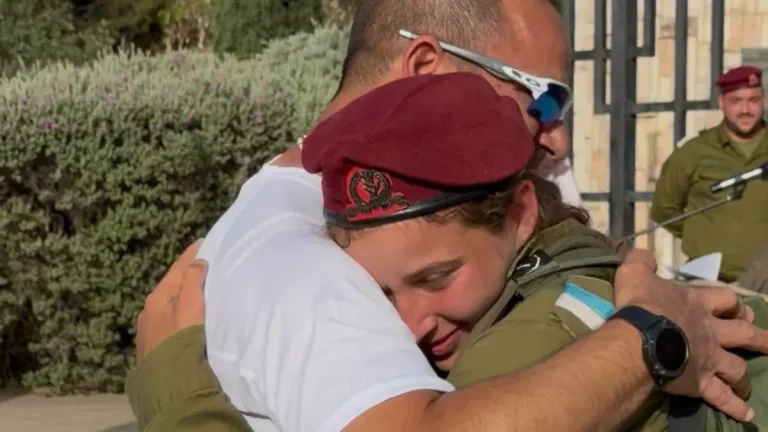
Now, the distance has become close, and the beret march dedicated to her brother’s memory is about to begin. Alongside the emotional parents, stand those who, by force of circumstance, have long since become a second family. “Friends from home and from the army have come here,” says mother Mali, “Since Liyav fell, these people have accompanied us to every event, sad and happy, big and small.”

“I know that if he were here, among all of us, he would be jumping with excitement,” she adds, and asks that Liyav, may he rest in peace, be remembered for the person he was, not for his fall. “Everyone says he’s a hero, and I agree, a hero because of his choices and the brother he was. But in any world, I would have preferred a living son whom I could hug and kiss.”
“He may not be here to give it to me, but I felt him every kilometer of the way,” Amit states proudly. “Since he fell, I always carry with me the sentence he scribbled in one of his notebooks: ‘A fighter stands tall – even when he can no longer stand.’ And truly, when I feel like everything is too much for me and I’m about to collapse, Liyav lifts me up. And I know this applies to the time I have left in the course, until the end.”