
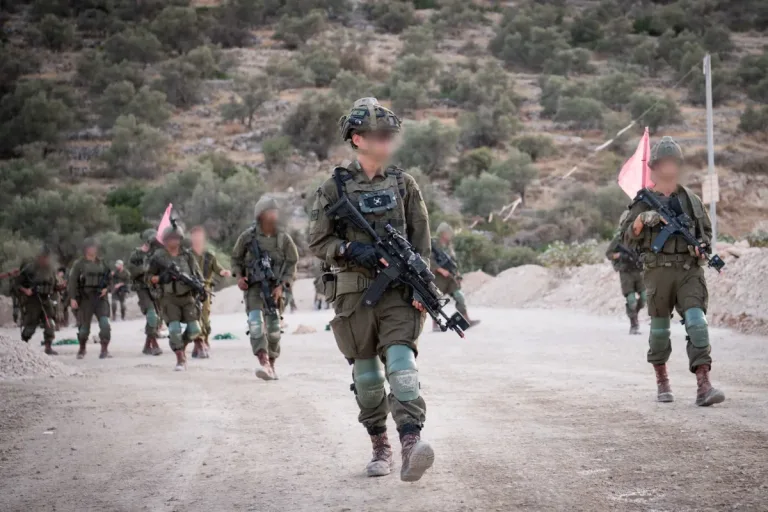
Between arrests and counter-terrorism operations in the Judea and Samaria region, soldiers of the Nahal Brigade’s 931st Battalion underwent 18 hours of training last week in the mountainous terrain of the sector. This time, they did so under the command of the new battalion commander, Lieutenant Colonel N., who led a training exercise of this magnitude for the first time since taking office.
The exercise was designed to prepare the battalion for a potential deployment to the north: a sector characterized by mountainous terrain, wadis, and complex areas. However, during these 18 hours, in addition to the challenging terrain, the mission itself was not static. Throughout the night, the soldiers were ambushed multiple times, practicing a sequence of rolling events.
“We went out for training as part of the battalion commander’s integration plan into the battalion, but also as part of our operational preparation for a possible mission in the north,” explains the battalion’s Operations Officer, Captain A. “This is unpleasant and physically challenging terrain, which also affects the mentality required for maneuvering in such an area.”
Thus, after several weeks of preparation, the exercise commenced with the order being issued in the afternoon. After receiving intelligence about enemy presence in the Ephraim Regional Brigade, forces were dispatched to the location and began searching the fortified area. They operated there for approximately six hours, engaging simulated explosive drones and a simulated enemy.
At this stage, to make the training as realistic as possible, the ‘Bagira’ system was integrated: a training device that attaches to the weapon and allows for the simulation of hits in real-time. “Every time a round hits a target, the ‘Bagira’ vibrates and indicates the success of the shot,” explains the Operations Officer. “Through this, we can truly understand where we performed better and where we performed less well. This way, not only does the exercise feel more realistic, but its results are also more effective for the future.”
After neutralizing all hostile forces in the area, the 931st Battalion soldiers received an alert about another developing incident – terrorists in the area of a wadi confluence. They immediately began advancing, led by the battalion commander, along a route of several kilometers through mountainous terrain that included ascents, terraces, and rocky wadis.
Upon reaching the area, they identified the enemy’s staging area and opened fire: the battalion commander issuing orders over the radio, directing the forces and determining the order of operations. The soldiers were required to operationally secure the wadi junction and ensure there was no further danger in the area.
But before they could ‘celebrate victory,’ another order was immediately received over the radio: they had to reach a settlement located 7 kilometers away in less than two hours. The battalion moved out again, and upon reaching their destination, they encountered a new scenario of a simulated mass casualty incident (MCI) with several casualties of varying degrees of injury.
“In parallel with treating them, we were required to continue clearing the area, with ‘terrorists’ lying in wait for us in each of the buildings,” describes Captain A. “The goal was to push the battalion system to its limits – to see how it continues to function when you have casualties to evacuate, an enemy in front of your eyes, and a mission you still need to complete.”
Indeed, according to him, one of the required achievements in this exercise is the battalion’s success as a system. “Ultimately, we need to know how to operate in sync: from the moment of planning and issuing the mission, to the parallel management of medical care and fire. Everyone here was tested – from the soldier on the front line to the battalion commander, together and individually.”
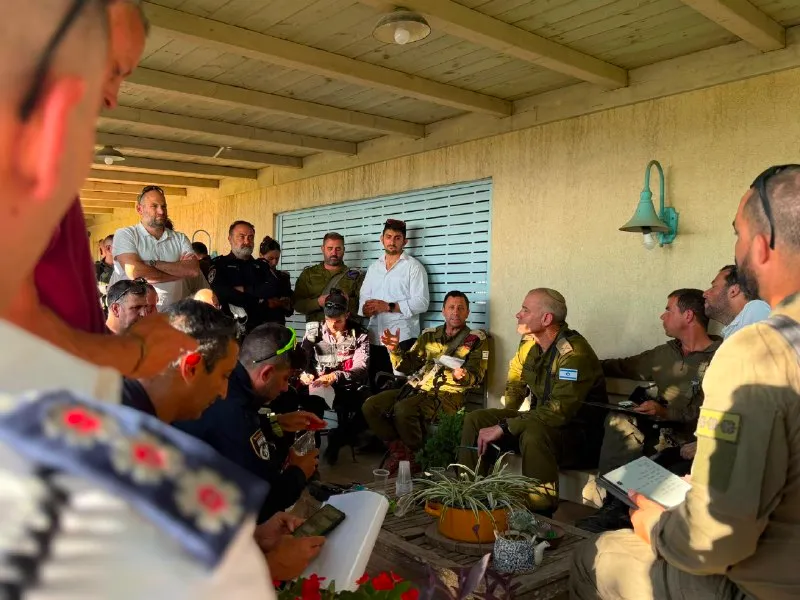
With the exercise concluding the following morning, commanders and soldiers returned for a debriefing and summary of the sequence of events. “After the series of surprises and scenarios that changed throughout the night, the goal was to stop, break down what happened in the field, and understand where the battalion functioned as planned – and what still requires improvement.”
For the 931st Battalion, who recently completed operational duty in southern Lebanon and then moved to the Judea and Samaria region – preparation for the next challenge does not end with this exercise. These days, the battalion continues its operations in the Ephraim Regional Brigade, maintaining its readiness with an eye towards the next mission. “We can never be sure what awaits us,” concludes the Operations Officer, “which is why we always look several steps ahead – and place ourselves in a position where we will be ready whenever we are required to be.”