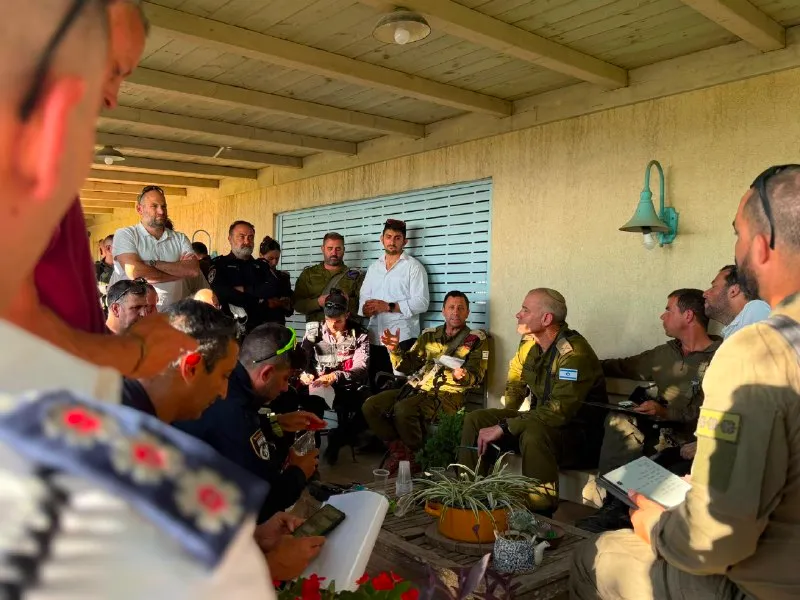

If you ask the reservists of 8207 to explain the northern sector, and specifically Lebanon, you will likely understand within a few minutes how well they know it. After all, after hundreds of reserve duty days, five rounds on the border, and tens of kilometers beyond it, there is no other option for them.
Indeed, when Lt. Col. Y’, the battalion commander, opens the conversation, he admits he has a particularly warm spot for the sector: “I live right here, opposite the areas where we operate. And for me, from personal familiarity with the place and the threats – the significance is magnified many times over.”
Now, the “Nachal” battalion is opening its sixth round, for the first time in an area that is perhaps geographically close, but operationally completely different – the Syrian sector, where they will operate under Division 474.
One might have assumed that upon arriving in the new territory, the battalion’s fighters’ training would focus on its characteristics. But precisely there, between defense missions, the fighters paused their operational routine to train with an emphasis on the Lebanese sector, and there is an explanation for this.
“We are engaged in a continuous series of ongoing activities in the Syrian sector, from the border to the security area, entering and exiting as needed,” presents the commander of Battalion 8207, “but even now, the reference scenario and the main objective remain maximum readiness. If we are prepared for intense combat like what we experienced there, those capabilities will be valid in any terrain.”
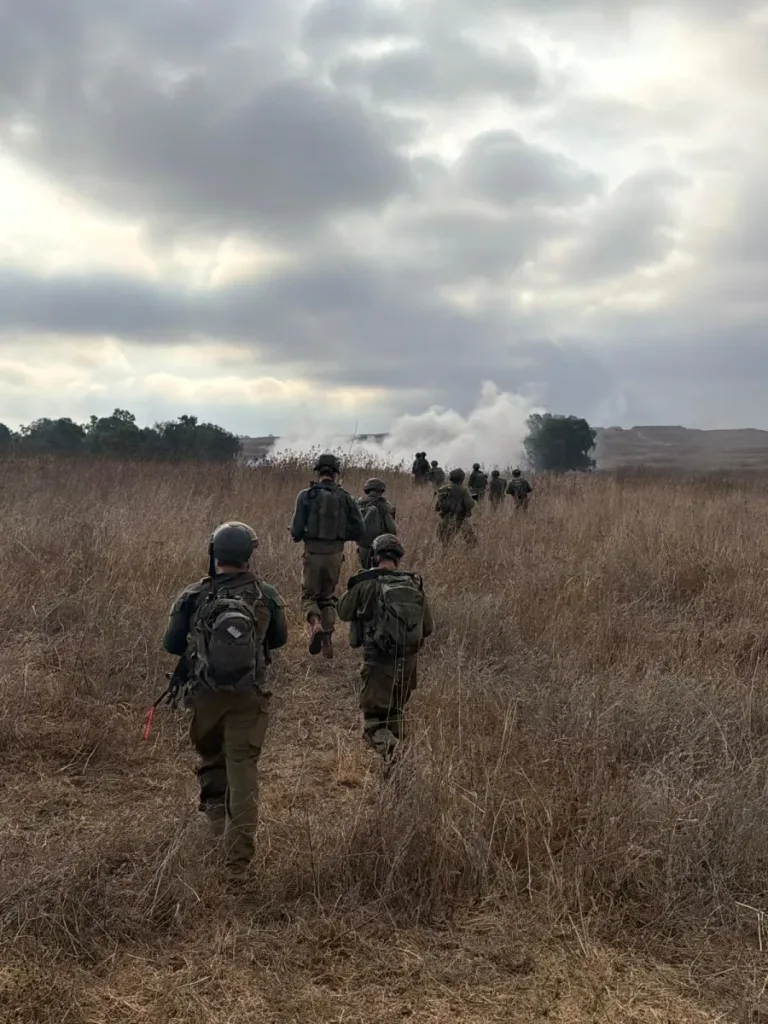
The battalion exercise, which began this morning and will continue for many more hours, was built from that same concept. “What is special here is the fact that the exercise did not appear on the original training schedule and was not built as part of the move to the Syrian sector. The commanders initiated it themselves, while they were deep in operational activity, and while the fighters were already in the sector,” he declares.
The main challenge was to integrate the training without disrupting ongoing operations: “We treat everything as a last opportunity to train before combat, which is why we chose to enter a comprehensive exercise. It’s impossible to bring everyone, of course, because we still need to fulfill the mission in the sector, so we divided them so that some are in the sector and some are in training. Later, the forces will rotate, and the entire battalion will undergo the exercise in full.”
An additional complexity arises from the timing of the current round. “These are not ‘standard’ months,” he admits, “this is a period that starts from July-August and continues through the holidays. This is perhaps the most difficult time for fighters to be away from home. There are children on vacation, families, and yet, each round anew, they understand the importance, and when there is an opportunity to train – they show up.”
The scenario chosen for the exercise, as Lt. Col. Y’ notes, simulated a ‘classic’ Lebanese maneuver. In the morning hours, before the ‘combat’ began, the forces were required to advance to the ‘assembly’ areas and organize for departure. For the battalion, this stage has also become an integral part of combat in recent years.
“If in the past it was perhaps more trivial,” the commander shares, “today, with the firing capabilities and aerial threats, this too has become a kind of battle in itself. How to organize the area, disperse the forces, and protect them.”
Upon completion of the assembly, they will immediately begin the next phase, which requires the battalion to adapt quickly to changing conditions: “From there, we move for several kilometers to the objective. Usually, we also train for a change of mission, which is what happens in practice. We plan something, and then suddenly there are all sorts of encounters and limitations, and we have to re-adapt ourselves, in all sorts of directions.”
Subsequently, the range of threats expands, placing combat in the aerial dimension at the center. “There will be soldiers positioned at points, and we will need to locate them with drones and practice attacking them. We are also integrating drones that will try to identify our progress. Some are even dropping simulated grenades from the air to illustrate the threat.”
At the end of hours of prolonged movement and encounters, the forces will reach the defined objective. “There they practice capturing objectives. In reality, it’s usually a Lebanese village,” he demonstrates, “and the ‘heavy’ assets also come into play, including live fire, simulated enemy, tanks, and engineering forces.”
And despite the focus on future operations, for the commander, one of the main goals is to examine everything that is happening behind the forces as well: “All the battalion’s arrays are to be examined – from medical to the administrative support company (Plas’am). It’s far from just the fighters at the tip.”
The comprehensive package also includes a mass casualty incident scenario. “To simulate such a situation, the fighters will experience a situation where a vehicle has overturned and been damaged,” he details, “they will have to right it, manage the situation, and evacuate as needed. Here arises the issue of evacuation routes, where today we understand that the entire complex, the entire system – is the important thing.”
When Lt. Col. Y’ is asked what he would consider a successful exercise, he doesn’t talk about combat without changes, upheavals, and complexities, but rather the opposite: “The most important thing for me is flexibility. There is what we planned, and that’s one thing, but there is what happens in reality, and how we deal with it – that’s what truly matters.”
For a reserve battalion that was called up on October 7th, and has already completed five rounds, some of them exceptionally long, even the very existence of the exercise, within the routine of operations, he defines as an achievement. “To fulfill the defense mission during these months,” the commander emphasizes, “and while managing to go out for an exercise, and to understand the importance of utilizing this time – that is a kind of victory, as we begin the mission in Syria.”