
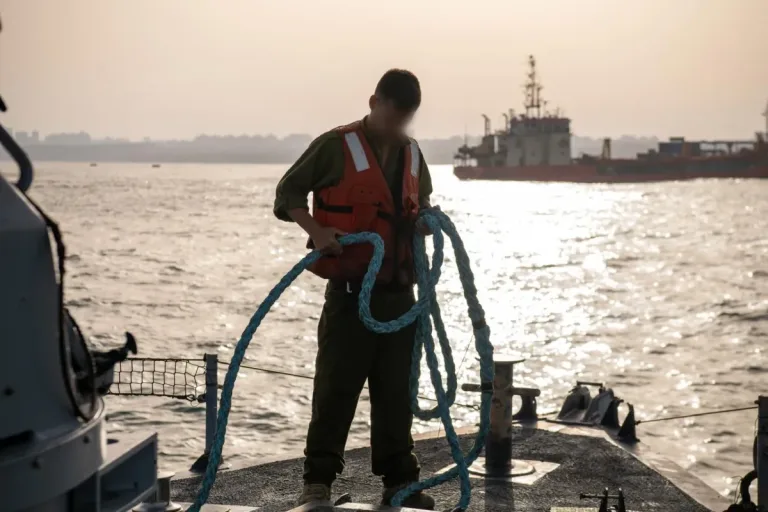
The Ashdod sector was particularly busy last week. A few meters from the coastline, one could find ‘Dvora’ patrol boats, wasps, and jet skis simulating ‘Red Tide’, with which hundreds of reservists train – those who were discharged two months ago, as well as those who have been reporting for years. All of these and more took part in a two-day exercise, whose ultimate goal is to increase the readiness of the reserve forces in Flotilla 916.

But for Lieutenant N., a Dvora commander and the training’s Operations Officer, these two days began long before the reservists passed through the checkpoint: “First of all, we ensured all the ships were ready, we handled the logistics, such as accommodation, food, and medical equipment, so that the integration of the reservists would be the best possible. This required a lot of work hours, flexibility, and versatility from us to make the exercise happen.”
After the preparations were complete, as the sun rose on Tuesday, the participants boarded the vessels and began practicing all the ‘base drills’. “It was important for us that every commander would take the helm and practice navigation and towing,” she explains, “In order to maintain relevance, we also conducted intelligence briefings, equipment training, and a review of changes and events experienced by the flotilla recently.”

The exercise, of course, did not end there: the Dvora boats eventually went out to sea for a live-fire exercise against targets from the direction of Gaza, both on the coast and at sea. And in the midst of the maritime exercise, the reservists were surprised for the first time with jet skis and wasps speeding towards them, heading towards the Israeli coast.
“We cooperated with ‘Snir’ [a naval commando unit] to simulate fast vessels attempting to penetrate territorial waters, similar to the scenarios of October 7th,” the officer notes, “To create an additional element of surprise and make the event even more difficult, we simulated further security threats and infiltration scenarios from the maritime border.”

The repelling of the attack continued until dark, and during this time, all the male and female reservists managed to go over the basic drills, as well as go out to sea, some in the afternoon and some in the evening.
On the second day, they conducted a ‘sector patrol’ in the Gaza Strip itself. “There is a need to know the area where you are fighting intimately,” explains Lieutenant N., “When you see the terrain also from the coast, and not just from the sea – you get a more complete and comprehensive picture. The goal is for them to know better where to deploy infantry forces and how to direct the maneuvering battalion accurately.”


Therefore, in addition to familiarizing themselves with the terrain, forces of 916 joined the battalion operating in the northern Strip and practiced several live-fire scenarios – at sea and on the coast. “The second day was a day focused on ranges and firing, as this is an area that has been more prominent than usual since the beginning of the war, and some of the veteran reservists have not experienced it,” the officer describes.
“Almost 100 percent of those summoned for reserve duty reported for this major exercise,” she testifies, “Maintaining the readiness of the reserve unit is extremely important. Everyone understands that the situation we are in is complex, and in order to function well in real-time – it is important to report for training that prepares you for it.”