
As I speak with Tommy Shaham, a 91-year-old Holocaust survivor, the conversation is interrupted by calls from schools, radio stations, and hosts of “memory salons.” They all ask him to come and share his testimony. “As long as I have a voice, I will continue to tell what happened there,” he declares with a smile that also conceals considerable pain.

Even at his age, Tommy continues to spread his story in the first person – a living memory of the horrors of the Holocaust. He does this not only in conversations with youth, soldiers, and adults, but also by joining representative delegations that return with Holocaust survivors to the darkest places.
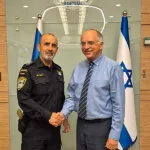
Shaham joined the “Witnesses in Uniform” journey, during which IDF officers travel to Poland, for the first time about 20 years ago, and has participated in several since. But it was only on the delegation held last November that he discovered a rather rare coincidence with the delegation’s doctor, Captain Dr. Yaakov.
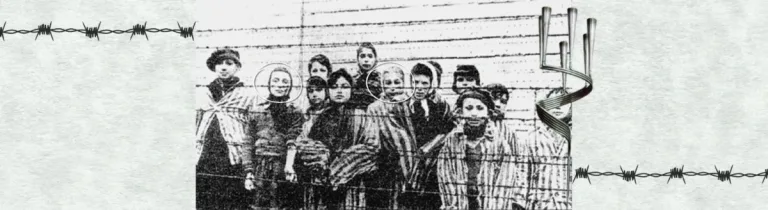
In preparation for the journey, Tommy gave testimony and showed participants photos depicting his story from Auschwitz. Then, something surprising happened: Dr. Yaakov recognized his grandmother, Marta Weiss, may she rest in peace, in a photo he was talking about. “I was completely shocked,” Yaakov said. “He shows these photos, along with testimonies collected later from the children who appeared in the photo – and I realize it’s my grandmother.”

Yaakov approached him, of course, and told him about the coincidence. “It turns out this was a staged photo taken by the Russians upon the liberation of the camp,” Yaakov explains. “That’s why it doesn’t appear in the Yad Vashem museum – and only at Auschwitz, during the delegation itself, did we both pose next to it.”
Tommy jokes that he joined this journey quite spontaneously: “I came to the officers’ preparations for the delegation at Yad Vashem and gave testimony as usual. But then the delegation commander convinced me to fly with them and share more memories. Although I hadn’t planned it, I decided to join them for 3 days in Poland.”
There, at the extermination camp, Tommy stood by the fence and spoke about a famous photograph taken right at the spot where they were standing during the camp’s liberation, in which he appears. “There were eight of us children,” he explains, “and by the way, I remember all of them to this day, as we met at the Auschwitz Museum again in 2005 to talk about what we had been through since then.”

Like Tommy, Grandmother Marta also survived to tell and testify about what she went through during the Holocaust. “She also dedicated her life to spreading what happened there and reminding people of it at every opportunity,” Yaakov shares. “She went on numerous delegations, some with the army, until she was no longer able. She passed away about two and a half years ago, just before the war broke out.”
Her survival story, like many others in the Holocaust, was a series of coincidences that also required a bit of luck. “When she was led to Auschwitz in ’44, her sister Eva and she were separated during selection, sent in two different directions – Eva to life and my grandmother, who was younger than her, to death,” Yaakov recounts. “By chance, an American or British plane flew over the camp exactly when they were being separated – and my grandmother took advantage of the commotion to join her sister’s line.”
Tommy survived thanks to another coincidence. “About a week before Auschwitz was liberated by the Russian army, masses of Jews were taken on a death march to empty the camp – I was one of them. It was so cold, minus 30 degrees Celsius, and I was looking with another child for ways to warm up. I said to him – ‘Look left and right, see if there are any guards – and let’s hide in a hut by the side of the road to warm up.'”
Thus, Tommy and his friend actually escaped the march – and a few minutes later, it passed, and they were saved. “We immediately returned to the camp – and saw that it remained empty. We started looking for food and clothes in the huts that had been vacated by the Germans, ate, and got dressed.”
At that very moment, Marta and Eva were also in the camp – during an attempt by the Nazis to burn it down to destroy evidence. “It happened to start raining, and that extinguished the fire. It’s likely that this also played a part in my grandmother’s survival,” Yaakov explains. Then, the camp was liberated by the Red Army, and the photograph in question was taken.

The journey itself, as both testify, instilled in them a strong sense of power. “To arrive at Auschwitz with those in uniform – that is a victory,” says Tommy Shaham with a firm voice. “All those photographed in this picture never believed that Jews would have such a state, one that could protect them, and even fight for their security beyond its borders.”
Captain Dr. Yaakov adds his part: “Grandmother passed away just before the war broke out – and perhaps it’s good that she didn’t hear about what happened on October 7th. But if she had seen the difference – that this time we have the means to protect ourselves and retaliate, she would have been filled with pride. When I went on the delegation, I naturally felt sadness and longing for my grandmother, but also great joy that I am fulfilling on Polish soil what she wished to represent in her life.”