
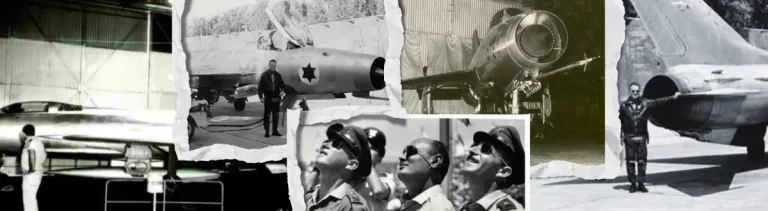
A fighter jet appears over the skies of Israel. It is quickly identified that the model does not belong to the Air Force, but is a Soviet MiG-21 – the enemy’s most advanced aircraft at the time. Two Mirage jets scramble to neutralize the mysterious intruder, until an unusual order arrives from the Air Force Commander himself: do not shoot it down. Only escort it for landing.
Thus, on August 16, 1966, Operation ‘Diamond’ reached its peak, providing one of the most significant intelligence achievements for the Air Force and the Mossad in those days. “It was a first-of-its-kind operation, aimed at bringing us the most prominent fighter jet of the other side,” says Avi Moshe Segal, curator of the Air Force Museum.
Air Force Archives
The daring idea began modestly. The then Air Force Commander, Major General Ezer Weizman (z”l), approached the Head of the Mossad, Major General Meir Amit (z”l), and asked: “Is there anything the Mossad can do to help the Air Force?” And in response, he requested: “Bring me a MiG-21.”
From this conversation, an intelligence and operational collaboration was born. “Essentially, a joint organization of the two bodies was established,” Avi explains. “Gradually, they realized that the most practical option was to find a MiG-21 pilot who would agree to defect to Israel and fly the aircraft with him.”
Fortunately, the Israeli attaché in Tehran knew people who knew people, and the right person was found – an Iraqi pilot named Munir Redfa. Redfa was of Christian origin and felt that his promotion in the army was being delayed because of it. Furthermore, he had significant disagreements with the Iraqi regime. “The sum he received for defecting was small, only 50,000 dollars,” emphasizes the museum curator. “It was a sum that allowed him to manage, but it didn’t make him a millionaire. He was an idealist.”
Air Force Archives
Now, with an Iraqi pilot recruited for the mission, another challenge emerged: Redfa was not a MiG-21 pilot at all. “He was a MiG-17 pilot, and for the operation to succeed, his commanders had to be convinced to send him for conversion training to the new model. To our great fortune, they agreed.”
Redfa agreed to the mission on one condition: that the Mossad would ensure his family also left Iraq and lived with him in Israel. For this purpose, an entire deception operation was devised. “We arranged for them to go on a ‘family conference’ in Europe,” Avi explains. “And the plan was that only when they were on an El Al flight on their way here, would Redfa take off from the Baghdad area.”
Mossad operatives met Redfa twice, once in Europe and once in Israel. “During his visit here, a few months before the takeoff, they even took him out to a nightclub,” Avi describes and continues, “Afterwards, Lieutenant Colonel Shaike Barakat, then head of Air Force Intelligence, took him for a flight in a two-seater Meteor aircraft along the route he would have to fly himself.”
During this waiting period, the operation and the aircraft were given a joint name: ‘The Blue Bird’. “It was referred to as the Blue Bird that needed to arrive, and the number of people who knew about the event was extremely limited.” On August 16, 1966, it truly arrived.
Munir Redfa took off from Iraq in a MiG-21 and flew to Israel. When he reached Israeli airspace, two Mirage jets rushed to investigate what was happening. One of the pilots was Ran Pekker, commander of Squadron 119. Even he was unaware of the secret operation. “Pekker didn’t understand what the most dangerous aircraft was doing so close to home and thought it needed to be shot down. He almost did, until he received explicit instructions from the Air Force Commander not to touch it.”
Thus, instead of an aerial battle, the two Mirage jets escorted the MiG to Hatzor Airbase. “The public was not told why it landed, or under what circumstances. The media reported that it was an Iraqi pilot who defected spontaneously; no one suspected it was a planned Mossad operation.”
Air Force Archives
Munir made sure to bring the aircraft’s flight manual with him, which contained all the necessary information for its operation. This opened one of the most fascinating chapters of study in the history of the Air Force. The MiG was inspected, dismantled, examined, and flown against Israeli aircraft. “Dani Shapira, the ‘Chief Test Pilot,’ would conduct dogfights in it,” Avi describes. “The MiG-21 was tested against every aircraft, with an emphasis on the Mirages, as they were its Western counterparts. Over time, its various weaknesses were revealed.”
“For example, they discovered it didn’t have much fuel capacity and couldn’t stay airborne for long compared to other fighter jets. Moreover – the fuel is located in the wings, and any hit to the wing is enough to blow it up. Additionally, they mapped out the directions where visibility from the cockpit was poor.” This knowledge did not remain in the museum or in the training manuals. It was directly incorporated into the operational learning of the Air Force.
Just as the Air Force was not the same after the historic landing, the ‘Blue Bird’ also changed – intentionally: “The aircraft was painted red and silver and marked with the number 007, the hallmark of agent James Bond, as a tribute to the cooperation with the Mossad. It was important that it looked different from the original MiG, so that pilots wouldn’t mistake it and try to shoot it down.”
Even under the layers of paint, the Israeli achievement did not go unnoticed by the world. The United States, which was fighting the MiG-21 in Vietnam at the time, also wanted to study the aircraft up close. After the MiG fulfilled its role in Israel, it was transferred to the Americans. “Therefore, the aircraft displayed today in the Air Force Museum is not the same one,” says the curator, “but an identical gift we received in return.”
Chief of Staff Yitzhak Rabin, Defense Minister Moshe Dayan, and Air Force Commander Mordechai Hod observing an aerial display where the MiG-21 was first presented, July 1967
This is the story of the aircraft that arrived in Israel as a ‘Blue Bird’: from a pilot who wanted a new life to an operation that changed how Israel understood its enemies – and a joint achievement of the Air Force and the Mossad that shone like a ‘diamond’.