
Shortly after 16 fighters from the 4th cohort of the Golan Reconnaissance Battalion completed eight months of training at the Golani Brigade’s training base and joined the unit for advanced training, their path took a turn – one that wasn’t part of any training program. Instead of continuing with the usual sequence, they joined the rest of the reconnaissance battalion’s fighters, who are designated to operate in the northern sector with an emphasis on the Golan Heights, and entered operational activity in Lebanon.

In the following weeks, they fought alongside the rest of the company’s forces and later integrated into operational activities in the northern sector. Once these were completed, they returned to finish the remaining four months of training – which culminated this week in the updated ‘culmination exercise’, which seemed to be built entirely on the operational reality they had been exposed to and already experienced firsthand.
“That’s it, the route is over, now we’re going to Lebanon.” It’s no coincidence that it’s with these words from the company commander, Captain D., to his subordinates – that he chooses to open our conversation. They, perhaps more than anything, manage to describe most accurately the complex reality that has affected so many units and brigades in recent years.

“I remember gathering the guys right at the beginning of ‘Roaring Lion’ and delivering the news,” he recalls. “It’s complex: at first, we were concerned about the fighters transitioning from a training mindset to a combat mindset. But in practice, they arrived with a lot of motivation, knowledge, and readiness – a full team in every sense of the word.”

From this additional experience, which not every fighter gains at the beginning of their combat service, the ‘culmination exercise’ that concluded the full training was built. “We tried to take everything they learned throughout the year and condense it into one week,” says Captain D. “From basic combat in open terrain, through maneuvering in populated areas, tracking, arrest exercises, and all the skills they acquired throughout the course and operational activity.”

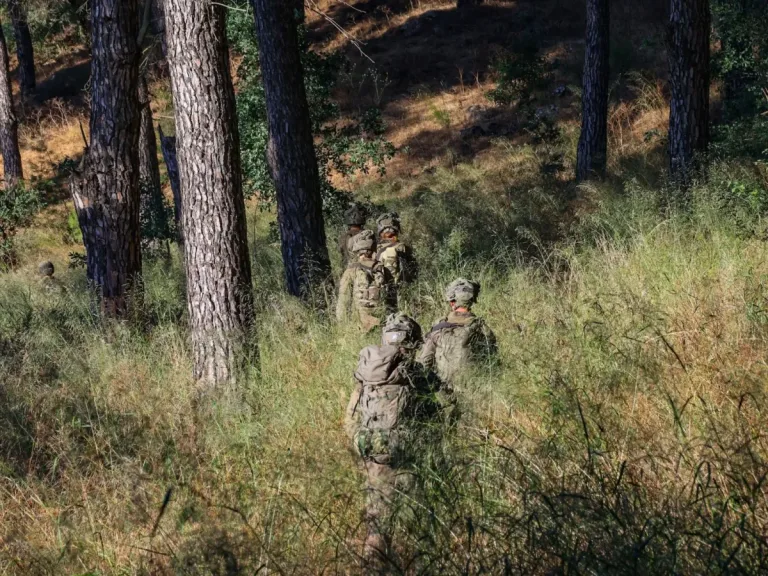
But the challenge is not limited to the professional content. Throughout the week, the fighters marched about 80 kilometers in mountainous terrain, starting at an altitude of about 450 meters and finishing at about 2,200 meters above sea level, on the summit of Mount Hermon.

It might surprise you, but this story actually began in the most routine place – the fighters’ barracks. “They go to sleep knowing that a culmination exercise awaits them, but without knowing exactly when it will start,” shares the company commander. “In the middle of the night, they are roused from their beds, receive a report of a large-scale attack, and within minutes enter the scenario.”

“From here, the ‘culmination exercise’ is essentially one long story – a large-scale attack on Israel from the north,” explains Captain D. In such a situation, he clarifies, the fighters must first focus on halting the attack.

And so, in the first 48 hours of the culmination exercise, they practiced ‘defense’. Only afterward did the situation change, and the forces moved to offense, advancing towards ‘enemy territory’, and initiating a series of events simulating the northern arena: combat in open terrain, capturing a village, and movement alongside emergency response teams and local security officers in the hills characteristic of the Golan Heights.

These capabilities are built from the first day of the course. After eight months of training at the Golani Brigade’s training base, the fighters arrive for an additional four months in the unit, during which they focus on navigation, tracking, urban warfare, advanced combat, night operations, drone operation, and in-depth familiarization with the terrain.
Indeed, even before the ‘culmination exercise’, operational reality had already become an integral part of the training. According to Captain D., the activity in Lebanon proved how much the capabilities emphasized in the course are reflected on the battlefield. “Hezbollah hides weapons and disguises them inside houses,” he demonstrates, “and we managed to find them only thanks to the sharp eyes of the fighters. Their experience is evident in the smallest details.”

As you read these words, the new reconnaissance battalion fighters have already completed the ‘culmination exercise’ and received the pin they worked so hard for over a year. But for them, the end of the course is not just a momentary excitement – but the starting shot for something much bigger, which they already want more of: “Today, now that they know what real combat is, they are even more eager to enter again and complete the mission. We received a cohort of fighters who take initiative and understand their ‘why’ very well – and that is already a success.”