
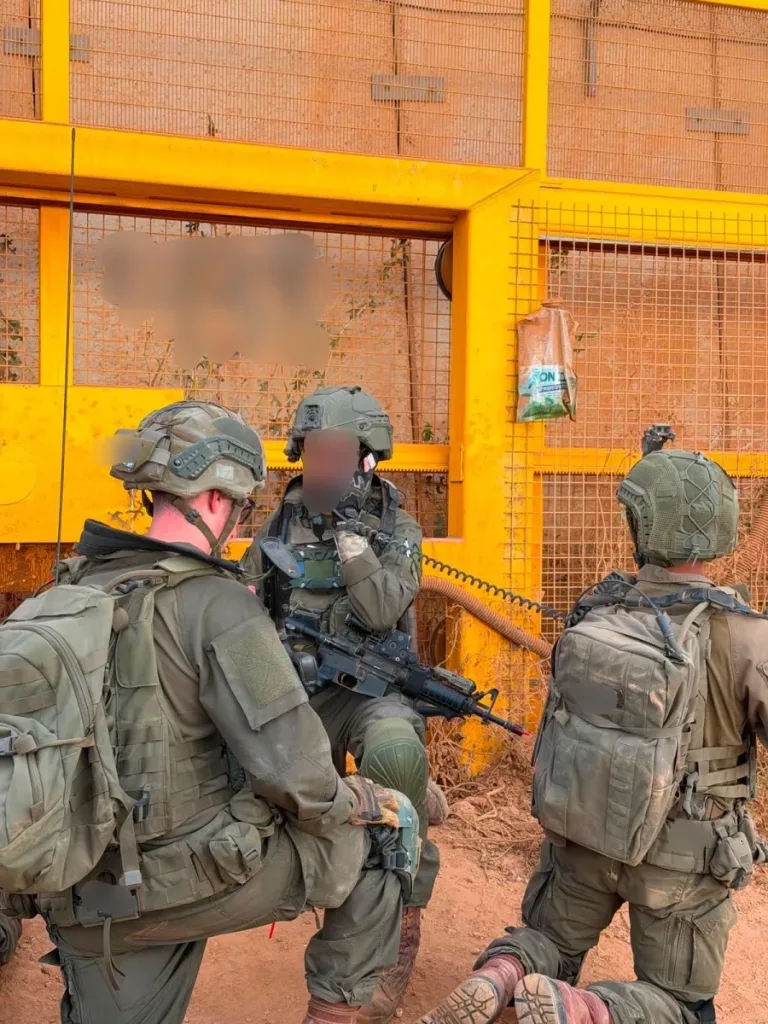
Just before infantry brigades took over responsibility for one of the northern sectors and took up positions in the 769th Territorial Brigade, the brigade decided to hold a dedicated brigade-level exercise. The exercise focused on a familiar challenge encountered in recent years – the performance of commanders and soldiers in combat, making weighty decisions, often within minutes. Participants included hundreds of soldiers and commanders, alongside all brigade elements, including combat intelligence units, intelligence, trackers, various medical personnel, fire support, and drones.

“We chose to start the exercise very early in the morning,” begins Major H., the brigade’s chief tracker, explaining. “At these times, there is sometimes fog, visibility conditions change, and over the years we have also encountered quite a few enemy attempts to carry out operations during this time window.”
However, contrary to what one might think, the exercise did not immediately begin with a terrorist infiltration or a face-to-face battle. Initially, commanders received only specific reports: an unusual detection along the barrier, an additional alert from a neighboring sector, intelligence information that began to accumulate, and a situation picture that was still unclear. “At this stage, the forces practiced what to do when they have preliminary intelligence fragments, or how to implement the battalion commander’s instructions,” he clarifies. Only later were drones, live fire, casualties added – and finally, an infiltration scenario.

At this stage, commanders were already required to deal with several events simultaneously. On one hand, a terrorist infiltration; on the other, casualties in a forward outpost, while a community required a response, and additional forces needed to join and reinforce. “This is precisely the dilemma we are examining: you have this situation, and now you have to decide whether to allocate forces for evacuation, continue the pursuit, or request reinforcements. There is no single right answer, but we want to see how the commander exercises judgment and manages risks in real-time.”
Indeed, the exercise, no less than it was training for the soldiers, served as an important testing ground for the top echelons as well: “We placed a lot of emphasis on the battalion commander’s role in the event – how he connects the dots, when he decides to gather and prepare the forces, what decisions he makes with partial and unclear information, and what his priorities are.”

Furthermore, from the perspective of the chief tracker, the cooperation between the battalions was unique. “Although each battalion is responsible for its sector, if it needs assistance, it must work in close cooperation with the neighboring battalion. Therefore, we wanted to see that they know how to communicate with each other, share the situation picture, and request the force multipliers that the brigade can provide – whether it’s trackers, intelligence, drones, fire support, or any other capability.”
And the trackers, for whom Major H. is responsible, were an integral part of the forces’ preparation. “A tracker who has been here for several years, for example, knows the area well. Therefore, when we assign him to a battalion, he not only shows the way, but he explains how to read the terrain, what is considered unusual, where to pay a little more attention, and what the routine defense in the sector looks like.”

Concurrently with the combat scenario, cooperation with the communities was also practiced. Each community in the brigade’s sector has a local defense squad, and this was also integrated as an integral part of the scenario. “We examined this connection from the activation stage, through the nature of communication, to the practical work together. In the end, we are defending the same area, and it is entirely a shared interest,” he describes.
And of course, the brigade-level exercise could not have taken place without the medical evacuation chain. “The forces also practiced initial treatment for a wounded soldier, evacuation, and transfer to the field dressing station up to the helipad,” recounts the chief tracker.

When asked about challenges for brigades arriving in the north, the commander points to the transition from one sector to another. “We are receiving units here that come from different sectors, whether from Gaza, Syria, or Judea and Samaria. They are familiar with combat, but not yet with this specific sector. Someone coming from Gaza, for example, understands that it is a different world. The topography is different, and the defense method is adapted accordingly. Here, you operate both within the area and in cross-border activities as needed.”
“In the end,” he concludes, “and I will use a sentence I believe in, we will defend as we train. If we do not challenge the forces now, the first time they will encounter these dilemmas will be in a real event. If every commander or soldier leaves here with a better defensive concept, identified a gap they didn’t know about before and is addressing it – for us, that is the goal.”