
Head of Staff’s Advisor for Gender Affairs, Brigadier General Rozital Aviv: “We understand that the operational effort is not temporary and this is essentially our new routine, and therefore we are also making adjustments in the way we operate regarding safety.”
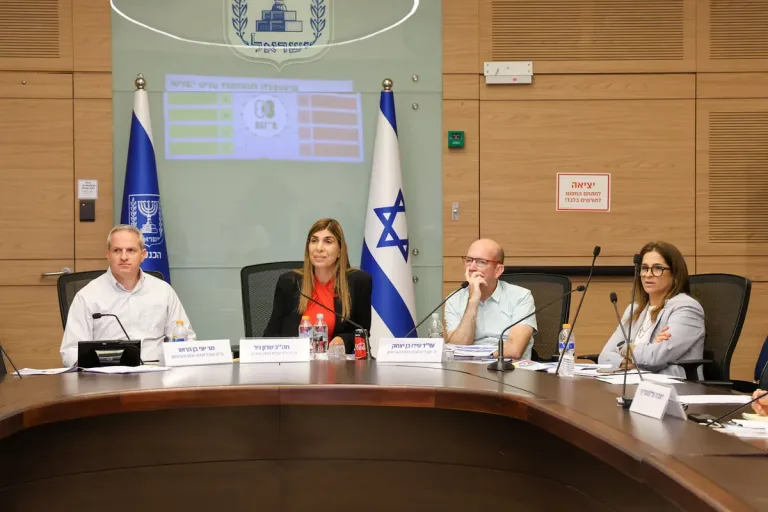
The foreign affairs and defense Committee convened today for a follow-up discussion on reporting and handling sexual harassment in the security forces. On December 25, a bill proposed by MK Merav Ben Ari, requiring the IDF, Israel Police, and Prison Service to report annually to the relevant Knesset committee on the number of sexual harassment cases within their organizations and how they are handled, was passed by the Knesset.
In her appeal to the committee requesting the discussion, MK Ben Ari added that “there is a need for a follow-up discussion to examine the implementation of the law and parliamentary oversight over it, including the preparedness of the relevant bodies.”
MK Sharon Nir, who chaired the meeting, said at the opening of the discussion: “The path to victory goes through a disciplined, capable, trained army with fighting spirit and a great sense of mission. The purpose of today’s discussion is to receive a clear account from the defense establishment, to examine how reports are actually handled, what steps are being taken to strengthen the sense of safety for male and female service members, and what else needs to be done to strengthen trust in the system.”
Head of Staff’s Advisor for Gender Affairs, Brigadier General Rozital Aviv: “The IDF has been engaged in an intense and ongoing campaign for almost two and a half years since October 7. We see the reserve forces as an integral part of military operations. We are constantly examining how we stand in relation to the force size, and we see that we have maintained a very large scope for almost the past three years, due to the operational effort.
We understand that the operational effort is not temporary. We understand that this is something ongoing, and this is essentially our new routine. Therefore, we are making adjustments both in the way we operate and in our conduct regarding safety. Safety is an integral component of the foundations, of the unit’s conduct, of its climate, and of its daily operations.”
The Head of Staff’s Advisor for Gender Affairs presented the data for 2025. In 2025, the Yohelam unit received 2,420 reports of sexual offenses in military circumstances. The reports cover a wide range of cases, from verbal harassment to serious physical incidents.
73% of the reports are in military circumstances, 13% in civilian circumstances, 11% before enlistment, and 3% in domestic violence. It should be noted that 71% of the reports are below the criminal threshold.
In the last decade, there has been a consistent increase in the number of reports of sexual offenses. The IDF states that the increase in reports is in line with the increase in force size, and also indicates an increase in the trust of service members in the organization’s ability to provide an effective response.
In 70% of the cases, men offended against women, 16% of the cases occurred between men, 9% between women, and 3% involved a woman offending against a man.
1798 of the victims are in mandatory service, 188 in reserves, 140 career officers, and 108 non-commissioned officers.
The distribution of cases shows that 10% of the complaints were handled through the criminal channel, 59% through the command channel, 5% managed with an external employer, and 22% were not fully processed because the victim chose not to pursue legal action against the offender. An additional 4% are cases that were not handled due to external circumstances.
Regarding the criminal channel, during 2025, 234 complaints were filed. 213 complaints were filed with the Military Police (MP) against 191 offenders, and an additional 21 complaints were filed with the Israel Police against civilians who offended against service members in military circumstances.
According to data from the Military Prosecution, indictments were filed against 42 offenders, and 21 others were brought to disciplinary proceedings. 7 cases were transferred for handling by unit commanders, 10 cases were transferred from the Military Police to the Israel Police for handling, and 48 victims chose to withdraw their complaint after filing it.
Regarding the command handling channels (which constitute 59% of the total complaints), a unit investigation was conducted in 436 incidents. 20% of the incidents resulted in disciplinary proceedings, 42% were handled through a warning or command reprimand, 23% led to a decision to remove from duty, and 13% were handled with systemic measures such as explanations and clarification of procedures. In only 2% of the incidents were the investigation results that there was no sexual harassment.
In the channel of handling with the employer, the access of 60 civilian contract workers to IDF bases was terminated, and a warning conversation was held with an additional 71 employees.
MK Merav Ben Ari: “These are very high numbers, and I very much hope it’s not related to our soldiers simply being worn out and tired, but I have a feeling it’s also because of that. Our male and female soldiers are working very hard, and this deterioration is troubling.”
Acting Chair of the Committee, MK Sharon Nir: “Ultimately, when it comes to discipline in the army, the issue of handling sexual harassment is super important, and it is directly related to the fact that we want a value-based, moral, and disciplined army. Therefore, such an army must have zero – zero – tolerance for sexual harassment.”