
This happened just a few days after their entry. Captain Dr. Y., then the medical officer of the 13th Battalion, was called to rescue wounded soldiers from a tank hit by an anti-tank missile. Under fire from Hamas terrorists, he was exposed to the immense complexity of evacuating casualties from a confined space and realized that the methods familiar to infantry forces are not always adapted to the unique structure of armored fighting vehicles (AFVs).

“It was a moment that made it clear to me that in-depth knowledge of the vehicle is no less critical,” he recounts nearly two years later. “Thanks to a platoon commander who was familiar with the complex structure of the tank and could maneuver within it, we managed to save a severely wounded soldier.” This realization became a turning point for him, and an opportunity to strengthen the connection between the infantry and armored corps – also in the medical aspect.
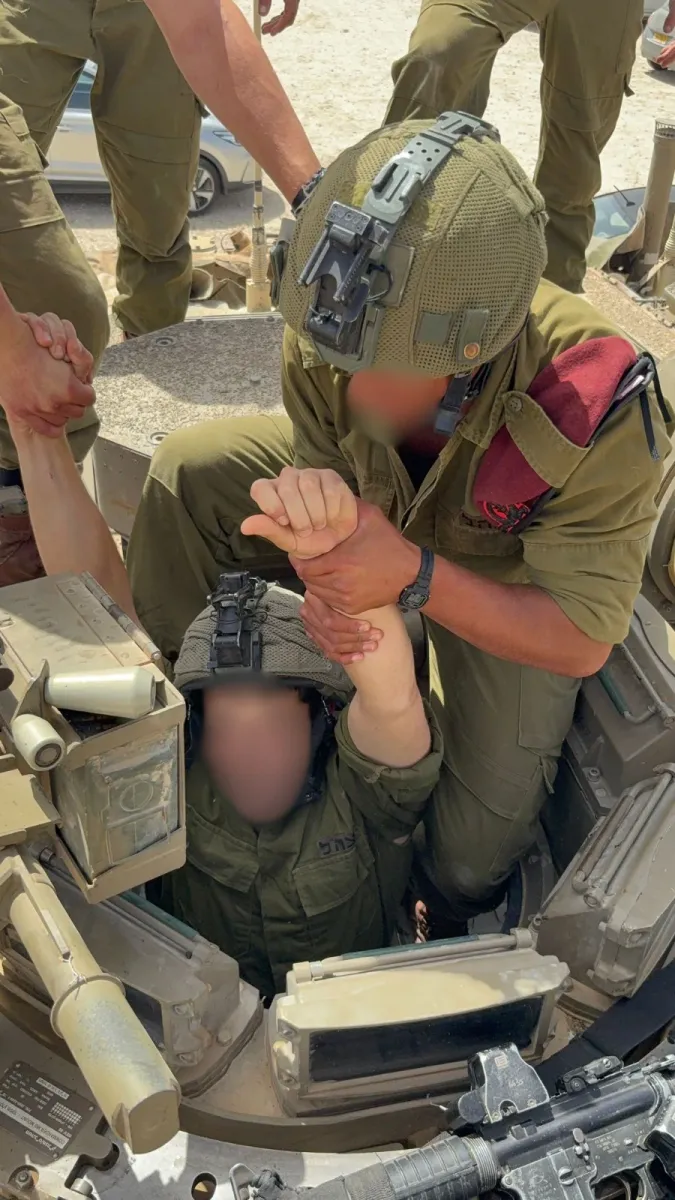
Now, as Captain Dr. Y. is the Chief Medical Officer of the 188th Brigade (‘Barak Division’), this is reflected in an exceptional training day he initiated, with the participation of Field Medical Teams (FMTs) 74 and 605, and the future medical squad leaders of the Commando Brigade. Instead of a theoretical lesson in an air-conditioned classroom, dozens of participants went out into the field last week for practical experience in rescuing wounded soldiers from a D9 armored personnel carrier, a tank, and an Namer APC.

“The training is divided into three stages,” explains Lieutenant L., the Medical Organization Officer of the 188th Brigade. “We start with dedicated videos showing the evacuation options from each vehicle separately, then move on to a physical familiarization with the AFVs led by the medics and paramedics of the FMTs, and conclude with a physical exercise of various scenarios.”
In the practical phase, the soldiers practice two main scenarios: evacuation from inside a damaged vehicle, and using an AFV as the fastest and most protected evacuation platform to exit a dangerous area. Each time, one soldier simulates the casualty, whose condition severity varies according to the exercise, and two others form the rescue team.

“We are building a scale of situations, from minor injuries to unconscious casualties requiring amputations,” adds Lieutenant L. Alongside the medical variables, the soldiers also practiced various technical elements: from evacuation through the tank’s turret or rear compartment, single evacuation from a D9, to loading two casualties into a Namer simultaneously.
“The work doesn’t end after the rescue,” emphasizes the Medical Organization Officer. “Therefore, throughout the day, we also practiced continuous medical response – starting IVs for blood transfusions, applying tourniquets, and more.” This is in preparation for evacuations where reaching a hospital might take time – for example, in geographically complex terrain or deep within enemy territory.

If there is one thing that becomes clearer as the day progresses, it is that this connection, where armored corps soldiers from the ‘Barak Division’ teach commando fighters the intricacies of evacuation, is a significant force multiplier on the battlefield.
Sergeant Major E., a non-commissioned officer in the operational medicine section at the Commando School, also understands this well: “This interface has proven itself to be essential for the fastest and safest possible rescue. In the end, the armored soldier fights alongside the commando fighter, and he is the one who can help save him if something unfortunate happens.”

“Even two years after that incident, this day is more relevant than ever – armored, commando, and infantry forces are fighting together in several sectors,” adds Captain Dr. Y. “Therefore, training like we conducted is the most significant closing of the circle for me.”
In the medical units, they hope this training is just the beginning. “The aspiration is to disseminate the knowledge to every doctor and fighter in the field,” shares Captain Dr. Y., “and to turn the lessons learned through blood and fire into a life-saving standard in every arena.”