
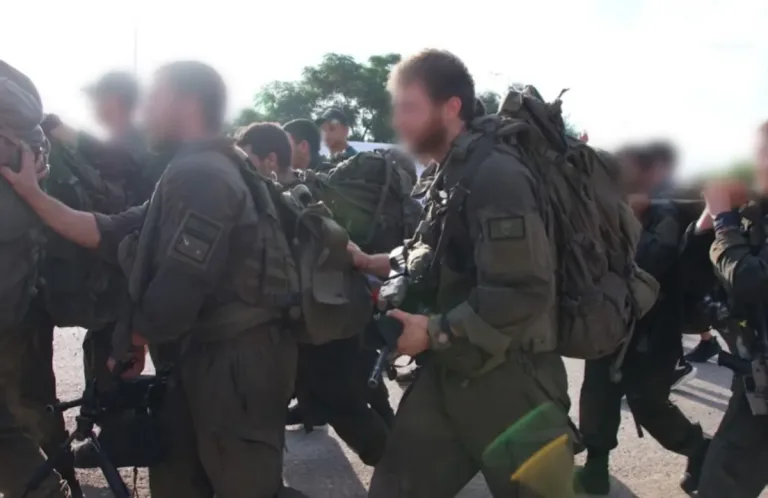
Against a backdrop of chalk cliffs that looked like they were taken from a postcard, on the beaches of Rosh HaNikra, dozens of the next armored reconnaissance fighters of the 401st Brigade marched last Wednesday morning. They completed the 50 km that stood between them and the black beret, on a journey that actually began more than eight months ago – during which they had already crossed the Lebanese border.

To understand the significance of the event, it is worth first explaining the meaning of the term ‘armored reconnaissance unit’. This refers to a platoon composed of soldiers trained for full infantry combat, whose role is to provide the tank with any operational solution it may need outside the vehicle. This is a collaboration reminiscent of the brigade combat teams that were formed throughout the war, only on a smaller scale.
“We operate like a radar scanning and preparing the area, and covering the blind spots of the tanks,” describes Lieutenant A., a company commander in the platoon’s training in the 46th Battalion. “If a terrorist tries to sneak up on a vehicle, we will eliminate him from the outside. And before a tank moves into a position, we will conduct a comprehensive check of the area for it. If there is a target it cannot fire at for any reason, our mortar or drone will finish the job.”

Unlike past reconnaissance units, the last of which was established about five years ago, the current soldiers were trained primarily as infantry fighters, not as tank crewmen. They underwent full training alongside the Golani Reconnaissance Battalion – as part of a company composed of them, those designated for the 7th Brigade’s reconnaissance unit, and two teams of Golani fighters themselves.
Lieutenant A. recalls the moment he first heard about the establishment, when he was actually a platoon commander in the 51st Battalion of Golani: “At first, they spoke about establishing a mortar platoon to be stationed near the border. But one day, the Chief Armored Officer came to us and explained that they wanted to redevelop unique armored reconnaissance and destruction teams, and I understood that this sounded like something I wanted to be a part of.”

After training at the Golani Brigade’s Training Base, they continued to a specialized completion course at the Infantry Corps School – which included operating advanced observation equipment and drones, urban warfare, and all the capabilities that complement armored forces in the field. “On the battlefield,” emphasizes the company commander, “we provide forward situational awareness, conduct night infiltrations, enter buildings, and carry out attacks with dedicated drones. These skills are not typically found in regular armored battalions.”
From there, the platoon’s entry into combat was exceptionally rapid. While their counterparts in Golani continued on their original training path, they were already maneuvering under the 401st Division Command in villages in the fifth and sixth depth lines in Lebanon.

The commanders foresaw the scenario and made sure to prepare the force accordingly: “From the first day of enlistment, we ran them under the most challenging conditions we could create, and demanded a lot from them very intensively, because we knew there was no time to waste. We understood that it was likely the fighters would encounter the security zone even before they got to hold the beret in their hands.”
Now, with the official completion of the reconnaissance unit’s establishment phase, the soldiers are expected to enter operational routine. This may include, depending on the dynamic reality in the various sectors, attack missions, defense, line holding, and further training. “As time goes by, we will continue to develop and acquire new skills,” he notes, “and learn which ones are most effective in real situations.”

Regarding the march itself, it seems that the extreme physical effort only highlighted the special bond that developed between the fighters during the unit’s establishment months. “What I will remember from that day is truly the atmosphere among them,” states Lieutenant A. “How even after 50 kilometers they still kept smiling. And if someone struggled with the walk, they just waited to take their hand or help them switch under the stretcher.”
“I am proud that these things are inherent in them as a platoon,” concludes the company commander. “Comradeship is perhaps the value we considered most important to emphasize along the way, precisely when it’s difficult – at that point, to know how to support the friend next to you.”