
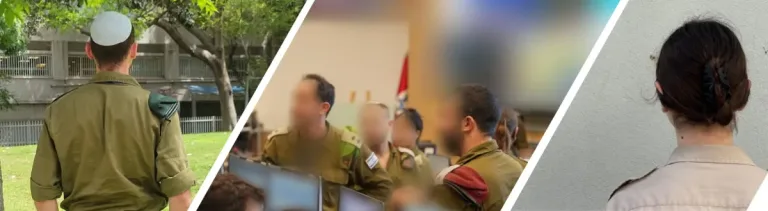
Lt. Col. D., head of operations at AMTZ, was at his son’s soccer practice when he received notification that the operation they had been intensely preparing for over several weeks was going live. This was last Friday, and that ‘operation’ was effectively the elimination of Hamas’s most senior leader in Gaza, Izz al-Din Haddad.
“From that moment on, I was obviously no longer in the game on the field,” he recounts. “I started mobilizing the entire wing, which operates like a conveyor belt. We begin updating everyone, from the command centers to the political echelon.”

Sgt. Maj. S., an officer in the Air Force’s elimination division, is part of that ‘factory.’ She participated in planning the aerial strike targets, based on her extensive knowledge of the eliminated individual. “I led everything related to the coordination with the squadron,” she describes. “We knew the window of opportunity would be narrow, so deep preparation and precise execution on short notice were required.”

Thus, fighter jets took off over the city of Jabalia, about 4 km north of Gaza City. After dropping precision munitions, a UAV also arrived and attacked a vehicle identified leaving the rubble of the targeted building. Within half an hour of the notification Lt. Col. D. received, the incident was completed, leaving only the wait for the official confirmation.
Hours later, the elimination of the head of Hamas’s military wing, Izz al-Din al-Haddad, became known. He was the most important and significant figure of the organization within the Gaza Strip, and one of the last of the generation of commanders who planned, engineered, and executed the October 7th massacre.
He had been on the target list for a long time, during which he held a series of the most important positions available in Hamas’s military wing. Upon taking its leadership, he exploited the position to rapidly rebuild terror infrastructure and continue to rule the Strip’s civilians with an iron fist.
An example of the cruelty he employed towards his own people can be seen in the public executions of anyone suspected of opposing Hamas, as documented in the Strip after the start of the ceasefire. These were carried out at his command, with his support, and at his demand.
And then, in his elimination, the knowledge that Sergeant Y., head of C2 (Command and Control) in Aman’s Operations Directorate, helped to formulate, came into play. “You gather every piece of information about that person,” he describes. “This makes the moments of truth much easier. You need to crack the enemy’s patterns of operation, which starts with their way of thinking. Haddad, for example, was driven by a very extreme ideology, hence his unwillingness to compromise or bow his head.”

His removal from the equation, as Sergeant Y. describes, has great significance for Hamas as a whole: “Cruel organizations need cruel leadership, and by eliminating Haddad, we are essentially leaving Hamas without significant and experienced leaders like him. This also sends a message – we can reach everyone. Until you disarm, no one will be immune. Certainly not the head of the military wing, no matter how much he tries to hide.”
“Ultimately, we cause the most senior terrorists to feel a sense of persecution that disrupts their decision-making. They know we are monitoring them even within the walls of their homes. In this case, for example, we analyzed his footage up close, to the extent that you could even see the whites of his eyes,” reveals Lt. Col. D. “This is a daily battle of wits, in which our side operates like a well-oiled machine, with extensive experience under its belt.”

Lt. Col. D. has headed the branch for 5 years: “Many times, in the moments immediately after major eliminations, such as Mohammed Sinwar, Mohammed Deif, or Nasrallah, I found myself standing in front of the screen saying, ‘Good, we got him too.’ And from there, we return to work, to the next bombs that will land at the precisely planned location.” Like him, Sgt. Maj. S. and Sergeant Y. also ‘clear the table’ of one mission – and move on to the next.