
By Pesach Benson • April 21, 2026
Jerusalem, 21 April, 2026 (TPS-IL) — Deeply held personal values, rather than political affiliation alone, play a decisive role in shaping how Israelis view hostage negotiations during times of crisis, helping explain why public opinion on the issue often remains deeply divided and resistant to change, according to an Israeli study.
The research, led by Prof. Ariel Knafo-Noam of the Hebrew University of Jerusalem, tracked public opinion throughout the ongoing war with Hamas. The findings, published in the peer-reviewed American Psychologist, concluded that values such as universalism and tradition act as psychological anchors, influencing not only what people think but how firmly they hold those views over time.
“Our findings indicate that when Israelis are faced with forming opinions about these agonizing life and death issues, they rely on their internal compasses in addition to the headlines or political cues,” Knafo-Noam said.
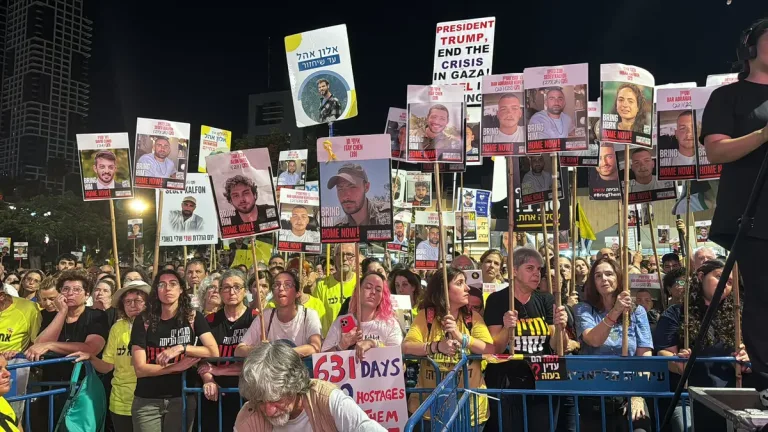
The study followed more than 7,000 Israeli participants across five separate samples, monitoring their attitudes from the first hostage deal in late 2023 through prolonged and often stalled negotiations in 2024 and early 2025, as Israel sought the release of 252 Israelis and foreigners taken captive by Hamas during the October 7, 2023 attack on southern Israel.
Participants in the study were presented with key details of proposed deals and asked to express their positions, allowing researchers to observe how opinions evolved as the conflict unfolded.
According to the findings, individuals who prioritize universalism — a value emphasizing concern for all people and a preference for peaceful solutions — were consistently more likely to support hostage deals. In contrast, those who place a high importance on tradition, defined as preserving cultural or religious norms, were more likely to oppose such agreements. Values related to power and social dominance were also linked to opposition, though less strongly than tradition.
Crucially, the study found that these value-based patterns held regardless of demographic factors such as age, gender, or education level. While political ideology and voting history remained influential, universalism continued to predict support for hostage deals even when accounting for political alignment.
Beyond shaping opinions, these values also affected how strongly those opinions were held. Researchers found that when a person’s stance aligned closely with their core values, they experienced a greater sense of certainty about their position.
This certainty, in turn, made individuals less likely to change their minds over time. The longitudinal portion of the study showed that participants whose views were strongly rooted in their values remained the most consistent, even as circumstances and public discourse shifted. In effect, the divide over hostage deals is not only about what Israelis think, but about how deeply those views are tied to their sense of what is right.
Knafo-Noam added that differences in opinion should not be seen simply as political divides, but as reflections of fundamentally different priorities. “People are very different in what they see as important in their lives, and they use their own personal sets of values to form different opinions even when they encounter the same set of facts about moral dilemmas,” he said. “Understanding public opinion divisions should be based on recognizing that diversity in values.”
The researchers suggest that these findings could have practical implications for policymakers, public communication, and international coverage of the conflict. Efforts to build public support for or against hostage deals may be limited if they rely only on political arguments or new information, since many people interpret those arguments through fixed value systems.
For journalists and observers abroad, the study offers a clearer lens for understanding Israeli debate. What may appear as political polarization or inconsistency is often a reflection of competing moral frameworks.
While the study focused specifically on Israeli society, its authors argue that the underlying dynamics are likely universal.