
By Eitan Elhadez-Barak • April 21, 2026
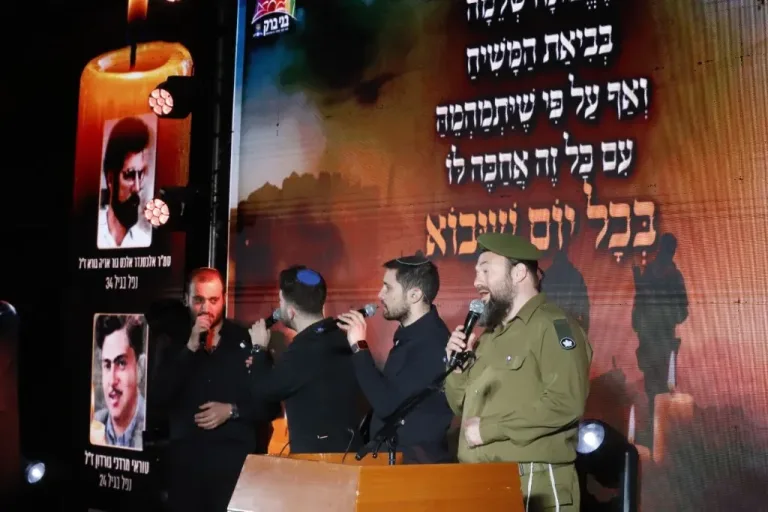
Jerusalem, 21 April, 2026 (TPS-IL) — A Memorial Day ceremony in the predominantly Haredi (Orthodox) city of Bnei Brak offered a rare moment of unity, as residents from Across Israel’s social and religious spectrum gathered Monday night.
Held on a hill overlooking the densely populated city, the event took on symbolic meaning in a place often associated with ambivalence toward Zionism and military service. For one evening, Israeli Flags were displayed prominently and uniformed soldiers stood alongside civilians in quiet reflection.
The ceremony commemorated 413 fallen individuals connected to the city, spanning decades.
The crowd reflected a cross-section of Israeli society. Secular attendees stood beside religious Zionists and Hasidic men dressed in traditional black coats and hats. Emergency responders from volunteer organizations, many of whom regularly confront tragedy, were also present.
Member of Knesset Tali Gottlieb, who grew up in Bnei Brak, described the gathering as a unifying event.
“I’m here every year, I grew up in this city,” Gottlieb said. “It’s an impressive and unifying ceremony that has everything — religious and spiritual content alongside ordinary content. There is pain here that crosses every sector, and everything is done with super-respect, without differentiation and without conditions.”
Bnei Brak, home to one of Israel’s largest Haredi communities, is often viewed through debates over military service and civic participation. Gottlieb pushed back against those perceptions.
“The Haredi society does not need to prove more than it has already proven in this war, certainly not after the infernal events of October,” she said. “True, my worldview is a mobilization for everyone, but not all the wisdom is in my hands. I respect the Haredi society for its structure and education. You don’t change everything in one go.”
Tradition, Loss, and Reflection
The event was marked by its distinctive atmosphere. Memorial Day falls during a period on the Hebrew calendar known as “the Omer,” when religious law restricts the use of musical instruments. The ceremony featured only vocal performances, creating a stripped-down tone.
While many of the fallen were from earlier years when Bnei Brak was more socially diverse, recent losses were also acknowledged, including victims of the October 7 attacks. Among them were Shlomo Eliyahu Alsheich, a 27-year-old resident killed at a music festival, and Eliyahu Toledano, who was abducted to Gaza and later died.
The ceremony included traditional elements such as the recitation of religious texts and the projection of the names of the fallen. Local officials and rabbis attended, while children gathered outside, observing from a distance.
“This ceremony is medicine for Israeli society,” Gottlieb said. “A society that does not seek progressiveness or conservatism, but a place where there is everything from everything.”
Integrating Haredi Jews into military life is one of Israel’s most politically sensitive issues, as the army faces manpower shortages. Most Haredi men have traditionally been exempt from the mandatory draft to pursue religious studies. The issue intensified after Hamas’ October 7, 2023, attack on southern communities. Strained by more than two years of war and extended reserve duty, the army projects it will lack 17,000 soldiers starting in 2027, as troops who enlisted for shortened 30-month terms begin completing service.
In early February, IDF Chief of Staff Lt. Gen. Eyal Zamir signed a landmark order establishing formal guidelines for integrating Haredi Jews into military service. It marked the first time such arrangements were codified in an official General Staff order.
The military began making plans to draft yeshiva students after Israel’s High Court of Justice ruled in 2024 that exemptions for the Haredi community were illegal.
Military service is compulsory for all Israeli citizens. However, Israel’s first Prime Minister, David Ben-Gurion, and the country’s leading rabbis agreed to a status quo that deferred service for Haredi men studying in yeshivot. At the time, no more than several hundred such students were enrolled.