

By TPS-IL • April 22, 2026
Jerusalem, 22 April, 2026 (TPS-IL) — In the days leading up to Israel’s Memorial Day and Independence Day, the National Library of Israel has received the personal archive of Maj.-Gen. Orde Charles Wingate, a British officer whose influence on the country’s early military thinking continues to resonate decades later.
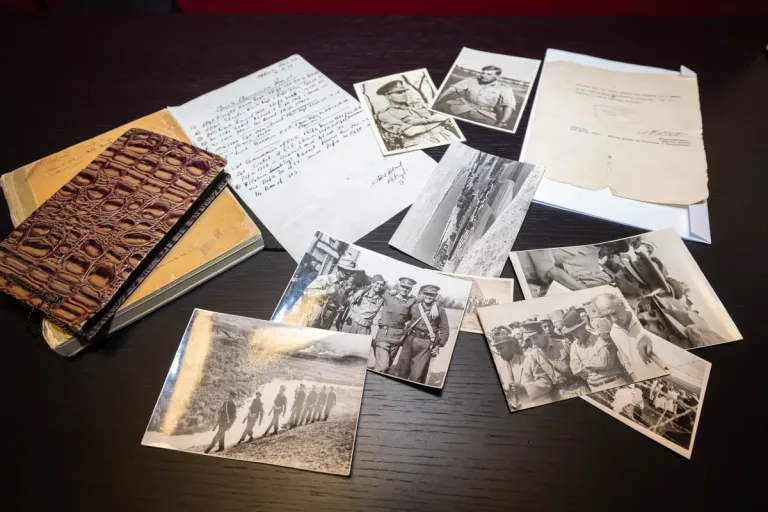
The newly acquired collection, described by the library as holding significant national value, includes previously unrevealed documents shedding light on Wingate’s activities in pre-state Israel, his ideological worldview, and his close ties with Zionist leaders, a library archivist told The Press Service of Israel.
“It’s the first time we are able to properly categorize and make his archive accessible for research, including scanning it for the general public,” archivist Rachel Misrati told TPS-IL.
“These are the original documents. They give the facts, from his army service, from letters to his family, his personal view on the developments that led to the formation of the State of Israel,” she said.
Wingate, a British Army officer active in Mandatory Palestine in the late 1930s, is widely regarded as a formative figure in the development of Jewish defense forces before the establishment of the state. His combat doctrine, centered on intelligence-driven operations, initiative, and night raids, later became foundational to the Israel Defense Forces.
Among the items in the archive are Hebrew study notebooks, a personal diary documenting his time in the country, operational plans, intelligence reports, and rare photographs. The collection also includes detailed documents outlining plans for a future Jewish army and materials related to the Special Night Squads, a joint British and Jewish unit that operated in northern Israel during the Arab Revolt.
Wingate established the Special Night Squads in 1938, introducing a new approach to combat that emphasized offensive action and close cooperation with local Jewish fighters. The units played a role in protecting settlements during the violence of the late 1930s and helped train future Israeli military leaders, including Yigal Allon and Moshe Dayan.
Within the pre-state Jewish community, known as the Yishuv, Wingate earned the nickname “The Friend,” reflecting his unusual position as a British officer who openly supported the Zionist cause. He maintained close relationships with leaders such as Chaim Weizmann and Moshe Sharett, and expressed support for the establishment of a Jewish state, a stance that ultimately led to his removal from the region by British authorities.
“The items in the archive show he was connected to everyone. He had the phone numbers of people in the Jewish Agency, and even the private number of Winston Churchill,” Misrati said.
Born in 1903 to a religious Christian family with pro-Zionist views, Wingate was trained at the Royal Military Academy and served in several postings before arriving in Mandatory Palestine in 1936. He later rose to the rank of major general during World War II and was killed in a plane crash in India in 1944.
“He believed it was his religious duty to help the founding of a Jewish state. The documents show he was also a very practical thinker, wanting to build a Jewish military force so that British troops could be deployed elsewhere, as he anticipated World War II,” Misrati said.
The collection was donated to the National Library by Clive Lewis, a London-based Jewish businessman and private collector.