
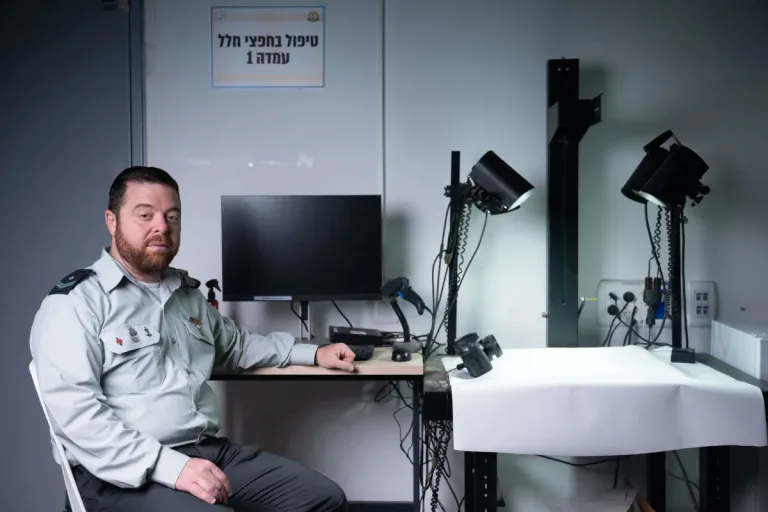
Where I meet Sergeant Major Lior Hayon, commander of the fallen care chain, it’s just him and me. The floor is clean, the fluorescent light is bright, and every word he says echoes in the empty corridors. “Close to 1,300 fallen soldiers were brought to the plaza you see here, in private cars, ambulances, and trucks,” he recalls the horrific scenes of that dark Saturday.
With all the gravity of the matter, the personnel of the Military Rabbinate’s ‘Tzvi Center’ were required to attach a name to each body, and determine whether it was a civilian, a male soldier, or a female soldier, or, God forbid – a terrorist. This is how the Tzvi Center assigns an identity to each body. And speed, as the chain commander clarifies, is of paramount importance when it comes to bereavement.

“If we, the army, do not inform the family, they might receive the worst possible news from a neighbor or acquaintance. Everything is transmitted on Telegram within minutes, and all of Israel will know which battalion it happened to, how many soldiers were killed and how many were injured,” says Sergeant Major Lior with a decisive voice. “We place great value on how families are informed of the loss of their loved ones – from this moment on, their fate is tied to the IDF. Immediately after identification, we update the Casualties Branch, and they send notification officers to the fallen soldier’s home.”

But the fallen care chain doesn’t end with identification – it only begins. Here, the personal effects found on the fallen soldiers come into play, which are collected by the Tzvi Center personnel. These will later be packed in blue boxes by the Casualties Unit – boxes that have reached so many doors throughout the war.
“Already at the identification and sorting station, we begin collecting the items that were on the fallen soldier when they arrived. In the personal effects room, we clean them, document them, seal them in packaging – and if possible, transfer them for further processing so they reach the family.”

When I ask him what items they make sure to collect, he answers me unequivocally: “Every ‘pip’, every shekel – including patches, even a snack bag found in their pants pocket. The families want to receive something they can feel, see, smell. Every small item is a whole world. In the end, it’s the last thing their son or daughter held: these items have supreme value.”
“Once, a fallen soldier arrived with a necklace, with a kind of amulet as a pendant,” Sergeant Major Lior recalls a particularly memorable case. “About 20 minutes later, we received a call from the father. The first question he asked was – where is the amulet? He asked to receive it as soon as possible, so of course, we cleaned and packed it first. At the funeral, he said that his son had spoken to him the day before: he told him, ‘Dad, I dreamed last night that I was returning the amulet to you.’ And it bothered him. This is just an example of the true value of each and every item.”
In the complex treatment room, a medically important investigation takes place. “Here, a forensic doctor deciphers the injuries on the fallen soldier. He uses a CT scan, and also documents everything – in case the family has questions. We hide nothing: in the end, it’s their son or daughter. If we don’t have answers to their questions – how, what, and why – that’s our failure,” he states.

And here too, the handling of personal effects doesn’t stop: “Necklaces, rings, kippahs, and the like, we collect already at the reception area. In the complex treatment room, on the other hand, we start checking the pockets. Then, we discover additional and special things.”
“We often found valuable items, phones being the most common example,” Sergeant Major Lior tells me as an example. “Sometimes, on October 7th, they arrived working, and we saw a message or call from ‘Mom’ on the screen. A sign that she hadn’t been informed yet. Here, you could say you truly enter the fallen soldier’s inner world – but your responsibility is still in effect, and you have to process it only later. After a day like that, it’s hard to get up.”
From here, after all the other personal effects left by the fallen soldier have been collected, the blue boxes are handed over to the bereaved families by the Casualty officers. The farewell is painful, but in a way, it represents closure – as does the physical farewell ceremony before burial.

“We always strive to allow the family to say goodbye to the fallen soldier – but if the sight is too difficult, the farewell is impossible. It’s something they can never bear,” he explains to me. Nevertheless, the center’s personnel make every effort. “Sometimes, we beautify them a little, and cover their faces. Then you can still stroke the fallen soldier’s hair, and there’s something tangible to say goodbye to.”
As implied, the escort continues to the cemeteries, where the fallen soldiers make their final journey. “In the days following October 7th, I led four funerals a day. We treated every soldier as if they were the only one killed in the war: because they deserve it, the fallen and their families.”

I couldn’t help but wonder how a person who deals with such a painful field day after day can keep their head held high, and speak so plainly about the sensitive role they fulfill.
“Look at this corridor,” he gestures to my right and left. “From end to end, we have three refrigerators, but on October 7th, they weren’t enough. We brought refrigerated containers into the corridors, and they waited here – because there was truly no other place. So yes, it created higher immunity and readiness, but the people here remember those moments and are still dealing with them today. I am also being treated – there’s no escape, it’s etched in the heart and doesn’t leave.”
And to continue looking forward, Sergeant Major Lior explains that he has nothing but faith in this work: that although it was at times unbearable, it was always sacred and heartwarming. “The fallen soldiers and their families deserve our 100 percent, so we put our personal difficulties aside. If you’re not there for that – don’t be there: especially when you are a professional in such a sensitive field.”