










“I didn’t have soldiers to mobilize, but I knew I had to take part”:
Lieutenant Y’ – Platoon Commander of Bardelas recruits, distinguished officer course graduate
On paper, the officer course seems like another clear step in Lieutenant Y’s military career. She enlisted in November 2021 as a Bardelas combatant, and since then has filled almost all command positions in the battalion – from squad leader to deputy platoon commander. But in practice, her ‘why’ to become a platoon commander matured into a decision during the officers’ course – on that dark Shabbat.
“Everything was routine, at least that’s how it felt, until my mother came into the room and told me: ‘There’s a war’,” she recounts, “Immediately all the messages in the WhatsApp groups started flying, and I immediately took the car and drove to the Gaza envelope. It was complicated, because I was at Bahad 1, so I didn’t have soldiers I could mobilize or assemble for combat, but I knew I had to take part.”

When she arrived in the south, she found herself in a situation that could not have been predicted: “We just arrived at a central assembly point and started distributing tasks among those who were there: searches, clearing areas, evacuating casualties – whatever was needed to stabilize the area.”
“It wasn’t easy. In the end, I was shoulder to shoulder with the combatants next to me, but I didn’t have ‘my’ people that I was responsible for, and that’s a situation you don’t train for at any stage.” And precisely there, she felt the unity of purpose and shared fate most strongly. “We were a mix of combatants from everywhere, trying to close gaps in real-time. Whether it was guys from Maglan, Kfir, Nahal, or Combat Intelligence, there was no difference between any of us.”
And then came the moment she describes as a turning point: returning to the training framework. “When the situation stabilized a bit and we got a clearer picture, we returned to finish the completion course,” recalls Lieutenant Y’. But precisely then, questions and complexities began to surface.
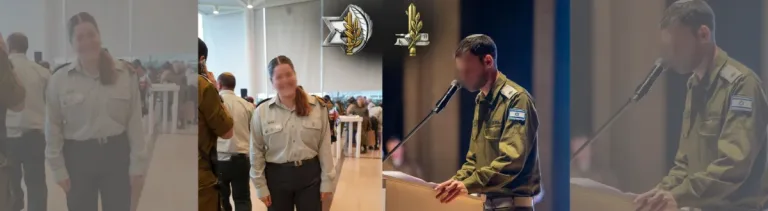
 Lieutenant Y’ at Bahad 1
“On the one hand, there was massive fighting, and my battalion was there, doing what I enlisted for, and there was the missed opportunity and regret that I wasn’t with them. On the other hand, everything I was doing was so that I would return to them better, more professional, and more precise – with the goal of leading them in the future on the battlefield.”
And it seems that out of this gap, her ‘why’ became clearer. “I wanted to do something in the army that has no equivalent in civilian life, and the moment I went into command – I found it. And since then, the meaning of staying in the army has intensified for me.”
Now, as she looks at the officer course itself, Lieutenant Y’ sees it as a transition point. From a commander who primarily knows her own unit, to a commander who needs to know how to lead diverse forces in synchronization: “This is done at the level of all corps. From Artillery, through Engineering and Infantry, to the Air Force – truly everyone together, with the goal that if necessary, we will command a task force in combat.”
 Lieutenant Y’ receiving the commendation
She describes receiving the commendation in the course not as a peak moment: “but as one that distills this entire period into something tangible that can be measured. In the end, being a distinguished graduate and standing in line with 11 other combatants, men, and being the only woman among them – was very significant.”
In the coming days, Y’ will enter her role as platoon commander of Bardelas recruits, and for her, the goal is one: “I have the privilege of training and preparing the next generation of female and male combatants for the battlefield, and that is an immense gift. If there is something special about us, it is the joint combat – women and men alike, equal in every respect.”
 Officer Course Commendation Pin
“Everyone asked themselves: ‘How can I contribute more?’ For me, this was the answer”:
Lt. Col. (Res.) A’ – Battalion Commander 6828 in Bislam”h, distinguished battalion commander course graduate
Unlike Lieutenant Y’, who was in the officers’ course when the war broke out, Lt. Col. (Res.) A’ was met by October 7th in a completely different place – being called up for reserve duty in Brigade 828 of Bislam”h directly from civilian life, and having to learn once again what command means during an intense campaign.
Lt. Col. (Res.) A’ enlisted in 2010 to the Givati Reconnaissance Unit, where he continued until the role of platoon commander, and was discharged. But even then, the connection was not truly severed. “I was always very connected to the idea and purpose of command in the army,” he clarifies, “so even when I wasn’t in permanent service – it was clear to me that I would continue in reserve duty.”
 Lt. Col. (Res.) A’, on the right
He remembers the war mainly through a rapid sequence of transitions between different fronts, without much time to stop. “Overall, we began a combat procedure for the north as part of Division 36, and after just a few days we understood that we were heading south and preparing for the maneuver in the Strip.”
Immediately afterward, he moved to the role of Deputy Battalion Commander 6828 of Bislam”h. There, although he was well acquainted with the world of command from his regular service, he felt a slightly different sensation. “In reserve duty, authority is different,” admits Lt. Col. (Res.) A’, “you have to know how to use it, but at the same time use other leadership skills, and specifically find common experiences, not just look from above.”
This transition, as he experienced it, became even sharper as the fighting progressed, and especially during the second operation, in Jabalia. Then, he found himself in a reality that few know, and it’s doubtful one can be prepared for it in advance. “During the fighting, the battalion commander was wounded and incapacitated, so as his deputy – I took over his role. Replacing a commander during a maneuver is not a simple event, neither for me nor certainly for the other soldiers, but it taught us a lot.”
And when I try to understand how one takes command in such an event, he repeatedly returns to what was built beforehand, and translates the foundations into actions in real-time: “You prepare in advance. My foundation in the battalion and with the people in routine is what led to the ability to command even as an acting battalion commander, and in the end, the real strength came from below, through my subordinates who gave me confidence and belief.”
Between two years of rotations, Lt. Col. (Res.) A’ describes that the big change is not only on the battlefield – but in the space between operations: “If in the past the role of a reserve commander was to meet and be with his soldiers mainly during peak moments, today the connection and command are before, during, and after the order. There is something about the war that has connected people, and requires command and leadership even in routine that is not reserve duty – and there is no other way.”
 Lt. Col. (Res.) A’ at the graduation ceremony
And from this place, he explains why he decided to attend the battalion commander course now – despite his family, work, and the feeling that there aren’t enough hours in the day to add to an already overloaded routine. “It’s a kind of call of the hour. It’s possible that without the war, I wouldn’t have felt the need to make this big leap, but something happened in our country. I estimate that everyone asked themselves during this period: ‘How can I contribute more?’ For me, this was the answer.”
Regarding the commendation itself, he only found out shortly before the ceremony, and with great joy for the important recognition, he knows well that the real success will be measured in the field. “It is a great honor for me, but in the end, it will become clear in the test of results. I wish for myself that it will be the same in real-time in the role itself, in the daily leadership of my people – before, during, and after the next rotation.”
 Battalion Commander Course Commendation Pin
Related Topics