
By bypassing the Suez Canal, it shaves weeks off delivery times, eliminates toll costs, and removes the risk of a blocked or contested maritime passage. This is not just energy security; it is price security.
The pipeline fulfills Europe's two most urgent needs: direct, stable access to its biggest partner (the Gulf), and the neutralization of the primary source of economic shock (Mideast energy disruptions). For Brussels, pushing this project is the single most effective "resilience" policy it can adopt.
Why SAUDI ARABIA Wins: Strategic Autonomy and Vision 2030
Riyadh’s economic future is enshrined in Vision 2030—the ambitious transformation into a global logistical and infrastructure hub. But Vision 2030 is currently vulnerable. Its energy export model depends profoundly on the Strait of Hormuz and the Bab al-Mandab—two points where antagonists have proven they can disrupt traffic at will. Yanbu, the Kingdom's main Red Sea port, was originally built to bypass Hormuz, but antagonists have also demonstrated they can target Yanbu. Even Yanbu’s supply must transit the contested waters of Yemen to reach Europe.
The KSA-Ashkelon solution is the ultimate strategic insurance policy for Riyadh. It detaches the Kingdom’s economic security from Tehran’s geographic proxies.
A direct overland pipeline to Ashkelon grants Saudi Arabia direct, rapid, and uncontested access to its single biggest customer: Europe. For the first time, Riyadh is not dependent on maritime good will; it controls its own contiguous export spine. This is strategic autonomy.
Furthermore, it fulfills Vision 2030’s core tenet of integrating KSA into global supply chains. A contiguous connection to the Med is the ultimate logistical hub.
Finally, for the world's largest oil company, Aramco, the sprint is a routine operational challenge. KSA has the flat, open desert, the equipment, and the massive Aramco logistic network that makes a 200km desert sprint a matter of months, not years. By leading this project, Riyadh proves its global indispensability and agility.
Why AMERICA Wins: Strategic Decoupling, Stability, Deterrence
Operation Prosperity Guardian is an expensive, defensive commitment that fails to deter. It commits U.S. forces to a permanent game of defense in a region it is trying to pivot away from. Washington needs a permanent, non-maritime solution to Middle East instability—one that doesn’t require more U.S. troops.
The KSA-Ashkelon pipeline is the definitive strategic decoupling. By providing a secure overland route for a massive percentage of global oil, it dramatically reduces Tehran’s leverage. If Tehran knows it can shut down Hormuz but that global markets will remain stable because Saudi crude is flowingContiguous to the Med, it loses its biggest strategic card. Deterrence is re-established.
Furthermore, this project binds vital allies—Saudi Arabia, Israel, Jordan, and the European Union—into a contiguous, shared, long-term strategic interest. This is "bottom-up" stability. It creates a robust, secure alternative to antagonistic initiatives like the Belt and Road, establishing a U.S.-backed energy superhighway that Iran cannot contest.
For a U.S. administration seeking to secure global markets and stabilize allies without further costly military commitments, the KSA-Ashkelon project is the perfect geopolitical counter-punch. It secures global interests without risking global war.
The Executive Blueprint: Feasible in 8 Months
The 8-month timeline is aggressive but entirely realistic if the project is treated as a war-footing strategic sprint. Infrastructure projects typically take years because of bureaucracy, not engineering. A contiguous project across flat desert with minimal statutory bottlenecks and Host Nation Support can be optimized with parallel, multi-pronged execution.
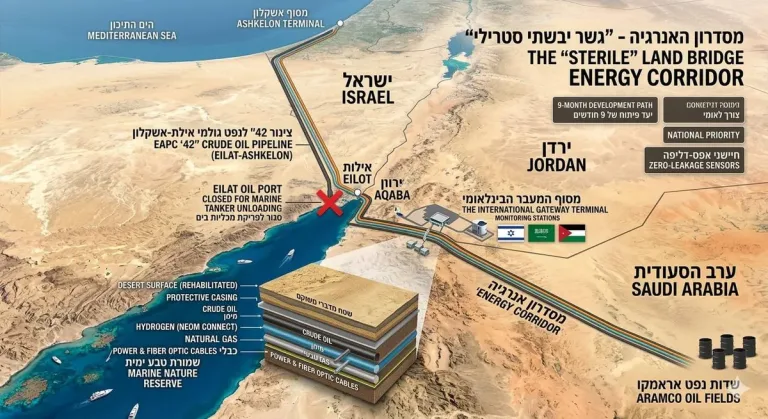
The foundation is already in place: Israel’s EAPC operates a massive, contiguous 42-inch diameter line (Eilat-Ashkelon), with a rated north-bound capacity of roughly 60 million tons per annum (1.2 million barrels per day).
This is the national spine, built, paid for, and operational.
The "final kilometer" is the contiguous connection of the Saudi and Israeli networks. Saudi Arabia’s Aramco network already extends towards its northwestern desert (near Tabuk), only roughly 200 kilometers from the Eilat terminal.
The remaining engineering sprint is twofold:
* The Final Cross-Border Link: Laying a contiguous, subterranean pipeline "link"—just a few kilometers—across the border. This requires standard desert trenching and a contiguous metering station at the exact junction of Saudi, Jordanian, and Israeli territory.
* Upgrading the National Spine: Israel’s EAPC line requires upgraded contiguous booster stations to maximize its flow rate and handle a massive influx of Saudi crude. These stations are modular and can be pre-manufactured factory-built and integrated in parallel.
With decisive political will and an emergency infrastructure declaration in Jerusalem, dozens of specialized teams (100 crews) can work contiguously on planning, procurement, trenching, and welding simultaneously, 24/7. U.S. logistic support can accelerate procurement (steel pipe, high-capacity booster pumps). Israel guaranteesHost Nation Support, fast-tracking approvals. Aramco executes the 200km desert sprint.
The "Sterile" Land Bridge Commitment: Protecting the Red Sea
To fulfill European ESG (Environmental, Social, and Governance) standards and protect the unique Eilat coral reefs (a vital Israeli asset), the project must be contiguous and sterile.
This is not a proposal to increase tanker traffic in Eilat. It is a "zero-tanker" solution. The connection is contiguous, subterranean, and land-based. The waters of Eilat remain clean, touristic, and untouched.
Furthermore, the new contiguous pipeline must be built with "Generation 5" safety standards, surpassing typical regulations:
* "Smart Pipe" with Fiber Optics: Layering contiguous fiber optic cables adjacent to the pipe for real-time leak detection (accurate to meters within seconds).
* Autonomous Shut-off Valves: Integrated smart valves every 500 meters that contiguously clamp shut if sensors detect a pressure drop, isolating the leak.
* Contiguous Double Containment: Using pipe-within-a-pipe design in contiguous ecologically sensitive zones.
Conclusion: Start Digging
The global economy is fragile, but the solution to energy security is robust. Defensive maritime patrols are an expensive and temporary fix. The definitive answer to Iran's Red Sea chokehold is a strategic paradigm shift.
The contiguous, land-based KSA-Ashkelon energy corridor is a classic "Win-Win-Win." For the European economy, it is price stability and resilience. For the Kingdom of Saudi Arabia, it is strategic autonomy and Vision 2030 empowerment. For the United States, it is a geopolitical decoupling of global energy from Tehran’s proxies.
We have the dormancy-giant hosting utility, the established geography, and potential partners with identical interests. In eight short months, we can be living in a completely new strategic reality. We just need to start digging.
The Strategic Imperative: Securing the West, Empowering the Gulf, Bypassing the Chaos
Global energy security is being held hostage. The burning tankers of the Red Sea and the missile attacks on energy infrastructure are symptomatic of a deep, structural vulnerability that maritime patrols cannot fix. While Operation Prosperity Guardian addresses the immediate symptoms, the long-term solution lies beneath the desert sands. A comprehensive technical and geopolitical analysis reveals that the fastest, most effective, and single most lucrative strategic move available to the West and the Gulf is the contiguous, land-based connection of Saudi Arabia’s oil fields to Israel’s Mediterranean port of Ashkelon. Feasible in just eight months, this project is not an Israeli strategic victory; it is the ultimate insurance policy for Riyadh, the stabilizing force for the European economy, and the definitive strategic counter-punch for the United States.
The visual is jarring, yet common: smoke billowing from a massive crude carrier in the Bab al-Mandab, commercial traffic rerouting by 10,000 kilometers, global inflation spiking, and international coalitions engaged in an expensive, defensive game of drone-interception. The proxy attacks on maritime choke points, coordinated with Iranian intelligence and arms, have achieved a long-feared strategic outcome: a geopolitical chokehold on the global economy.
By blocking a waterway that handles 12 percent of seaborne oil gand 8 percent of global liquefied natural gas, Tehran’s proxies have created a permanent condition of high-stakes instability. Operation Prosperity Guardian has stabilized the waters but failed to solve the systemic vulnerability. Defensive maritime actions address the symptom. The disease is global energy’s dependence on a single, fragile maritime line of communication. Experience has proven that these choke points are too effective a weapon for antagonists to voluntarily surrender. The current crisis is not temporary; it is the new normal.
The West is shunning Russian oil and gas, and its energy security now depends profoundly on the Middle East and Africa. Yet, to access this energy, ships must transit the exact regions antagonists control. The "resilience" global capitals crave—energy security that can withstand the whims of a militia—will not be found on the water.
It will be found on land. The most effective strategic move available right now is the contiguous, land-based energy paradigms shift: connecting Saudi Arabia’s oil network directly to Israel’s Mediterranean port of Ashkelon, via a contiguous desert land bridge.
This analysis is not a utopian vision; it is a summons to action. Given the political will in Washington, the strategic vision in Riyadh, and the economic desperation in Brussels, this project can be fully operational within eight months. The primary winners of this project are not Israel; they are the governments of Saudi Arabia, the European Union, and the United States. They must now seize their biggest strategic opportunity of the decade.
Why EUROPE Wins: Stabilizing the Med, Fighting Inflation
Europe’s economy is fragile, struggling with inflation, and attempting to permanently replace Russian energy with stable alternatives. The current Red Sea crisis has shattered that stability. Rerouting ships around the Cape of Good Hope adds roughly $1 million per round trip in fuel costs and 14 days to delivery. The cost of container shipping has tripled. The result is a persistent inflationary pressure that European central banks are failing to defeat.
The KSA-Ashkelon pipeline is the definitive economic stabilizing force for Europe. It converts Israel, for the first time, from an "energy island" into a contiguous energy "land bridge," directly connecting Saudi crude to the Mediterranean Sea.
Europe is trying to replace Russian supply, but its alternatives (American and Gulf supply) must make complex journeys. The Ashkelon solution simplifies everything.