























By Pesach Benson and Ezra Lev Cohen • December 25, 2025
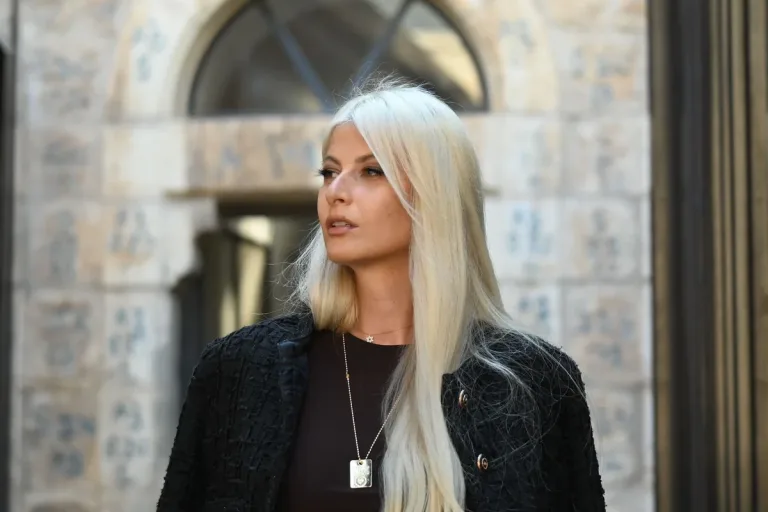
Jerusalem, 25 December, 2025 (TPS-IL) — Canadian-Slovakian model Miriam Mattova is intensifying her public advocacy to hold social media platforms accountable for online hate, saying unchecked anonymity has helped normalize antisemitic threats and allowed violent rhetoric to flourish without consequences.
Mattova, 33, who lives in Toronto, has become an outspoken critic of what she describes as regulatory inaction by governments and technology companies, particularly as she faces a sustained campaign of online harassment. In November, she was forced out of an Uber ride after a driver learned she was Jewish, an incident that later led to a settlement she says she cannot discuss. Since then, she says the volume of threats directed at her online has surged, with messages praising Adolf Hitler, calling for her murder, and targeting her Jewish identity and Zionism.
“This level of anonymity creates a breeding ground for extremism, harassment and escalation,” Mattova told The Press Service of Israel. “It allows hate to be amplified and normalized without accountability, and violent rhetoric becomes casual. Threats start to feel acceptable to the people making them.”
Examples of the messages Mattova says she sees daily on Instagram and Twitter include explicit praise of violence and genocide. She shared screen-captures of some comments.
“Hittttttler was right,” one comment said. Others were more overtly threatening, such as, “Should have just slit your throat lol,” and “SHAMELESS GENOCIDAL LOVER!!! ONE DAY YOULL REAP WHAT YOU SOW!!!” Some posts attempted to separate antisemitism from anti-Zionism while still targeting her identity, such as, “She’s a self-proclaimed Zionist. Stop conflating that with Judaism. These genocidal maniacs and those who support their vile regime should know no peace. #FreePalestine,” and “another Slovakia bitch pretending to be a jew. Zionism is Nazism and not Judaism.”
Mattova’s advocacy gained further urgency following the arrest of three men linked to Islamic State, arrested by Toronto police and accused of attempting to kidnap Jewish women at gunpoint. One of the three was released on bail, a decision that sparked anger within the Jewish community. The three were arrested in Mattova’s neighborhood, further deepening concerns about public safety.
“It’s quite scary getting all these death threats and then seeing terrorists being let out on bail. I have no words to this country anymore,” she told TPS-IL.
Mattova stressed that her criticism is not directed at police officers themselves, whom she praised for making the arrests, but at what she sees as systemic failures to treat threats seriously. “I was very proud of the police that they caught these types of people,” she said. “But the next day, when I opened the news and found out that they were released on bail, I was very disappointed. Especially because I’m getting 20 to 30 threats on social media a day. Like, how should I feel?”
She has filed official complaints with police and says documenting threats is essential, even when results are slow. “Filing a report is essential. It creates an official record and helps establish patterns if threats escalate,” she said. “In my case, they do escalate, but nothing seems to happen.”
Fighting Online Hate
Mattova, who holds a PhD in political science focused on government regulation and accountability, argues that social media platforms remain governed by outdated rules that no longer reflect the scale or impact of online hate. “Instagram was created 15 years ago and we still sign off to the same terms and regulations as 15 years ago, when hate was completely different,” she said. “Online hate is the ground zero for extremism, and regulations have not kept pace with technology.”
She believes stronger verification measures are necessary, including linking accounts to verified identification or financial credentials. “We cannot have people that are not traceable online spreading things that are either not true or threatening people or harassing people online,” Mattova said. “There is no difference between saying something to a person in real life or saying it online.”
The recent deadly attack on Jews at Sydney’s Bondi Beach “reminds us that online hate does not only stay online. It radicalizes individuals and validates dangerous ideologies and lowers the threshold for violence.”
Rejecting accusations that Jews speak out to silence debate, Mattova said the stakes are existential. “We speak out because we want to stay alive,” she said. “When antisemitic threats are minimized, when perpetrators face no real consequences and society treats these warnings as overreactions, it echoes the same dangerous pattern my family lived through before the Holocaust.”
Her grandmother, a Holocaust survivor now in her 90s, has also been targeted in online attacks. “They are attacking my grandmother and telling me that Hitler should do the same thing to my family,” Mattova said. “That is so unacceptable. It’s a feeling of deep disappointment that she has to see this.”
Despite the hostility, Mattova said she is not planning to leave Canada. Instead, she is seeking structural change. She plans to partner with the Toronto-based organization End Violence Everywhere to issue an open letter to politicians calling for enforceable standards for online platforms. “If the platforms will not take responsibility and self-regulate, then our governments must compel them to do so,” she said.
Mattova is also continuining her advocacy for Israel Friends, a nonprofit that has delivered over $55 million in aid for civilian security teams and support for Israelis suffering from post-traumatic stress disorder (PTSD).
“My goal is to engage policymakers and company leaders,” Mattova added. “But if they don’t respond, we cannot even have a debate. Speaking up is not a choice for me. It’s a matter of survival.”
Related Topics