
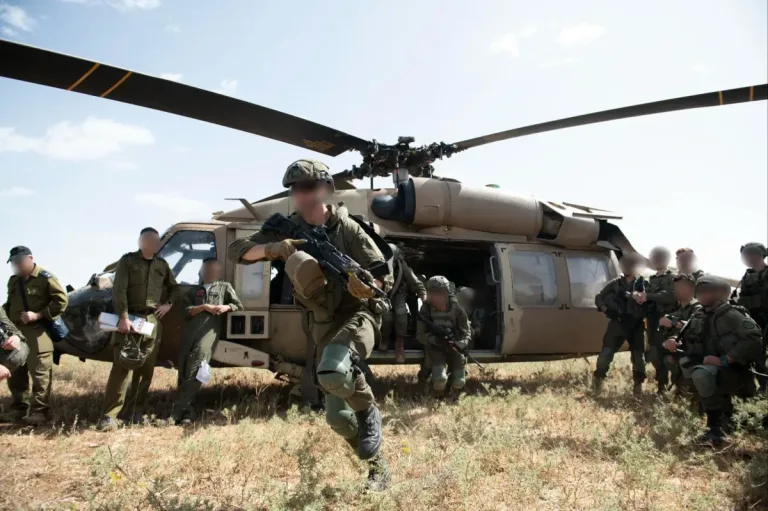
Just before entering operational activity, fighters from cohorts A’ and B’ of the ‘Erez’ program arrived last week in the Jerusalem mountains – to conduct their first airborne exercise since the project’s establishment, led by the Air Force Cooperation Unit.

The two cohorts that participated are currently in academic studies during their advanced training phase. Alongside their studies and exercises to improve their fitness, the fighters engage in operational activities in various sectors – in the battalions where they are destined to command themselves.
The training focused on two scenarios: In the first phase, the fighters were required to perform an airborne evacuation from the field. The teams moved one by one to the takeoff point, after receiving a briefing from the aircrew and learning how to secure the landing site. Afterwards, they loaded ‘wounded’ on stretchers onto the helicopter, took off to another landing pad, and performed an orderly disembarkation – as they would be required to do in real-time.


Afterwards, the fighters moved to the second phase: guiding aircraft to attack enemy targets. “They had to communicate continuously with the helicopter crew and provide guidance for precise strikes,” explains the deputy commander of the advanced training track in the program, Lieutenant Y’, “The focus here is on building consistent dialogue and a clear situational picture for the forces in the air.”
“Our expectation from the Erez fighters, who are also destined to be the next commanders, is to be first in terms of their level of understanding and knowledge of how to operate such an event,” he continues, “This is why there is a great emphasis during training on command skills – and in each team, one trainee is chosen to serve as the commander. We give them the push from the side to manage the event and make the important decisions.”

“The transition from classroom lessons to operational activity, as we practiced today, is very sharp,” describes Sergeant Z’, a fighter in training from cohort B’, “From here, we are destined to go up together as a company to the northern sector, after a few days of preparations we made to arrive as ready as possible.”
For Sergeant A’, another fighter in training, the intensive period of studies, courses, and exercises is what builds the next generation of commanders for the unit: “The goal is that when we reach the battlefield – we will be as professional and connected as possible to the operational reality, and arrive with practical experience.”

“An event like the one we practiced today happens in operational routine on a daily basis,” notes Lieutenant Y’, “Therefore, the ability to maintain good communication with the Air Force and other friendly forces in real-time is among the most important capabilities a commander in the field needs.”