
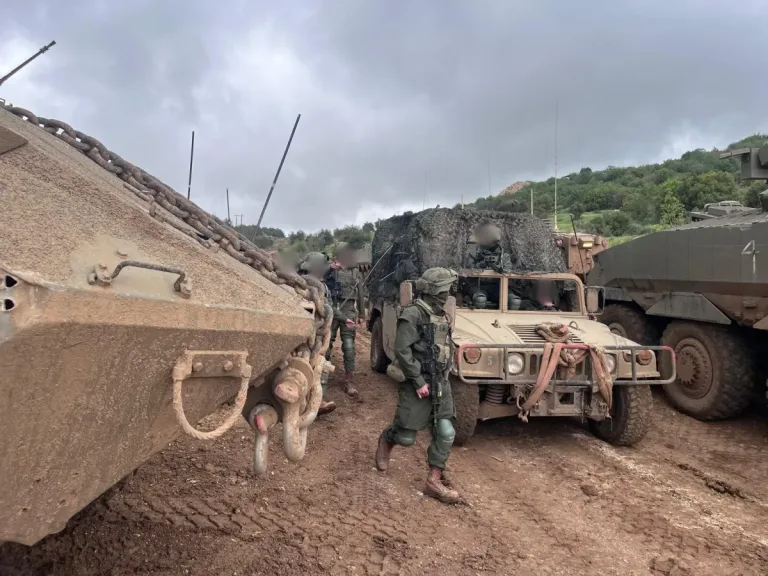
Inside the APC, David Bowie’s “Space Oddity” plays, and the lyrics: “This is Major Tom to ground control” echo within. Outside – silence. Occasionally, an APC engine roars, or another vehicle drives through mud puddles. Around me, the mountains and ravines symbolize – I too, like Major Tom from the song, have left the ground. I have arrived in Lebanon.
When the Namer’s ramp opened, the landscape of the Cedar Land unfolded before me. “Welcome to Lebanon,” one of the soldiers sitting on the bench said to me with a smile. The Waze on the phone of the person to my right also gave its signals, warning that there was no GPS reception in the area.

Already on the third day of ‘The Lion’s Roar,’ the Nahal Brigade entered Lebanon, with its reconnaissance unit at the forefront – whose soldiers I am meeting in this APC. They began by clearing the villages in the south, with a direct movement of all brigades, from the sea to Mount Dov.
“The operation was characterized by extensive searches. House by house, wadi by wadi,” describes Sergeant Major A., a reconnaissance soldier. “The goal was to create a security zone, and to destroy Hezbollah’s terror infrastructure within it, in order to prevent them from launching missiles and drones into Israeli territory and the northern settlements.”
Another effort the fighting forces concentrated on was the threat of raids, knowing that the villages in the area serve as staging grounds for Hezbollah operatives, and for the ‘Radwan’ force in particular.

An interesting point in this regard, which may explain the relatively high number of terrorists captured since the operation began, goes back to the days before the operation. At that time, ‘Radwan’ operatives were concentrated in the northern Litani region.
They descended to the south of the country and were assisted by local Hezbollah operatives to deal with the terrain and nature of the fighting in the area, as they were not familiar with it. Gradually, most of those locals were eliminated or fled, and the ‘Radwan’ operatives were left alone, in an unfamiliar territory, facing IDF soldiers who were already accustomed to fighting there and arrived prepared.

During one of the transfers between the positions, the commander of the Nahal reconnaissance unit, Lieutenant Colonel S., entered the APC and began to detail the stages of their fighting at the beginning of the operation: “The first mission we received was to lead the brigade in the defensive effort in Beit Leif – with the aim of clearing it of terrorists. It was a long, focused, and intensive operation, during which we raided various locations, located a lot of weaponry and equipment, and came face-to-face with a large number of terrorists.”
After the drive, I met Sergeant Major A. and Sergeant A. Both said there wasn’t anyone there who hadn’t located weapons and equipment. “There are houses and buildings everywhere that look completely small or innocent,” describes Sergeant A. “Here a children’s room, there a kitchen. I couldn’t believe some of the places where we found weapons and ammunition.”

During a routine search, they discovered a spot where 12 long-range Hezbollah rockets were unloaded from the vehicles. “In another case in Beit Leif, we found 4 significant weapons caches – in very unusual places,” testifies Sergeant A. “We did a regular search of a house, suddenly noticed a side room, and inside was a magazine. After that, we identified a clutch, and from there it led to the actual weapons stockpile.”
In these operations, most of the brigade’s challenging battles took place. In one of those incidents, four of the reconnaissance unit’s soldiers fell: Captain Noam Madmoni, Sergeant Major Ben Cohen, Sergeant Major Maxim Antis, and Sergeant Major Gilad Harel, may they rest in peace.
After that difficult day, returning to combat was not an easy task at all. “It felt a bit like we had arrived at a shiva (mourning period), while fighting in Lebanon,” shares Sergeant Major A. with pain. “People here have lost their friends, their brothers in arms, and yet, they get up – and move forward for the sake of those who are no longer with us.”
Our last stop was the roof of a tall building – the first position of the Nahal reconnaissance unit in the operation. From there, the entire landscape that had just moments before thundered with artillery fire stretched out before me. From there, I re-entered the Namer, along with the soldiers I had met inside, on their way to rest at home. And when the ramp opened again, the border was already behind us – facing the northern settlements, which our soldiers inside are defending.