
By Pesach Benson • April 15, 2026
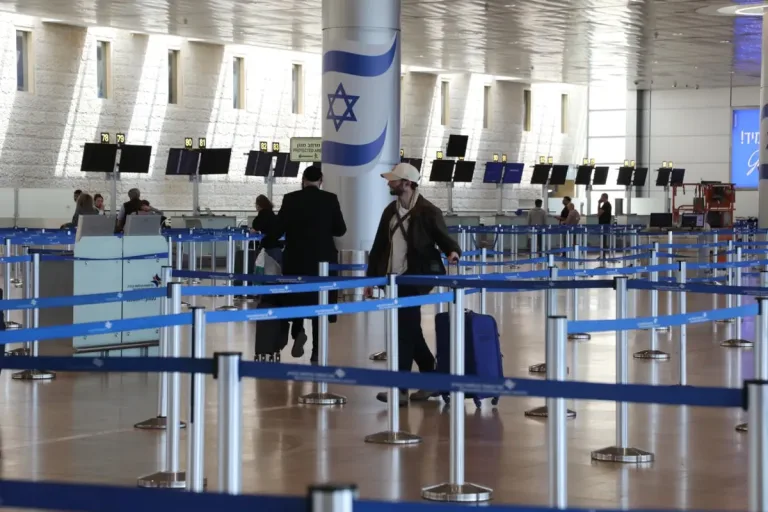
Jerusalem, 15 April, 2026 (TPS-IL) — Israel’s aviation sector was left dangerously unprepared for prolonged conflict, a major state audit released Tuesday found, with the government holding no effective emergency plan, no leverage over its own airlines, and no backup airport despite deciding to build one nearly three decades ago.
The report, produced by State Comptroller Matanyahu Engelman following an audit conducted between December 2024 and March 2025, examined how government bodies handled the collapse of Israeli aviation triggered by the October 7, 2023, Hamas attack and the June 2025 military campaign against Iran. The State Comptroller regularly reviews Israel’s preparedness and the effectiveness of government policies.
“In the [Gaza war] and [2025 war with Iran], it became clear that civil aviation was not properly prepared for a long-term war,” Englman said. “The missile fire from Iran and Lebanon [in 2026] illustrates once again that the state authorities must ensure that the aviation system operates properly even in emergencies.”
The report’s conclusion on the country’s aviation infrastructure was stark. “In the event of damage to Ben Gurion or increased rocket fire toward the area, Israel has no way out of the country,” the audit warned.
Israel has no practical overland exits, making Ben-Gurion International Airport near Tel Aviv the country’s near-exclusive global gateway. When Hamas launched its assault, most foreign airlines suspended flights due to combination of safety fears, potential legal liability, aviation logistics and crews refusing to fly to Israel. Passenger numbers at Ben Gurion collapsed from a projected 24 million in 2024 to just 13.9 million — a 44 percent shortfall — while flights fell from roughly 144,000 in 2023 to 102,000, according to the report.
Israeli carriers stepped in, but with demand far outstripping supply, prices soared. El Al, the country’s flag carrier, posted a record operating profit of $773 million in 2024 and a net profit of $545 million. Travel costs in Israel’s consumer price index rose 10 percent in 2023, 5 percent in 2024, and another 10 percent in just the first half of 2025. In February 2026, after the audit’s period, El Al was fined a record $39 million for wartime price gouging.
The audit found that Israel’s National Emergency Authority had no scenario for a prolonged war, and neither the Civil Aviation Authority nor the Ministry of Transport had prepared plans for one. Even after October 7, no such scenario was updated before the report’s close in March 2025. “There is no long-term war scenario in the reference scenarios,” the report stated, “and therefore the Ministry of Transport and the Civil Aviation Authority did not formulate a plan to cope with such a scenario.”
No Government Leverage
The government was also found to have no real leverage over Israeli airlines despite covering roughly 95 percent of their security costs and extending billions of dollars in loan guarantees. The state holds a so-called “golden share” in El Al — a special stake retained after the airline’s 2004 privatization — but the report found that this “does not give the state the ability to actually influence the functioning of the company, either in routine times or in emergencies,” such as ordering additional flights, setting ticket prices, or determining routes.
In addition, a “Vital Interests Order” that might have expedited the process of repatriating Israelis stranded abroad was never invoked. According to Englman, El Al voluntarily flew around 100 rescue flights in the first days of the war, but the government had no legal mechanism to require this.
The Iran campaign of June 2025 brought the failures into sharp focus. Israeli airspace was closed entirely for nearly two weeks. Tens of thousands of Israelis found themselves stranded abroad with no guidance from authorities. The Civil Aviation Authority and the Transport Ministry “did not proactively direct passengers on how to act,” the report found. Some Israelis hired boats from Cyprus or traveled overland through Jordan. A government decision formally assigning the Transport Ministry responsibility for coordinating returns came only five days into the operation.
Military reservists who received emergency call-up orders while abroad fared no better. When Hamas attacked in 2023, no protocol existed to prioritize their return. Soldiers “were forced to search for flights and pay high prices” to rush back to Israel, and the Foreign Ministry confirmed reservists reported paying inflated fares with no reimbursement.
The report also found that a plan to build a supplementary airport has been delayed for 28 years. “The State Comptroller views the conduct of state authorities, including the Ministry of Transport and the Planning Administration, with great severity,” it stated. No decision on a site had been reached.
Among its few positive findings, the audit praised the Civil Aviation Authority for maintaining round-the-clock telephone contact with foreign airlines throughout the crisis and deploying its director personally to engage aviation bodies worldwide.