
















‘Who Is a Jew’ Bill Fails Knesset Preliminary Vote
Israel's Knesset rejected the controversial "Who Is a Jew" bill in a 60-15 preliminary vote, blocking efforts to redefine Jewish registration and conversion.



Israel's Knesset rejected the controversial "Who Is a Jew" bill in a 60-15 preliminary vote, blocking efforts to redefine Jewish registration and conversion.
Knesset approves two bills for October 7 commemoration in first reading, designating 24 Tishrei as a memorial day and establishing a heritage authority.
Israel's Knesset rejected the controversial "Who Is a Jew" bill in a 60-15 preliminary vote, blocking efforts to redefine Jewish registration and conversion.
By Pesach Benson • January 14, 2026
Jerusalem, 14 January, 2026 (TPS-IL) — The Knesset on Wednesday rejected a controversial bill seeking to redefine who may be registered as Jewish in Israel’s population registry, dealing a blow to an initiative backed primarily by Orthodox (Haredi) lawmakers.
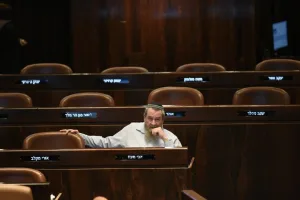
The proposal, known as the “Who is a Jew” bill and sponsored by MK Avi Maoz of the far-right Noam party, was defeated in a preliminary reading by a vote of 60 against and 15 in favor. Support for the bill came almost exclusively from the Haredi Shas and United Torah Judaism factions. Likud lawmakers voted against the measure, while members of the Religious Zionism and Otzma Yehudit parties were absent from the plenum.
The bill aimed to stipulate that registration as a Jew in official population records would be based solely on conversions recognized by Israel’s state rabbinical courts, effectively excluding Reform and Conservative conversions from recognition for civil registration purposes.
Maoz introduced the legislation in response to a 2021 High Court of Justice ruling that required the state to recognize non-Orthodox conversions performed in Israel for the purpose of immigration under the Law of Return. That law defines a Jew as someone “born to a Jewish mother or who converted, and is not a member of another religion.” The court ruled that the wording obligates the state to recognize non-Orthodox conversions as well.
Rather than amending the politically sensitive Law of Return, Maoz sought to bypass the ruling by changing the Population Registry Law. The bill also proposed restoring the nationality clause to Israeli identity cards.
Following the vote, Maoz criticized coalition partners who declined to support the measure, singling out National Security Minister Itamar Ben-Gvir. “Just a month ago, Ben-Gvir declared publicly, ‘We need to pass the Who is a Jew bill,’” Maoz said.
The Law of Return is an Israeli law giving any Jew the right to live in Israel and obtain Israeli citizenship. Unanimously passed by the Knesset in 1950, the law did not define who is a Jew for purposes of immigration.
In 1970, the last time the Law of Return was amended, the Knesset extended immigration rights to people with one Jewish grandparent. It also offered the same rights to the immigrant’s spouse and children, regardless of whether those individuals would be considered Jewish under religious law.
Israel's coalition pushes to repeal a key corruption law, 'fraud and breach of trust,' a central charge in PM Netanyahu's 2020 trial. Critics warn this move.
By Pesach Benson • January 12, 2026
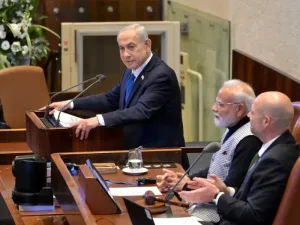
Jerusalem, 12 January, 2026 (TPS-IL) — Israel’s governing coalition on Monday introduced a bill that would abolish the criminal offense of “fraud and breach of trust,” a key charge in Prime Minister Benjamin Netanyahu’s ongoing corruption trial. The move has sparked fierce criticism from opposition parties, who say the legislation is designed to protect Netanyahu and undermine the rule of law.
The bill is expected to be considered by the Ministerial Committee for Legislation next week before moving to the Knesset for further debate.
Netanyahu, on trial since 2020, faces charges of bribery, fraud, and breach of trust in three high-profile cases, known as Cases 1000, 2000, and 4000. The legislation, if passed, would repeal Article 284 of Israel’s Penal Code, which has defined the offense since 1977.
Netanyahu faces charges of fraud, accepting bribes, and breach of trust stemming from three separate police investigations. He denies all wrongdoing.
In the case known as the “Bezeq Affair,” Netanyahu, while serving as communications minister, is accused of granting regulatory benefits to the Bezeq telecom giant. In return, Bezeq’s majority shareholder, Shaul Elovitch, allegedly provided Netanyahu with favorable coverage on the Walla news site, which he owned.
In the second investigation, known as the “Yediot Affair,” Netanyahu allegedly helped *Yediot Aharonot* publisher Arnon Mozes by advancing regulations on newspaper distribution to Mozes’s advantage. In exchange, Mozes is accused of offering Netanyahu favorable coverage.
In a separate investigation known as the “Gifts Affair,” Netanyahu and his wife Sara are accused of accepting $200,000 in gifts from Hollywood producer Arnon Milchan in exchange for assistance with a U.S. visa and changes to tax provisions benefiting Milchan. This case is widely regarded as the most serious one against Netanyahu.
In a joint statement, the bill’s sponsors — MKs Ofir Katz (Likud), Simcha Rothman (Religious Zionist Party), and Michel Buskila (New Hope) — described the offense as vague and prone to abuse. “This offense enables selective and biased enforcement,” the lawmakers said, arguing that it has been used to prosecute officials for conduct that is ethically questionable but not clearly criminal. They added that Israel already has laws covering bribery, money laundering, fraud, forgery, insider trading, and obstruction of justice, and the bill would introduce clearer criminal provisions, including conflicts of interest involving close relatives and misuse of government information. At the same time, the coalition said disciplinary and ethics enforcement would be strengthened.
Opposition leaders denounced the bill as an attack on democracy. “This is not a reform; it is a full-fledged coup that will turn Israel into a failed and backward third-world country,” said Yair Lapid, leader of Yesh Atid. He vowed to fight the bill “in the Knesset, in the streets, and in the courts.”
Yair Golan, head of the left-wing Democrats party, described it as “a truly mafia-like move by a government whose senior figures are evading justice.” He added, “The message to the public is clear: it is permissible to deceive and betray trust, as long as the seat of power remains secure.”
Civil society groups echoed the alarm. Tomer Naor, vice president for law and strategy at the Movement for Quality Government, said, “The offense of fraud and breach of trust is one of the strongest defenses we have for integrity in public life. Its abolition would leave sophisticated corruption effectively legal.”
Netanyahu made the unprecedented move of submitting an “extraordinary” pardon request to President Isaac Herzog in November.
No serving Israeli prime minister has ever been indicted on criminal charges. Ehud Olmert stepped down in 2008 ahead of his own indictment for corruption. Olmert was eventually convicted and served two-thirds of a 27-month prison sentence.
Israel's Knesset plenum debated a motion challenging the High Court's authority on amending Basic Laws. MK Avichai Boaron argued court orders are void without.
The Knesset plenum held a discussion on a motion for the agenda regarding “The court’s decision to issue an order nisi on amending a Basic Law was made without authority, and is void from its inception (void)” by MK Avichai Boaron.
MK Avichai Boaron: “This is a fundamental question. Who runs the State of Israel? Who leads it? Who received the authority to advance its affairs? Is it the sovereign people or the court? Does each branch operate within the scope of authority granted to it by law? Is there a limit to the judiciary in the State of Israel, or not?
An action without authority is void from its inception. This is a fundamental principle in every democratic regime. The Knesset is no longer an administrative authority. It is the legislative authority. There are directives, orders that we will not be able to uphold and execute, and it is fitting that the one sitting in the Supreme Court hear these words. In countless contemptible decisions, the High Court tramples the will of the people and the Knesset. There are judges in Jerusalem, but there are also legislators and a government in Jerusalem. The court is authorized to interpret Basic Laws, but not to nullify them. Disqualifying Basic Laws does not strengthen democracy, but rather undermines it.
The Knesset will not allow a situation where the court turns itself into a super-legislator. We are here to restore governability, and it doesn’t matter who controls this house – right or left. This is a motion for the rule of law and for the rule of the people.”
Minister of Justice, MK Yariv Levin: “This is an important and worthy motion for the agenda. The basis of any democracy is that no one holds all the powers, and no one is above the law, with oversight over everyone. There is a judiciary that is supposed to judge and decide on disputes and disagreements. It must do so within the framework of the law that the legislative branch establishes. We want three branches of government that have a balance between them. We want the court to deal with what it is authorized to do, and that certainly the Knesset’s legislation will be respected by everyone, including the judges.”
24 Members of Knesset supported raising the issue for the Knesset’s agenda and its transfer for discussion in the plenum. Two Members of Knesset opposed.
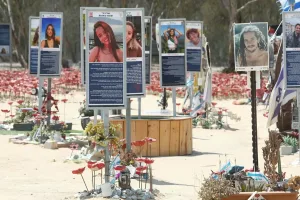
Israel's Knesset has approved a proposed law in its first reading to commemorate the events of October 7th, establishing a state memorial day and a.
approved in First Reading: Law to Commemorate the Events of October 7th
The Knesset plenum approved in its first reading the proposed law to commemorate the events of October 7th – Sukkot, 5786-2025. 18 Knesset members supported the proposal, with no opposing votes, and it will be transferred for discussion in the Education, Culture, and Sports Committee.
It is proposed to establish the 24th of Tishrei as the State Memorial Day for the events of October 7th – Sukkot. On this day, in accordance with the proposal in the law, state ceremonies will be held, the flag will be lowered to half-mast at state institutions, and a special discussion will be held in the Knesset.
It is further proposed to establish a Commemoration, Memory, and Heritage Authority for the events of October 7th, which will act to carry out commemoration activities and preserve national memory. Additionally, a commemoration site and museum will be established in the Western Negev region.
Finally, it is proposed that until the Authority is established, the Prime Minister’s Office will coordinate memory, documentation, and commemoration activities, and the minister responsible for implementing the law will be the Prime Minister.
The explanatory notes to the proposal state: “This law is based on the understanding that preserving memory, documentation, and developing heritage are essential for the rehabilitation and development of communities, and they carry significant weight in the rehabilitation of Israeli society. Commemoration and memory contribute to strengthening personal, community, regional, and national resilience, as well as strengthening national and international solidarity and cohesion, by creating a meaningful connection between the past and the future, connecting citizens to the shared national story, and enabling bereaved families to find a supportive community.”
Approved in First Reading: State Memorial Day to Commemorate the Events of October 7th; Additionally, a Memory and Commemoration Authority will be Established
The Knesset plenum approved in its first reading the proposed law for the commemoration of the massacre and the remembrance of heroism on the 22nd of Tishrei (Simchat Torah) – October 7th, 5785-2025, by MK Etty Attar and a group of Knesset members, to which a proposal by MK Naama Lazimi was attached. 18 Knesset members supported the proposal, with no opposing votes, and it will be returned for discussion in the Education, Culture, and Sports Committee.
It is proposed to establish a state memorial day for the massacre and heroism on the 24th of Tishrei in order to preserve the events of October 7th in the national consciousness for generations. This day will be marked, among other things, by a state memorial ceremony, a special discussion in the Knesset, and ceremonies and activities in educational institutions. According to the proposal, on this day the state flag will be lowered to half-mast and broadcast programs will reflect the special nature of the day.
Furthermore, it is proposed to establish a Memory Authority, which will be a statutory corporation, to fulfill the objectives of the proposed law. Its responsibilities will include: establishing and making accessible a central database to the public, operating a commemoration site, establishing a museum and archive, and holding cultural and memorial events.
The explanatory notes to the proposal state: “The purpose of the proposed law is to ensure for generations the memory of the events of October 7th, including the acts of massacre and terror and the abduction of civilians and security forces personnel, to honor and commemorate the memory of the fallen and the victims, to document the stories of the massacre survivors, and to commemorate the acts of heroism and the resilience shown by the people of Israel.”
Approved in First Reading: Temporary Order Stipulating that Legal Proceedings Concerning Security Prisoners Will Generally Be Conducted via Visual Conferencing
The Knesset plenum approved in its first reading the proposed law for conducting visual conferencing proceedings involving detainees, prisoners, and incarcerated individuals (Temporary Order), 5786-2025, by MK Tzvi Fogel. 11 Knesset members supported the proposal, with no opposing votes, and it will be returned for discussion in the constitution committee.
It is proposed to establish, as a temporary order for a period of four years, a regulation mandating that court proceedings concerning security prisoners be conducted via visual conferencing, based on a joint declaration by the Minister of Justice and the Minister of National Security regarding security restrictions due to the risk posed by the prisoners and their transportation. Exceptions for initial arrest hearings and the hearing of testimonies are stipulated within the framework of the regulation.
In addition, it is proposed to establish general arrangements for conducting court proceedings concerning detainees, prisoners, and incarcerated individuals via visual conferencing, in situations where the normal course of life in the country or a part thereof is disrupted due to the security situation, a genuine public health concern, or natural disasters, based on a declaration by the Minister of Justice. The extension of a declaration of security restriction or a full restriction will require the approval of the Constitution, Law, and Justice Committee.
The explanatory notes to the proposal state: “During the outbreak of the Coronavirus pandemic and throughout the Swords of Iron War, a system was implemented that allowed for visual conferencing proceedings for detainees and prisoners in a wide range of legal proceedings.
Due to the situation during the Swords of Iron War, emergency regulations were enacted for a short period, allowing for visual conferencing proceedings for detainees and prisoners. Subsequently, the law for conducting visual conferencing proceedings involving detainees and prisoners (Temporary Order – Swords of Iron) was enacted, until it was replaced by the law for conducting visual conferencing proceedings involving detainees, prisoners, and incarcerated individuals (Temporary Order – Swords of Iron), 5784-2023.
It is now proposed to re-enact the law, largely as it was before its expiration, for a period of four years, which can be extended by order, while disconnecting it from the state of war and the special situation that prevailed in the home front.”
Knesset approves two bills for October 7 commemoration in first reading, designating 24 Tishrei as a memorial day and establishing a heritage authority.
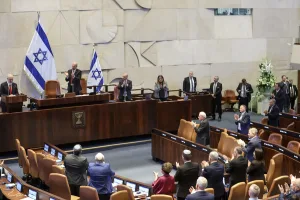
In its sitting on Wednesday, the Knesset Plenum voted to approve in first reading two bills for commemoration of the October 7 events.
The first bill approved in first reading was the Commemoration of the October 7 Events Bill, 2025. In the vote, 18 Members of Knesset supported the bill, without opposing votes, and it will be turned over to the Education, Culture and Sports Committee for deliberation.
It is proposed to designate the 24th of Tishrei as a national memorial day for marking the October 7 events. On this day, as proposed in the bill, state ceremonies will be held, the flag will be lowered to half-mast in state institutions and a special debate will be held by the Knesset.
It is further proposed to establish a commemoration, memorial and heritage authority for the October 7 events, which will work to carry out the actions for commemoration and preservation of the national memory. In addition, a commemoration site and a museum will be set up in the western Negev region.
It is further proposed that until creation of the authority, the Prime Minister’s Office will coordinate the memory, documentation and commemoration activities, and that the minister in charge of the bill’s implementation will be the Prime Minister.
The explanatory notes to the bill state: “This bill is based on the conception that preservation of memory, documentation and development of heritage are essential to the rehabilitation and development of the localities, and bear great weight in the rehabilitation of Israeli society. The commemoration and memory contribute to strengthening the personal, community, regional and national resilience, and to strengthening national and international solidarity and unity, by forging a meaningful bond between the past and the future, connecting the citizens to the shared national story and enabling the members of bereaved families to find a supportive community.”
Also approved in first reading was the Marking the Memory of the Massacre and Commemorating the Heroism of October 7 Bill, 2025, sponsored by MK Etty Hava Atia (Likud) and a group of MKs, to which a bill sponsored by MK Naama Lazimi (Labor) was attached. In the vote, 18 Members of Knesset supported the bill, without opposing votes, and it will be returned to the Education, Culture and Sports Committee for deliberation.
This bill proposes to establish a national memorial day on the 24th of Tishrei, in order to preserve the October 7 events in the national consciousness for generations. The day will be marked, among other things, by a state memorial ceremony, a special debate in the Knesset and ceremonies and activities in educational institutions. It is proposed that the national flag will be lowered to half-mast and that broadcast programming will express the special character of the day. It is also proposed to establish a memorial authority that will be a statutory corporation and will operate to fulfill the purposes of the bill.
The explanatory notes to the bill state: “The purpose of the bill is to ensure that the October 7 events will be remembered for generations, including the acts of massacre and terrorism and the kidnapping of civilians and members of the security forces; to honor and commemorate the fallen and those who were killed; to document the stories of the massacre’s survivors and the resilience displayed by the people of Israel.”
Former Jerusalem Mayor Uri Lupolianski, 74, died after a prolonged illness. He championed volunteerism, founding Israel's Yad Sarah, leaving a complex civic.
By Pesach Benson • January 8, 2026
Jerusalem, 8 January, 2026 (TPS-IL) — Former Jerusalem mayor and longtime Knesset member Uri Lupolianski, a prominent Israeli public figure whose career combined decades of civic service with a later corruption conviction, died Wednesday night at the age of 74 after a prolonged illness. Lupolianski, who led Israel’s capital from 2003-2008, founded one of Israel’s largest volunteer-based social aid efforts.
He will be buried Thursday morning in Jerusalem.
Born in 1951 in the northern Israeli city of Haifa, Lupolianski was married and is survived by his wife and 12 children. He served as a military medic in his youth, an experience that would later influence his focus on health and social welfare. In 1976, after encountering difficulties obtaining medical equipment for a family member, he launched a small volunteer initiative to help people in need access essential devices.
That initiative eventually grew into Yad Sarah, a nationwide nonprofit organization that lends medical and mobility equipment to the elderly, people with disabilities, and those suffering from serious illness. Today, the organization operates dozens of branches across Israel and relies on thousands of volunteers, becoming a familiar presence in hospitals and homes across the country. The organization is named after his Polish grandmother, who perished in the Holocaust.
Lupolianski’s contribution to Israeli society through volunteerism earned him widespread recognition. Over the years, he received numerous awards, including the Israel Prize, the President’s Award for Volunteerism, the Knesset Speaker’s Award, and other honors from civic and social organizations. The Israel Prize, one of the country’s highest distinctions, was awarded to Yad Sarah in 1994, with Lupolianski accepting the honor on the organization’s behalf.
Parallel to his social work, Lupolianski built a long career in municipal politics. He entered public life in 1989, when he was elected to the Jerusalem City Council as a representative of Degel HaTorah, an Orthodox (Haredi) political party. He went on to serve in a series of senior municipal roles, including deputy mayor, acting mayor, chairman of the city’s planning and building committee, and head of family and community services.
In 2003, Lupolianski was elected mayor of Jerusalem, becoming the first Haredi leader to hold the post. His election was widely seen as a landmark moment for the integration of Haredi politicians into senior levels of public administration. He served one term and chose not to seek reelection in 2008.
Lupolianski’s public image was later damaged by his involvement in the Holyland affair, a major corruption case centered on a large real estate development project in Jerusalem. In 2014, he was convicted of accepting bribes after funds from a state witness were transferred to Yad Sarah. He was initially sentenced to six years in prison and fined NIS 500,000 ($157,000), but due to serious medical conditions, Israel’s Supreme Court reduced his sentence to six months of community service.
Following his death, Israeli leaders from across the political spectrum issued statements of condolence. President Isaac Herzog described Lupolianski as a “man of the people,” saying that his life’s work “became a global model for volunteerism.”
The Prime Minister’s Office said Lupolianski “embodied the spirit of Jerusalem” and was a pioneer in integrating the Haredi community into senior public service, adding that his life showed one could “maintain deep religious devotion while serving the entire public.”
Yad Sarah said in a statement, “We are stunned and heartbroken over the passing of our revered leader, the pillar of kindness,” adding, “Woe to the ship that has lost its captain.”
Knesset member Uri Maklev of United Torah Judaism said, “The world of kindness has today lost its greatest architect,” praising Lupolianski’s lifelong commitment to helping others with “warmth, integrity, and sensitivity.”
The Knesset committee examines the growing use of medical cannabis among Israeli soldiers with PTSD after two years of war. A veteran shares his powerful.
By Pesach Benson • January 7, 2026
Jerusalem, 7 January, 2026 (TPS-IL) — The Knesset’s Special Committee for Combating Drug and Alcohol Abuse met on Wednesday to address the rising use of addictive substances among soldiers suffering from post-traumatic stress disorder (PTSD) during two years of war. The discussion, chaired by MK Ariel Kellner (Likud), focused on treatment options, Rehabilitation, and the growing reliance on medical cannabis among disabled soldiers.
Tzuriel Friedman, a disabled soldier and CEO and founder of the Grow Like Victors association, shared with lawmakers his account of struggling with PTSD and thoughts of suicide.
“I had five suicide attempts, one of them by hanging,” Friedman said. “I was saved only because the rope broke. I was clinically dead. I was addicted to pills. Today, I am treated with cannabis, and I have a family, a career, and an association that helps other soldiers.” Friedman described how his organization supports soldiers and civilians dealing with addiction to alcohol, drugs, and medications, helping them regain a sense of purpose through sports, physical activity, and community integration. He urged lawmakers to recognize these soldiers as their own children and called for immediate action to strengthen rehabilitation and mental health support.
Dr. Mordechai Lobotsky, deputy chief physician at the Ministry of Defense, presented statistics highlighting a surge in medical cannabis use among disabled soldiers.
“Since the outbreak of the war, the number of IDF disabled personnel treated with medical cannabis for PTSD has increased by 140%,” Lobotsky said. Currently, approximately 6,000 soldiers receive funding for medical cannabis, with about 3,500 new patients added over the past two years. Lobotsky emphasized that the Rehabilitation Division primarily funds treatment but lacks the resources for comprehensive therapy.
PTSD is a mental health condition triggered by experiencing or witnessing a terrifying event. Symptoms include flashbacks, nightmares, severe anxiety, and uncontrollable thoughts. People with PTSD often avoid reminders of the trauma and may experience negative changes in beliefs and feelings. The condition is typically managed with therapy and medication.
In two years of war, more than 3,700 Israeli soldiers have been diagnosed with PTSD, while another 9,000 have applied for recognition.
During the discussion, some lawmakers expressed concerns about the reliance on cannabis for treatment. MK Akram Mahson (New Hope) questioned whether medical cannabis is the appropriate response, citing the potential involvement of senior officials in the industry.
Kellner stressed the importance of a holistic, national approach. “This is our commitment as a country, as a society, and as a Knesset. The fight against mental trauma is no less important than the fight on the battlefield. We need mental strength, social solidarity, and mutual guarantee,” he said, pledging continued cooperation with government officials to expand support for PTSD patients.
Medical cannabis is legal in Israel and regulated by the Health Ministry, allowing patients with approved conditions to receive cannabis-based treatment under medical supervision.
Israel's Knesset approved a bill in preliminary reading to bypass competitive procedures for appointing the Civil Service Commissioner, restoring government.
In its sitting on Wednesday, the Knesset Plenum voted to approve in preliminary reading the civil service Bill (Appointments) (Amendment—Appointing Commissioner and Assigning a Temporary Post), 2025, sponsored by MKs Amit Halevi and Ofir Katz (Likud). In the vote, 60 Members of Knesset supported the bill, versus 46 opposing votes, and it will be turned over to the House Committee to determine the committee in which the bill will be deliberated.
It is proposed to stipulate that the appointment of the Civil Service Commissioner will not require holding a tender or any other competitive procedure. It is further proposed to establish provisions on the appointment of a substitute Civil Service Commissioner.
The explanatory notes to the bill state: “The proposed amendment is designed to restore the power to the appointing authority—the Government—in accordance with the original will of the legislator, and to rectify the change created by the [court] ruling. The purpose of the amendment is to clarify unequivocally that the appointment of the Civil Service Commission does not require holding a tender or any other competitive procedure, similarly to other senior posts for which there is no competitive requirement—such as the Israel Police commissioner, the Israel Security Agency (Shin Bet) director, the Governor of the Bank of Israel, directors general of government ministries and more.”
Prime Minister Netanyahu personally met the family of Haymanut Kasau, missing since February 2024, vowing to bring her home. Knesset Member Tsega Melaku also.
Prime Minister Benjamin Netanyahu, this evening, at his Knesset office, met with the family of the child Haymanut Kasau, who has been missing since February 2024.
Prime Minister Netanyahu told the members of her family: “I will personally get involved in the matter. We will bring her back.”
Knesset Member Tsega Melaku also attended the meeting.
Opposition Leader MK Yair Lapid warns Israel's cost of living crisis is causing a generation to despair, leading to peak negative migration as citizens lose.
In its sitting on Monday, the Knesset Plenum held a debate with the participation of the Prime Minister, at the request of 40 Members of Knesset, on the topic of “An extreme Government that acts against the Zionist majority and harms national unity and the basic values of the State of Israel.”
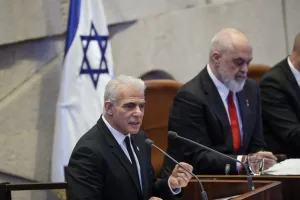
During the debate, Leader of the Opposition MK Yair Lapid (Yesh Atid) said, “I ask Israel’s citizens—do you live better or worse than three years ago? What is the state of your bank account? Is your life more costly or less? What about your children’s education, is it better or worse?
“All that is before I have mentioned October 7, the most terrible event that has happened to this country, and it too happened over the past three years. And that is before I have mentioned the fact that while our heroic combatants are being killed and injured every day, your Government is advancing a disgraceful and shameful draft-dodging bill, which will also not pass. We are in an election year, so that is what we will go to elections over, what is happening in the life of real people.
“I remind you that things can be different. During [the term of] our Government, we lowered the percentage of violent crime dramatically, the protection racketeering, the murders, the sexual offenses, the violence. These are not opinions, these are facts. People felt safe to leave the house. We didn’t perform any miracles. We worked at it in a thorough, orderly and quiet manner. All the professional officials would come to me, to the Prime Minister’s Office, to report to me personally on their progress.
“The cost of living is causing the collapse of an entire generation of Israelis. They have understood that no one is really going to deal with this. Your Government continues to transfer NIS 60 billion every year to draft-dodgers, and continues to maintain ministries that are completely unnecessary. It continues to transfer coalition funds here at night as if there were no tomorrow.
“Something else happened while you weren’t here. Your Minister of Finance said that the President of the Supreme Court should be trampled. You got up here recently and said that you recognized the fact that [Justice] Isaac Amit was President of the Supreme Court. I appreciated that. How is it that we have not heard a word of condemnation from you? I stood here time after time and said that I was adamantly opposed to any incitement against the Prime Minister and his family. How are you keeping silent?
“The data from the Central Bureau of Statistics (CBS) has been released, and it has become apparent that for two years there has been a peak of negative migration from Israel; 69,300 Israeli citizens have left Israel this year. Over the past three years, 200,000 have left. Last year, 875 physicians left Israel, and 3,000 engineers left the country. According to the CBS, that is the profile of those who are leaving: Young people, educated, working, who pay taxes and serve in reserves. The backbone of this country. The people who keep it alive.
“They are leaving in hundreds of thousands, an entire emigration movement, because they feel they have been forsaken by a Government that hates them, does not appreciate their sacrifice, is indifferent to their difficulty, is contemptuous of their values. I think, of course, that they are wrong; I think that we must not give up.
“Israel is a cause that is worth fighting for. Not only do I love this country, I also believe in it. It has been and remains the best country in the world to raise children. That is the tragedy. They don’t hate the country, they have despaired. They looked at your Government, Mr. [Prime Minister], and stopped believing in the State of Israel’s future. Don’t you think that is a problem?
“Bereaved families are shattered when they see how an attempt is being made to give the Haredim an exemption from bereavement. Maya Ohana Moreno, widow of Israeli hero Emmanuel Moreno, came to the foreign affairs and Defense committee and told about her orphaned children, who insisted on becoming combat soldiers. The answer she got was when [MK Yitshak] Goldknop (United Torah Judaism) came to the meeting especially to say that telling the Haredim to enlist is like putting a yellow badge on them. My father had a yellow badge in the ghetto. Then he made Aliyah and enlisted in the Jewish army so that it would not happen again.
“Three years ago, I was Prime Minister. Life was better. I stood here and said to you, ‘I am handing over to you a country in excellent condition,’ because that’s what we were. A country in excellent condition. Strong, safe, Hamas knew that it could not cross the fence, the world was in favor of us, the economy was excellent. We managed this country much better than you. More quietly, many fewer dead and injured, much more efficiently. That is what we know how to do. Instead of whining about the deep state and the court, we know how to work and to manage a country for the benefit of its citizens.
“We will come and propose a new dawn for the State of Israel. We will propose the possibility that we will not define ourselves by the quarrels among us. We will propose the possibility that unity is not when everyone thinks the same; unity is mutual respect. That basic thing, when you are capable of listening to people who think differently from you.
“We know how to lower crime, to lower the cost of living, to lower the noise and the toxicity that surround our lives. We know how to take NIS 60 billion from the draft-dodgers and to transfer them to education, healthcare and policing. We know how to make the world go back to loving the State of Israel. Without having Palestinian flags greet our young people when they take their post-army trips.
“We know how to make a judicial reform. A judicial reform needs to be made, I have always thought so, but it must be done with moderation, cautiously, to repair and not to destroy. With us, the reform will end in a constitution, not a civil war. We know how to manage security. Security is managed when it can be taken for granted. When the citizens don’t think about it. They know that the Government will respond to any threat swiftly, with force and without hesitation. Unlike you, we know how to run a country, and we don’t think only about ourselves, but about all of Israel’s citizens,” said Leader of the Opposition MK Lapid.