














Israel Boosts Readiness Following Assassination of Hezbollah’s Top Commander
Israel heightens defenses in response to Hezbollah's military chief assassination, fearing retaliation. IDF braces for potential rocket barrages and


Israel heightens defenses in response to Hezbollah's military chief assassination, fearing retaliation. IDF braces for potential rocket barrages and
Israel confirms killing key Hamas supply chief in Gaza airstrike, escalating tensions in the region. IDF takes action against terrorism.
Israel heightens defenses in response to Hezbollah's military chief assassination, fearing retaliation. IDF braces for potential rocket barrages and
By Pesach Benson • November 24, 2025
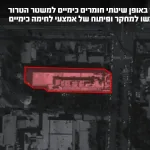
Jerusalem, 24 November, 2025 (TPS-IL) — Israel is reinforcing its defenses in the north amid expectations that Hezbollah may attempt to retaliate for Sunday’s assassination of Haytham Ali Tabatabai, the Lebanese group’s military chief of staff. Security officials say Hezbollah could seek to answer the strike with rocket barrages on Israeli communities, cross-border raids into Israel or against IDF positions in southern Lebanon, or by directing the Houthis to carry out attacks on Israel. At the same time, some in the defense establishment believe Hezbollah’s current weakened state may lead it to refrain from responding.
The decision comes as the IDF continues preparations for what it describes as a “weakening round” against Hezbollah, including further “enforcement strikes” in Lebanon aimed at disrupting the organization’s military buildup. Israeli prime minister Benjamin Netanyahu addressed the nation Sunday evening, framing Tabataba’i’s killing as a major achievement in Israel’s ongoing effort to prevent Hezbollah from restoring its capabilities.
“A few hours ago, the IDF eliminated Haytham Ali Tabatabai, the chief of staff of the Hezbollah terror organization,” Netanyahu said. “Tabatabai was a mass murderer. His hands were full of the blood of many Israelis and Americans; it is not for no reason that the United States offered a five-million-dollar prize for his head. Tabataba’i served as a senior commander in the Radwan Force. This is the force that planned to conquer the Galilee and slaughter many of our citizens.”
Netanyahu said Tabatabai had recently been overseeing Hezbollah’s renewed rearmament efforts following the “heavy blows” the group suffered in previous Israeli operations, including the Pager Operation and the elimination of its longtime leader, Hassan Nasrallah. “I thank the IDF and the security forces who conducted a professional, precise, and successful operation today,” he said, adding that Israel’s policy under his leadership “is absolutely clear: Under my leadership, the State of Israel will not allow Hezbollah to rebuild its power, and we will not allow it to pose a threat to the State of Israel again.”
Netanyahu called on Lebanon’s government to uphold its commitments to disarm Hezbollah. “Only in this way can a better future be made possible for every citizen in Lebanon, and only in this way can good and secure neighborly relations be established between Israel and Lebanon,” he said.
In the same address, the Prime Minister also welcomed an American policy decision. “On this occasion, I also want to commend President Trump on his decision to outlaw and designate the ‘Muslim Brotherhood’ organization as a terrorist organization. This is an organization that endangers stability throughout the Middle East and also beyond the Middle East. Therefore, the State of Israel has already outlawed part of the organization, and we are working to complete this action soon.”
Tabatabai, long one of the most senior commanders in Hezbollah’s hierarchy, was designated an international terrorist in 2016. U.S. officials noted at the time that “his actions are part of a major effort to cause instability in the region.” He directed Hezbollah’s special forces in Syria and Yemen, where he coordinated operations with pro-Iranian militias and provided assistance to the Houthis. Israel says he joined Hezbollah in the 1980s and rose through several senior roles, including in the elite Radwan Force. During the recent war, Tabatabai led Hezbollah’s operations division and advanced further as other commanders were eliminated. After the ceasefire, he became Hezbollah’s chief of staff and “worked extensively to restore their readiness for war with Israel,” the IDF said.
On Monday, the IDF conducted what it described as a scheduled training exercise in the Eastern Galilee. The military warned residents to expect visible movement of troops and vehicles, stressing that “there is no fear of a security incident. In the event of a real incident, the residents will be informed by the security forces.” The drill is part of the IDF’s annual 2025 training schedule.
Israel has stepped up its strikes on Hezbollah as the Iran-backed terror group tries to regroup and rebuild.
Under the terms of the ceasefire that went into effect on November 27, 2024, Hezbollah is required to withdraw its armed forces from southern Lebanon. According to UN Security Council Resolution 1701, which ended the 2006 Second Lebanon War, the group is prohibited from operating south of the Litani River.
Israeli airstrike targets Hezbollah’s number two man in Beirut, escalating tensions in the region as Prime Minister Netanyahu takes action against the
By Pesach Benson • November 23, 2025
Jerusalem, 23 november, 2025 (TPS-IL) — An Israeli airstrike in Beirut on targeted Hezbollah senior commander and number two man Haytham Ali Tabatabai, Prime Minister Benjamin Netanyahu’s office confirmed.
Tabatabai is considered Hezbollah’s de facto chief of staff and the group’s second-most senior figure after secretary general Naim Qassem.
It wasn’t clear if Tabatabai survived the strike.
The U.S. previously offered a $5 million reward for information on Tabatabai, who previously led the terror group’s special forces in Syria and Yemen.
Israel has stepped up its strikes on Hezbollah as the Iran-backed terror group tries to regroup and rebuild.
Under the terms of the ceasefire that went into effect on November 27, 2024, Hezbollah is required to withdraw its armed forces from southern Lebanon. According to UN Security Council Resolution 1701, which ended the 2006 Second Lebanon War, the group is prohibited from operating south of the Litani River.
India and Israel strengthen strategic partnership with Minister Goyal's visit, boosting investments and innovation. Talks resume for Free Trade Agreement.
By Pesach Benson • November 23, 2025
Jerusalem, 23 November, 2025 (TPS-IL) — India’s Minister of commerce and Industry Piyush Goyal concluded a three-day visit to Israel on Sunday with meetings with both Prime Minister Benjamin Netanyahu and President Isaac Herzog.
“Israel and India are strengthening our strategic partnership, more investments, more innovation, and a strong economic corridor from India through Israel to Europe. Together we are building economic power,” Netanyahu tweeted afterwards.
Goyal briefed Netanyahu on the outcomes of the India-Israel Business Forum and CEOs Forum, which brought more than 60 Indian business leaders to Israel. The two also discussed negotiations for a Free Trade Agreement, which were officially resumed on Thursday with the signing of a Memorandum of Understanding (MOU).
Earlier, Goyal met President Isaac Herzog, who welcomed the progress toward a deeper economic relationship. “I’m especially happy that you’re here to sign an MOU… the sky’s the limit. We have to work hard on it, but I think we are like-minded in so many things,” Herzog told Goyal. He added: “The impact of India and the affection towards India in Israel is outstanding… I think the relations are excellent, but we can even upgrade them more.”
During the meeting, Goyal conveyed “the warm greetings of the people of India” and highlighted the strong outcomes from the Business Forum and CEOs Forum, describing them as the “first big step” toward FTA talks. He emphasized India’s “robust growth story” and expanding opportunities for Israeli companies in innovation, technology, manufacturing, agriculture, and investment.
Goyal led a delegation of around 100 representatives from nearly 70 Indian companies, India’s largest ever trade delegation to Israel.
India, the world’s fifth-largest economy with a population of roughly 1.4 billion, is a strategic destination for Israeli exports. Exports of Israeli goods and services to India reached about $3.1 billion in 2024, growing 56% over four years despite regional conflicts. A free trade agreement is expected to reduce high tariffs and trade barriers while also addressing digital trade, services, intellectual property, government procurement, and other areas essential for deepening cooperation.
On Friday, Goyal met Agriculture and Food Security Minister Avi Dichter, who outlined Israel’s 25-year food-security roadmap, its advanced seed-improvement capabilities, and world-leading water-reuse technologies. A day earlier, Goyal met his Israeli counterpart, Nir Barkat, to review trade flows and identify new areas of collaboration. Goyal later posted that their discussions covered “the full spectrum of our strategic partnership… and the first big step towards FTA negotiations.”
Both countries reaffirmed their commitment to advancing FTA negotiations and accelerating cooperation in investment, technology, and industrial innovation. Bilateral trade, which stood at $200 million in 1992, reached a peak of $10.7 billion in 2022-23 (excluding defence).
Since the outbreak of the October 7 war, Israeli-Indian trade declined as airlines cut back on flights to Tel Aviv and Iran-backed Houthis in Yemen disrupted international shipping in the Red Sea.
Israel and India signed a bilateral investment agreement in September, which Israeli officials hailed as the first of its kind between India and a Western-oriented member of the Organisation for Economic Co-operation and Development (OECD).
Israel’s military chief to impose sanctions on officers involved in October 7 failures, targeting senior commanders and subordinates. IDF to release official
By Pesach Benson • November 23, 2025
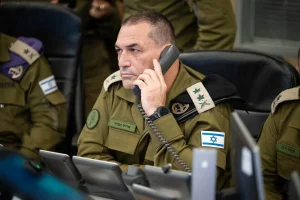
Jerusalem, 23 November, 2025 (TPS-IL) — Israel’s military chief will begin imposing personal sanctions and take command measures against officers involved in the failures of Hamas’ attack on October 7, 2023.
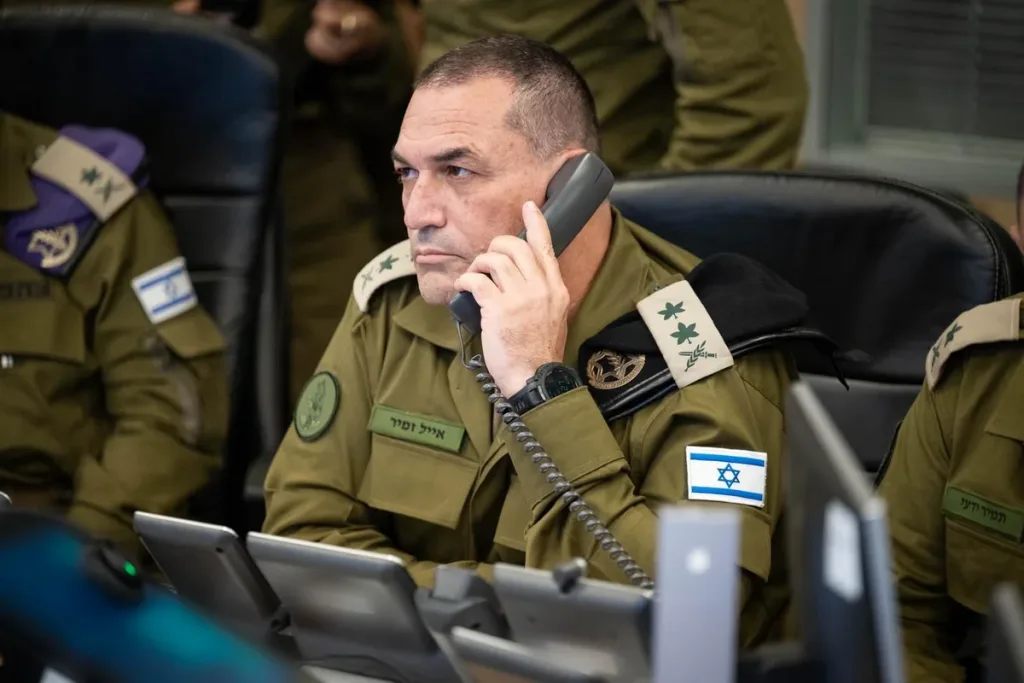
Chief of Staff Lt. Gen. Eyal Zamir originally intended to make these decisions earlier but delayed them due to ongoing operational developments. The sanctions will primarily target senior commanders considered responsible, as well as subordinate officers who held command responsibilities that day. Some of those subject to the sanctions have already retired, while others remain in active service. The Israel Defense Forces has not disclosed names or details of the measures.
Earlier this month, Zamir stated he would take “personal decisions” regarding senior officers based on findings from an external panel of experts appointed to review the October 7 probe. The initial investigations had been led by former IDF Chief of Staff Herzi Halevi. Upon assuming his role in March, Zamir established the external panel to reassess those investigations, which concluded that most were inadequate and some wholly unacceptable.
Zamir is scheduled to conclude meetings with the relevant officers by Sunday evening, after which the IDF will release an official statement detailing the sanctions. In parallel, similar discussions are taking place among lower-ranking officers.
The IDF has released a series of detailed internal probes examining how roughly 5,000 terrorists from Hamas and Palestinian Islamic Jihad were able to storm Israeli communities and overrun military positions. The reports reveal that the army’s chain of command collapsed amid the chaos, as soldiers found themselves vastly outnumbered.
However, an independent review of the investigations by a panel of retired military officers led by Maj. Gen. Sami Turgeman found flaws in many of the 25 different reports.
“The surprise of October 7 did not emerge from a vacuum,” said the Turgeman report, which was released on November 11. “Direct intelligence had accumulated which, if professionally analyzed, could and should have led to an alert and a significant operational response.” The report highlighted six major causes of the disaster: a conceptual failure in understanding Hamas’ intentions, intelligence shortcomings, neglect of long-standing defense plans, flawed organizational culture, persistent gaps between assessed threats and operational readiness, and deficient decision-making during the attack.
The review also identified systemic problems that had persisted for years. Warnings from senior IDF officials in 2023 suggested that Israel’s perceived internal divisions could embolden enemies, yet the army did not adjust alert levels or force deployments. Longstanding intelligence reports, known internally as the “Jericho Wall” plan, detailing Hamas’s preparations, were dismissed as unrealistic. The panel also found gaps in coordination between the IDF, police, Israel Security Agency (Shin Bet), and other government agencies.
Zamir’s predecessor, Lt. Gen. Herzi Halevi, stepped down from the position in January.
The sanctions will likely fuel further calls for a state commission of inquiry into the government’s handling of the attack. The army’s investigations did not include decisions made by the political echelon. Netanyahu has resisted calls for a formal state commission of inquiry, calling it “politically biased.” Critics accuse him of delaying and weakening the probe. Such commissions, led by senior Supreme Court justices, can summon witnesses, collect evidence, and make recommendations, though the government is not required to follow them.
Israel’s last commission, investigating a Mount Meron stampede that killed 45, held Netanyahu personally responsible in 2024.
Around 1,200 people were killed, and 252 Israelis and foreigners were taken captive by Hamas during the October 7, 2023, attack on southern Israel. The bodies of three Israelis and one Thai national are still held in Gaza.
Israel confirms killing key Hamas supply chief in Gaza airstrike, escalating tensions in the region. IDF takes action against terrorism.

By Ehud Amiton/TPS • November 23, 2025
Jerusalem, 23 November, 2025 (TPS-IL) — The Israel Defense Forces confirmed on Sunday that it killed Alaa Hadidi, head of Hamas’s supply and equipment department, in an airstrike in Gaza on Saturday.
“Hadidi was a central knowledge center in the organization’s supply and production field and served during the war as a conduit for transferring weapons from Hamas headquarters to battalions and commanders in the field for fighting against our forces,” the IDF said.
The escalation followed a Hamas threat to end the ceasefire, triggered by a Palestinian gunman opening fire on Israeli troops in southern Gaza. Prime Minister Benjamin Netanyahu’s Office confirmed that five senior Hamas officials were killed in the subsequent airstrikes, a move a US official said the Trump administration supports.
“The IDF will not tolerate attacks on our forces, and we will continue to target those responsible for terrorism,” an Israeli military spokesperson said.
The incident began Saturday morning when a gunman crossed the Yellow Line—the border dividing Israeli and Hamas-controlled Gaza—approaching IDF troops in a vehicle while using the humanitarian corridor. Soldiers returned fire, killing the operative. “He aimed his weapon at our soldiers, endangering civilians in the area,” the IDF stated, releasing footage of the confrontation.
Following the initial attack, Israeli warplanes struck multiple Hamas positions across Gaza. The identities of the four other senior Hamas officials killed alongside Hadidi have not been publicly disclosed. “These strikes disrupt Hamas’s ability to arm its fighters and threaten Israeli communities,” Netanyahu said in a statement.
In a related development, the IDF announced that it neutralized all 17 Palestinian terrorists who had attempted to escape from a Hamas tunnel on Israeli-controlled land in eastern Rafah. They had emerged Friday from underground hideouts and sought to return to the Hamas side of the Yellow Line.
“After a 24-hour operation, all infiltrators were either killed or captured,” the IDF said.
Around 1,200 people were killed and 252 Israelis and foreigners were taken captive by Hamas during the October 7, 2023, attack on southern Israel. The bodies of two Israelis and one Thai national are still held in Gaza.
Israel and India resume free trade talks, creating huge opportunities for exporters and industrialists. Strategic economic partnership strengthens Israeli
By Pesach Benson • november 20, 2025
Jerusalem, 20 November, 2025 (TPS-IL) — Israel and India officially resumed negotiations on a free trade agreement on Thursday. The move comes as Indian Commerce and Industry Minister Piyush Goyal arrived in Israel with a delegation of around 100 representatives from nearly 70 Indian companies.
“Today we are opening a new page in trade relations between Israel and India,” said Israeli Economy and Industry Minister Nir Barkat. “The official renewal of talks on a free trade agreement is a strategic achievement that strengthens the Israeli economy and creates huge opportunities for our exporters and industrialists. India is an economic powerhouse with tremendous potential for cooperation, and the personal and direct connection that has been built between the countries allows us to promote agreements that will generate growth, innovation, and jobs for Israelis.”
Goyal, on his first visit to Israel, stressed the opportunities of bilateral trade. “This is a match made in heaven that has touched the ground – India for Israel and Israel for India. Together with the investment agreement that has already been signed, we will open the markets together for the movement of goods, services, and investments. We strive for and will reach an agreement that is balanced, broad, and good for both sides.”
India, the world’s fifth-largest economy with a population of roughly 1.4 billion, is a strategic destination for Israeli exports. Exports of Israeli goods and services to India reached about $3.1 billion in 2024, growing 56% over four years despite regional conflicts. A free trade agreement is expected to reduce high tariffs and trade barriers while also addressing digital trade, services, intellectual property, government procurement, and other areas essential for deepening cooperation.
“India offers an investor-friendly and predictable atmosphere to do business. It offers huge opportunities for businesses of both sides,” Goyal said at the India-Israel Business Summit in Tel Aviv. He highlighted the ten “Ds” that make India an attractive investment hub, including democracy, demographic dividend, digitalisation, development, and decisive leadership.
Barkat called India a “great bet” for investment, describing it as “a giant waking up… huge size, huge growth. India is the biggest country, the world’s fifth-largest economy, and soon to be the third-largest. It is a great bet for us. I am telling everyone to hedge on India.” He highlighted opportunities for Indian infrastructure companies in Israel and praised initiatives like the India-Middle East-Europe Economic Corridor (IMEC) for expanding connectivity and trade.
Barkat added, “We went through very challenging two years—a terrible war that exposed the monsters around us… But everyone understands we dismantled them. Despite that, India remains central to Israel’s strategic economic outlook. India is a great bet for us, and we want to be the best partner for India.”
Israel and India signed a bilateral investment agreement in September, which Israeli officials hailed as the first of its kind between India and a Western-oriented member of the Organisation for Economic Co-operation and Development (OECD).
Israel strengthens air defenses with $8.7 billion U.S.-backed Iron Dome expansion. Defense Ministry announces major contract with Rafael Advanced Defense
By Pesach Benson • November 20, 2025
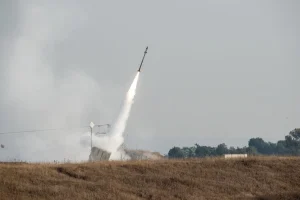
Jerusalem, 20 November, 2025 (TPS-IL) — Israel signed a multi-billion-dollar contract with defense contractor Rafael Advanced Defense Systems to expand serial production of the Iron Dome missile defense system, the Defense Ministry announced on Thursday.
The funding comes from an $8.7 billion U.S. aid package approved by Congress in April 2024, with $5.2 billion specifically earmarked to strengthen Israel’s air defense systems.
The Iron Dome system, developed in Israel and manufactured in collaboration with the U.S. government, provides defense against short- and medium-range rocket and missile threats, as well as UAV threats. Throughout the recent war, the system has exhibited outstanding performance with remarkable interception rates, delivering crucial protection to Israel’s home front against missile, rocket, UAV, and cruise missile attacks. Featuring cutting-edge technologies, Iron Dome ranks among the world’s most sophisticated air defense systems. Rafael is the system’s lead contractor.
“The Iron Dome system has become one of the world’s finest air defense systems in history. Over the years, and particularly during recent military operations, Iron Dome has protected our nation’s skies and successfully intercepted thousands of threats from Gaza, Lebanon, and other theaters — serving as a protective shield for Israeli citizens,” Defense Minister Israel Katz said.
Stressing the U.S. partnership in Iron Dome’s research and development, Katz added, “Together, we will continue developing and enhancing the world’s most advanced air defense systems — ensuring the security of our state and Israel’s strategic superiority for decades to come.”
Iron Dome is the best-known system in Israel’s multi-tiered air defense network. Romania became the first European buyer of an Israeli Iron Dome with a €2 billion ($2.3 billion) deal signed in May.
Other layers include David’s Sling, designed to shoot down medium-range threats at high altitudes, and the C-Dome system, designed to protect naval assets from short-range threats. C-Dome made its first operational intercept in April 2024.
The Arrow-3 system, which is designed to intercept ballistic missiles, had its first operational success when it shot down a ballistic missile fired by Iran-backed Houthi rebels in Yemen in November 2023. It is widely believed to be the first time a missile was intercepted in outer space, though Israeli officials have not confirmed this.
Israel also became the first country to deploy a laser-based air defense system, the Iron Beam, which intercepted scores of active enemy threats in May.
International demand for Israel’s military technology has surged as European countries increased their defense budgets in response to Russia’s war in Ukraine. Israel set a new all-time record for defense exports in 2024, with sales reaching $14.79 billion.
Israel begins expropriating land near ancient Biblical capital of Sebastia for preservation and development, citing neglect by landowners and Palestinian

By Pesach Benson • November 20, 2025
Jerusalem, 20 November, 2025 (TPS-IL) — Israel has begun expropriating land near the ancient Biblical capital of Sebastia for the “preservation and development” of the archaeological site, the Defense Ministry’s Civil Administration announced on Thursday.
The move is in response to “intentional neglect by the landowners and the Palestinian authorities,” the Civil Administration said.
The Civil Administration stressed that 1,800 dunams (445 acres) of land are located in Area C of Samaria, where Israel has both administrative and security jurisdiction.
The move aims to allow “infrastructure development, the expansion of archaeological excavations, and the uncovering of additional historical findings,” the Civil Administration said. “This is being done in accordance with the law, and as part of a broad project led by the ministry of Heritage, which includes an investment of roughly NIS 32 million [$9.8 million] to upgrade the site, improve visitor access, and develop the archaeological area.”
The park borders the Palestinian village of Sebastia in Area B, where the Palestinian Authority manages civilian affairs. No village land will be appropriated.
Sebastia was the capital of the Israelite Kingdom during the reigns of Omri and Ahab. Israeli archaeologists resumed excavations at Sebastia in May, the first digging in decades.
Archaeological excavations were held at the site in the early 1900s and then in the 1930s. Jordan initiated smaller excavations in 1967 before the outbreak of the Six-Day War.
The Civil Administration gave the green light to work on creating a national park in Sebastia in the 2000s. However, work stopped 12 years ago “amid political chaos and lack of budget,” Eyal Freiman, Staff Officer of Archaeology at the Civil Administration for Judea and Samaria, told The Press Service of Israel in May.
As TPS-IL reported in April, Israeli archaeologists find themselves effectively blacklisted by the international academic community, unable to publish findings from Judea and Samaria. The politics-driven policies of the academic archaeological world result in the erasing of biblical history. Meanwhile, the Palestinian Authority deliberately strives to wipe out evidence of the Jewish connection to the land and imperils sites of tremendous historical value, archaeological experts told TPS-IL.
In an attempt to change the equation, the Israeli government allocated an unprecedented $33 million budget to preserve archaeological sites in Area C.
As another part of this effort, the Israel Antiquities Authority, together with leading universities, organized the first international conference on Judea and Samaria archaeology and site conservation, which attracted dozens of researchers from many countries in February.
To further protect Jewish heritage sites, there have been calls to extend the Israeli Antiquities Authority’s jurisdiction to Judea and Samaria, replacing the Civil Administration’s Archaeology Staff Officer. Proponents argue that the Civil Administration is not equipped to deal with the challenges of preserving and excavating sites. Critics warn this move may get all Israeli archaeology banned from international cooperation.
Join the virtual Aliyah fair on 30.11.2025 for all things Israel. Register now for valuable insights, resources, and opportunities to make your move to the Holy
REGISTRATION
Israel uncovers arms smuggling network involving soldiers, transporting weapons from Syria to criminal elements in the north.
By Ehud Amiton/TPS • November 19, 2025
Jerusalem, 19 November, 2025 (TPS-IL) — Israel uncovered a significant weapons smuggling network involving several northern residents, including five soldiers, the authorities announced on Wednesday.
According to the Israel Security Agency (Shin Bet), the Israel Defense Forces and the Israel Police, the suspects were repeatedly transporting weapons from Syria into Israel and handing them over to criminal elements in the north.
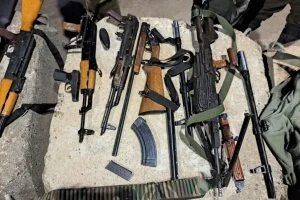
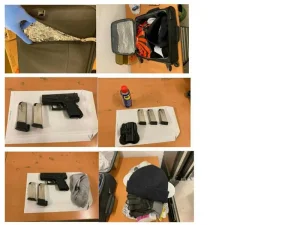
The smuggled weapons included explosives, RPG missiles, assault rifles, and large quantities of ammunition. Among those arrested is Iyad Halabi, 45, a sergeant major from Yarka, a northern Druze village, and Rami Abu Shah, 49, of the Israeli-Arab town of Shfaram, who coordinated with Syrian arms traffickers.