





















By Pesach Benson • February 24, 2026
Jerusalem, 24 February, 2026 (TPS-IL) — When Hamas terrorists breached Israel’s southern border fence on the morning of October 7, 2023, tens of thousands of residents living within kilometres of the Gaza Strip suddenly needed to flee. What followed was a test of decades of emergency planning — a test Israel failed almost completely.
A sweeping audit released by Israel’s State Comptroller Matanyahu Englman on Tuesday revealed that a country with more than 75 years of conflict experience had left its most exposed communities without functional evacuation plans. Border towns that had lived under the shadow of rocket fire for years — and whose residents had been promised a system that would protect them — were sent into chaos with no coordinated response awaiting them.
The State Comptroller regularly reviews Israel’s preparedness and the effectiveness of government policies. Englman also released reports highlighting the chaos of wartime displacement and how children lost two years of education.
“Since the Second Lebanon War in 2006, and for about two decades, Israeli governments have been required to regulate the treatment of the population on the home front in civil and security emergencies, but they did not do so,” Englman said in presenting his findings. “Plans were not updated. There were zero regulated national operational plans and zero emergency markings.”
Plans on Paper
Three plans existed on paper.
The “Guest Hotel” plan, originally drafted in 2012 and updated in 2022, was intended to govern the absorption of evacuees into hotels across the country. The “Safe Distance” plan, approved in principle in 2021, was designed to guide the evacuation of communities within a few kilometres of Israel’s borders. A third, “Breath of Fresh Air,” covered only short-term emergency shelter — nothing suited to prolonged displacement.
None of the three plans had been formally ratified by the Israeli cabinet. None had been backed by binding budget commitments. And none had been tested in drills that matched the reality they were supposed to address, the State Comptroller found. Instead, absorbing authorities held exercises in schools and public buildings — venues that proved entirely unsuitable once it became clear that a prolonged war would require thousands of people to live in hotels for months.
The consequences were starkest in Israel’s border communities.
Kiryat Shmona, a city of approximately 24,000 residents located 1.3 kilometres from the Lebanese border, had no operational evacuation plan at all. Over the preceding decade, the IDF had explicitly ruled out a full-scale evacuation of the city, assuming residents could shelter in place during any future conflict. The city therefore held no evacuation drills, trained no dedicated personnel, and had designated no absorption destinations for its residents.
When the order to leave finally came, approximately 21,000 people fled without any framework to receive them. They were eventually dispersed across roughly 300 hotels and guesthouses in 100 communities spread across the country — a scattering the audit describes as having caused “unnecessary suffering” and deepened residents’ “anxiety and uncertainty.” As early as 2020, the State Comptroller’s office had warned that Kiryat Shmona’s evacuation planning was dangerously incomplete and urged the Israel Defense Forces (IDF) and relevant ministries to act.
The warning went unheeded.
The situation in Israel’s south was equally damning. Sderot, a city of approximately 27,000 residents sitting 1.3 kilometres from Gaza, was explicitly excluded from the “Safe Distance” plan because it lay just beyond the designated coverage zone. The Eshkol Regional Council — which encompasses dozens of communities directly abutting the border fence and bore the brunt of the October 7 massacre — had prepared evacuation arrangements for only 11 of its 32 member communities.
Across the five southern authorities examined by auditors, none had rehearsed a full out-of-boundary evacuation. Most emergency databases covered only welfare recipients, leaving the vast majority of ordinary residents unaccounted for in any pre-war contingency plan. The IDF, the Ministry of the Interior, and the national emergency authority had never instructed southern communities to prepare for large-scale displacement.
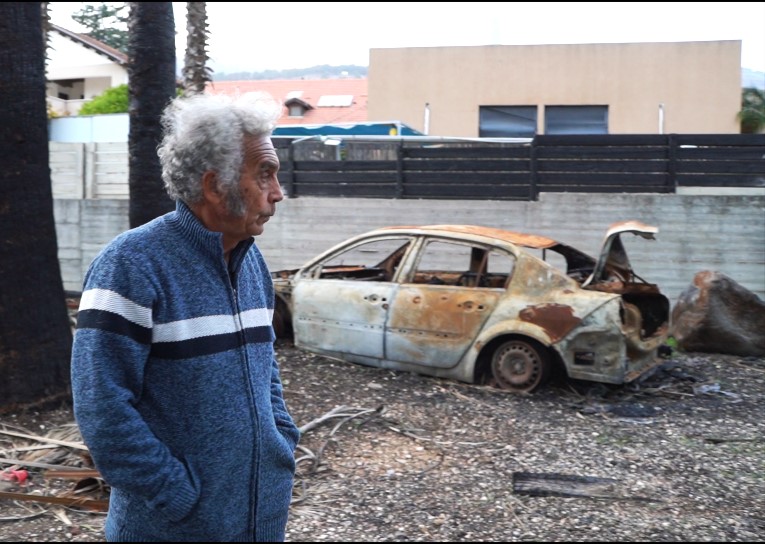
In the northern Israeli city of Kiryat Shmona on Dec. 26, 2024, David Kamari looks at damage to his yard caused by Hezbollah rocket fire. Photo by Anna Epshtein/TPS-IL
The ‘Accountability Vacuum’
The audit identified a structural explanation for this sustained failure: a prolonged, unresolved turf war between two government bodies over who bore ultimate responsibility. One is Israel’s National Emergency Authority, known by its Hebrew acronym, RACHEL, which is under the authority of the Defense Ministry. The other body is the Interior Ministry.
According to Englman’s report, RACHEL and the Interior Ministry never agreed on their respective roles in a mass civilian evacuation. Each pointed to the other. Neither prepared adequately. The result was what the audit characterized as an “accountability vacuum” — a gap at the heart of the national emergency system that no government had chosen to close.
“Despite my appeal to the Prime Minister, he did not resolve the dispute between the Ministers of Defense and the Interior over their respective authorities,” Englman said. “The Interior Ministry’s approach — that it has no responsibility for the evacuation event and was not required to activate the system — cannot be accepted.”
In response to the State Comptroller’s report, the Defense Ministry said the National Emergency Authority has operated with an expansive approach since the start of the war, leading inter-ministerial coordination for evacuations from the south and north. It said advance plans enabled the evacuation of roughly 124,000 people and that preparedness efforts are continuing.
Approximately 210,000 Israelis were ultimately evacuated from their homes in the north and south in the first three months of the war. The audit concludes that their ordeal was not a failure of resources or geography, but of political will and institutional accountability — a failure years in the making, laid bare in a single morning.
Related Topics