




















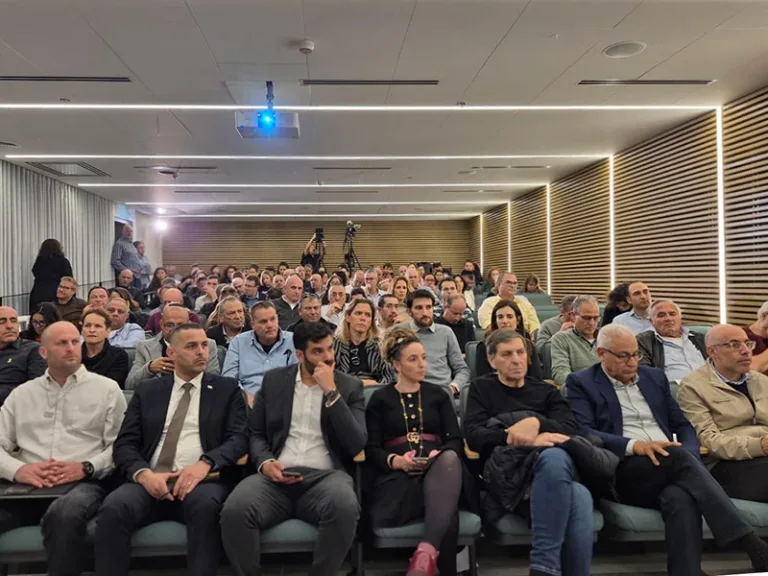
Today, Monday (01/12), the opening discussion of the inter-ministerial team for the regulation of the waste sector took place, led by the Ministry of Environmental Protection. The discussion was attended by the Minister of Environmental Protection Idit Silman, the Director General of the Ministry Rami Rosen, Senior Deputy Director General for Local Government, Education and Community Elad Amichai, Chairman of the Interior and Environmental Protection Committee MK Yitzhak Kroizer, Deputy Head of the Budget Division at the Treasury Ali Bing, Head of the Staff for Combating Arab Crime Ro’i Kahlon, representatives of the Accountant General and heads of local authorities. This is the first meeting of the inter-ministerial team, and its purpose is to lay a professional foundation for the formulation of comprehensive regulation for the waste sector in Israel, which will provide a long-term solution to the challenges of environment, health, economy, and service in this field.
Idit Silman, Minister of Environmental Protection: “The waste sector in Israel requires clear environmental regulation that provides certainty to the waste sector and, first and foremost, to local authorities. One that is done together with all market players. Only through open, professional, and determined dialogue between government ministries, local authorities, and the entities operating in the field, can we achieve optimal utilization of raw materials, reduce landfilling, ensure continuous essential service, reduce environmental nuisances, and protect public health and the environment.”
During the discussion, the Minister presented the basic principles according to which the regulation will be formulated, including a transition to waste management based on a circular economy model, adoption of the waste treatment hierarchy, setting clear national goals, and ensuring waste management that will protect public health and the environment. The regulation will apply to all waste streams – municipal, industrial, and commercial waste. Furthermore, it will define duties and responsibilities for all parties in the production, collection, and treatment chain – producers and importers, local authorities, the government, and residents.
It was also emphasized that the regulation will be based on the ‘polluter pays’ principle, will integrate economic tools and extended producer responsibility, and will ensure full transparency in the waste market through licensing, registration, and technological tracking of waste movement. Concurrently, waste treatment was defined as an essential service requiring continuity, quality, and reasonable pricing, as well as strengthening enforcement and addressing serious phenomena such as illegal waste fires, with an emphasis on the seam line and Judea and Samaria.
The Minister emphasized to the team members the expectation for professional, efficient, and transparent work, by adopting applicable solutions practiced in OECD countries, involving the public and stakeholders throughout the process, and accelerating existing processes with the aim of strengthening local authorities, establishing certainty for the waste sector, and promoting a gradual transition to a modern, stable, and sustainable waste sector.
As part of the activities led by the Ministry in 2025, significant regulatory steps were promoted, including the publication of amendment memoranda to the Deposit Law and the Packaging Law, an amendment to the Cleanliness Preservation Law to ensure continuity of waste services, and the completion of an agreed text for the Construction Waste Law in preparation for its second and third readings, which is expected to be promoted in the coming year as a central component in reducing landfilling and regulating the field. Alongside this, the Ministry continues to promote the establishment and expansion of advanced end-of-life facilities for waste treatment, sorting, and recycling, and waste-to-energy recovery, including new sorting facilities and the promotion of waste-to-energy facilities, including in the Neot Hovav area.
The work process to date and several alternatives formulated as the basis for the team’s work were also presented.
In recent years, the Ministry has continued to promote the national waste strategy, which includes accelerating the planning and establishment of advanced facilities for waste treatment, sorting, and recycling, and waste-to-energy recovery. At the same time, the Ministry published amendments to the Packaging Law and the Deposit Law for public comments, aimed at strengthening the responsibility of producers and importers, increasing collection and recycling volumes, and improving the quality of recycled raw materials. In addition, the Ministry supported the expansion of separation systems in local authorities. These steps and many others in the field signify a transition from a sector based on landfilling to a modern sector based on a circular economy.
Related Topics