


























Background:
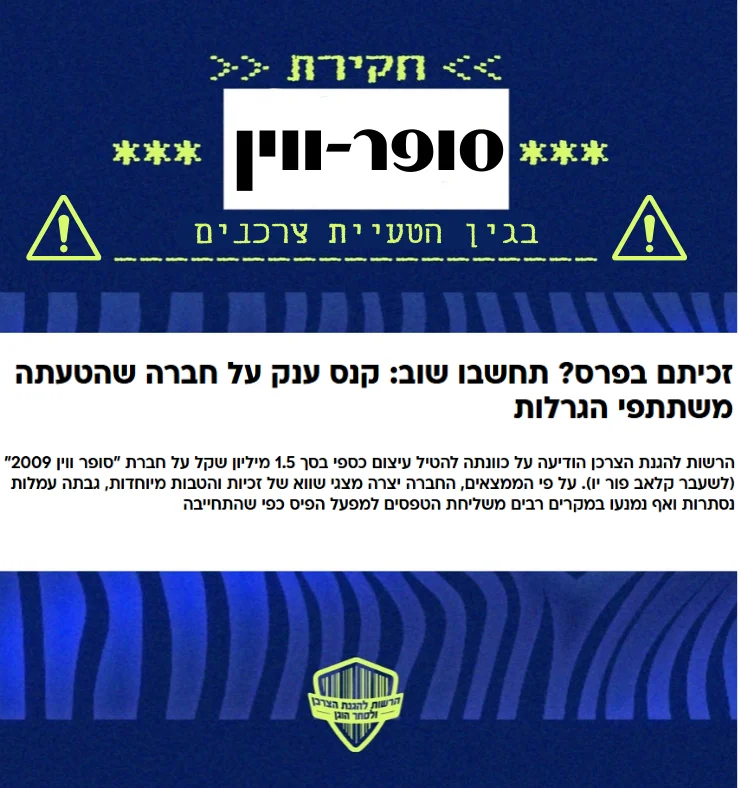
The Authority received consumer complaints against the company, and as a result opened an investigation.
The company was previously called “Club For You Business Development Ltd.”, and as of June 2023 it is called Super Win 2009 Ltd.
The company operates a customer club for group and individual lotteries and operates a website at www.club4u.co.il.
The company presents itself as assisting consumers in filling out the lottery form, sending it, and checking it, in exchange for a paid monthly subscription.
Company’s Method of Operation:
The company approaches consumers and claims to each consumer that they were selected from a database and won a special benefit that only they are entitled to, and that they won a lottery or were selected in some sample to be a “promotional customer” – this status supposedly grants them the right to purchase the subscription at the price offered by the company, and in return, they are asked to recommend the company to other customers.
Authority’s investigation Findings:
- The company created the impression that the consumer won a prize or other benefit that was only available to some customers, even though there was no actual prize or benefit, as the company did not conduct any lotteries or samples, and in fact, any consumer could receive the company’s services at these prices.
- The company misled regarding the transaction price and its terms. Sometimes the company did not send the personal combinations provided by the participants to Mifal Hapayis for participation in the lotteries according to the terms of the subscription they purchased.
- The company misled consumers by not disclosing to consumers during the marketing call all the details regarding the transaction price and its terms. The company did not state that it charges a 10% commission on the consumer’s winnings, that the subscription price may change from time to time, and that there can be over 8 lotteries in a month, for which the consumer will be charged twice in that month. Additionally, some consumers were not informed that these were lottery tickets with lines shared with other consumers, so even if they won, the winnings would be divided according to the number of winners.
- The company did not disclose to consumers during the marketing call all the details that must be disclosed during remote marketing, such as details regarding the right to cancel the transaction, the company’s identification number, and its address.
Consumer Protection Law Sections Violated:
- Section 3(b)(9) – Creating an impression to the consumer, that there is some benefit when in fact there is no benefit, constitutes unfair influence.
- Section 2(a) – Prohibits providing information that may mislead a consumer on any material matter.
- Section 14c(a) – Failure to disclose details that must be disclosed during remote marketing.
Kobi Zerihan, Commissioner of the Israel Consumer Protection and Fair Trade Authority:
“Presenting a false impression of winning or a benefit, when it is untrue, is a severe harm to consumers and an exploitation of their trust. The investigation findings reveal a misleading pattern of operation, including the concealment of material information regarding the transaction terms, the transaction price, and the method of participation in lotteries. The Authority will not tolerate such conduct and will continue to act decisively against businesses that mislead consumers and harm their basic rights.”
Related Topics