

























Knesset Press Release • July 20, 2025
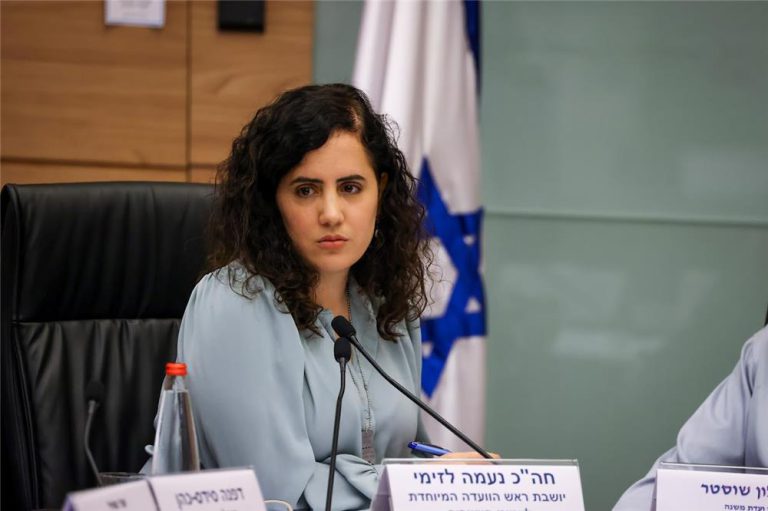
The Special Committee on Young Israelis, chaired by MK Naama Lazimi (Labor), convened on Wednesday for a debate on the planning, budget and future of the five-year plan for Arab society, as it pertains to young people. Committee Chair MK Lazimi noted that this was the third debate on the topic.
The committee chair said, “The young men and women from Arab society cope with a series of unique challenges in the transition to adult life—integration into higher education, the job market and integration into Israeli society in general. The data speaks for itself—high unemployment rates, a low rate of integration in academic studies, a lack of adapted vocational guidance, and ongoing difficulty in receiving equal opportunities.
“In recent years, dedicated government budgets have been allocated for advancement of Arab society. But in light of the cuts to the budgets of the five-year plans and the Government’s policy on the issue—it is necessary to examine the implementation of the plans, to ensure that they offer a real response to the population of young people, and to propose directions for improvement and adaptation [of the plans] to the needs on the ground,” said MK Lazimi.
Dr. Nasreen Haddad Haj-Yahya, CEO of the NAS Research & Consulting firm, said that the share of young people (aged 18–34) in Arab society, from the total number of young people in Israel, stands at 27%, and the population of young people from Arab society numbers some 600,000. At present, she said, the share of Arabs from the total number of young people in Israel is at a peak, since the birth rate in Arab society has dropped and it is currently similar to that of Jewish society. Of the population of the Arab localities, 75% live in localities ranked in Central Bureau of Statistics socioeconomic clusters 1–3, versus 23% of the population in Jewish and mixed localities.
Dr. Haddad-Haj Yahya pointed at inequality in budgeting of the Arab education system, and said that the efforts to reduce the inequality in budgeting the education system had borne fruit, but an Arab student is budgeted at 40% (about NIS 13,000) less than his or her Jewish peer. She said that a gap still exists, particularly in schools with students of low socioeconomic status, and particularly in high school. She said that informal education in Arab society was still insufficiently established, and suffered from a series of shortcomings in physical infrastructure, human capital and development of instructional materials and adapted activities. Dr. Haddad-Haj Yahya stated that the inequality leads to dropping out, lower achievements in matriculation certificate eligibility and the quality of matriculation, and difficulties in acquisition of the Arabic, Hebrew and English languages.
A Ministry of Education official denied the extent of the budgetary gap in elementary schools, but said that a gap existed in high schools, since there the budget is given on the basis of students and programs.
Hussam Abu Baker, CEO of AlFanar, said that there was no government body dealing with idle young people in Arab society. He told about his attempts to establish cooperation and initiate government programs, but said that the main obstacle was funding for these programs, and that civil society on its own would not succeed in operating such programs.
Shira Berliner Poleg, acting director of the Governmental Institute of Technological Education and Training (MAHAT) at the Ministry of Labor, said that there were programs for mentoring, economic assistance and tuition funding, especially for the Arab and Bedouin population. In some of the programs, 35% of the budgets are intended for women.
Ahsan Hino, director of employment for diverse populations at the Ministry of Labor, described various activities and said that 100% of the budget was utilized every year. Abed Shehadeh, representative of the National Committee of Heads of Arab Local Authorities, called to stop relying on the budgets of five-year plans and to allocate a permanent and ongoing budget.
Hanadi Shaer, Vice CEO at AJEEC-NISPED, told about a series of activities for training and job placement, but said that there was uncertainty with regard to budgeting and the scope of the coming five-year plan.