
















Knesset Press Release • July 21, 2025
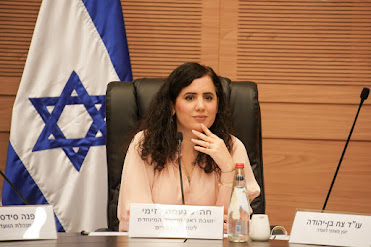
The Special committee on Young Israelis, chaired by MK Naama Lazimi (Labor), convened on Monday for a debate on the impact and ramifications of a diplomatic arrangement on the next generations.
Committee Chair MK Lazimi said, “Everyone talks about the cost of war, but no one talks about the benefits of the peace that will come. A society must strive for a diplomatic arrangement that will bring development, peace, normalization, prosperity, and welfare. We must develop infrastructure for such an arrangement that will open the trade, technology, transport, and water agreements. Real security reflects the interests of both sides.”
Shaul Yanai of the Forum for Regional Thinking said, “Security and peace are two sides of the same coin. Hamas wanted to stop peace agreements between Israel and Saudi Arabia and Indonesia, the largest Muslim country in the world, and therefore launched the October 7 attack. Such a development would have brought about open borders with the vast majority of the Arab world, a land bridge for Israeli industries that would bring great savings and huge development.”
According to Lt. Col. (res.) Omer Zanany of the Berl Katznelson Center, the Israeli Initiative is based on the gradual establishment of a demilitarized, peaceful Palestinian state and the creation of a regional moderate alliance led by the U.S. Its action plan aims to end the war in Gaza and is based on a clear timetable of 3–5 years, including a sharp transition from war to political action, setting a horizon based on two states during a peace conference, where an international-regional framework will be established to support its advancement. According to Zanany, the transition period, which will begin immediately after the conference, will last two to three years and include international and Arab involvement in the reconstruction of the Gaza Strip and the establishment of Palestinian state institutions and mechanisms, with the aim of building a renewed Palestinian Authority that will act effectively against terror and serve as the basis for the Palestinian state. The transition period will also include a halt to the “de facto annexation measures that have been accelerated in the past year,” global recognition of a demilitarized Palestinian state existing in peace alongside Israel, the launch of large-scale economic development projects in partnership with Arab states and the Palestinians, and the establishment of a regional defense coalition under an American security umbrella to address the Iranian threat and other regional threats.
Zanany argued that these measures would ensure stability and establish a regional partnership. At the end of the transition period, he explained, Palestinian elections will take place under conditions that will enable the establishment of a new and legitimate Palestinian leadership, and promote a proper framework for diplomatic negotiations on a stable Israeli-Palestinian regional agreement.
A representative of the Alliance for the Two-State Solution called for coexistence and a regional agreement, “which is possible and not a fantasy.” He added: “Influential figures in the Arab world are interested in normalization with Israel that is based on two states for two peoples. Israelis want peace and Palestinians want dignity and freedom. Each side must give the other what it seeks.”
Actress Roni Hadar emphasized the need for a diplomatic arrangement, “which is essential and critical for the future of all our children, and not a future of wars and conflicts.” Teenagers, she argued, “are becoming more racist and hateful because there is no hope, and such hope is what drives sanity and prosperity.”
A reporter for DemocraTV called for a “normal future for children in Gaza and Sderot,” and said “both sides need to understand each other’s language, identity, world, and narrative, because when there is no familiarity, there is hatred, distance, and alienation.”
Rotem Sivan of the Ima Era (Awake Mothers) movement said “loss of trust among mothers must bring an end to the war, and we must learn to speak with today’s youth and succeed in bringing about rehabilitation.” Paz Zemach of the Pink Front movement said, “This government does not care about our lives, and every day gives us reasons to leave. We do not want to merely survive; we want to live.” Ron Yamin of the Geneva initiative and Peace Now said, “We have a responsibility to the future generations, and we refuse to pass the problem on to others. We are sick and tired of leaders who are afraid of complex decisions.”
Eyal Zeevi, head of the Palestinians Division at the national security Council, said “War costs are heavy, as are future security expenses, and therefore economic engines and productivity growth must be developed.”