















Knesset Press Release • January 7, 2026
The National Security committee on Tuesday held a debate on the enforcement of noise regulations in mosques in Israel and Judea and Samaria.
The agenda for the debate stated that, according to updated data from the Israel Police for 2025, there has been a dramatic and unprecedented shift in the fight against noise disturbances from mosques in “little Israel,” with a 1,200% increase in enforcement, removal of loudspeakers, and issuance of fines. However, in Judea and Samaria, the situation remains unchanged, with no enforcement despite efforts by the Civil Administration in Judea and Samaria to promote legislation similar to that in “little Israel.”
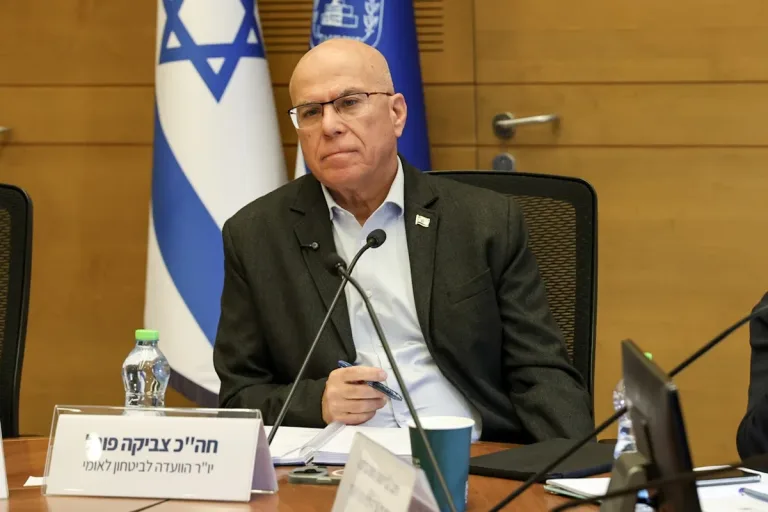
Committee Chair MK Tzvika Foghel (Otzma Yehudit) said the damage caused by the noise should not be underestimated. According to studies, it causes health problems, as well as psychological and economic harm. “In Judea and Samaria, the issue is more complicated because the police do not have authority to act, and the IDF does not always have the required force to do so,” he said, while referring to the noise from mosques as an “unacceptable nuisance that should not continue.”
MK Amit Halevi Likud) said, “This is an unbearable imposition that the radical jihad seeks to impose on the public space. Today, the rights are not balanced. I am not against religious thought and religious freedom, but not one that seeks to impose itself on me.”
MK Eliyahu Revivo (Likud) said, “The right to free religious worship is sacred and pure, and we must allow it, but only in terms of faith, not as a catalyst to harm those who do not share the same religion and belief.”
An IDF official explained that environment-related issues in Area A and B of the Judea and Samaria were transferred to Palestinian Authority jurisdiction after the Oslo Accords. “Enforcement can only be done in exceptional cases, such as when public order or the security of Israeli communities or nearby IDF bases is at risk,” she said. “A cabinet decision allows enforcement in Area B without referring every time to the political echelon, but in Area A, a decision by the political echelon is still required for each specific enforcement action.”
Civil Administration representatives argued that most problems are resolved through dialogue, even though the process may be long. Lev Sternin, Senior Coordinator of Environmental Planning in the Civil Administration, stated that should there be repeated complaints about noise from a mosque, the Administration would request the enforcement unit to take the necessary actions based on a professional report. Asked by Committee Chair MK Foghel how many such actions have been taken over the past decade against mosques that violated the “gentlemen’s agreement,” Sternin said, “I am not aware of any.” An IDF official said the army temporarily closed down a mosque at the Cave of the Patriarchs in Hebron due to a violation.
An Israel Police official stated that in the Judea and Samaria District (Shai District), the police do not have enforcement authority. Another police official outlined the regulations and procedures for dealing with noise disturbances, which allow the police to address the issue, and added: “We approached the legal advisor to Judea and Samaria to establish a foundation for action in Areas A and B, and yesterday we received a position that there is a way to act in these areas.”
Roee Gottlieb, head of the Noise Exposure Prevention Department in the Ministry of Environmental Protection, argued that the existing legislation is sufficient, and places of worship are not exempt from the regulations. Some mosques cooperate, while others do not, and in most cases, the issue is handled through the Ministry of Interior. In the event that mosques do not cooperate, fines are issued, and if the violation recurs, equipment is confiscated. “We do not have authority in Judea and Samaria,” he said.
Ministry of Interior official Lior Shahar said, “The ministry employs 300 imams. We know how to work with them, and we usually manage to create joint and creative solutions, such as a shared public address system, and we ensure compliance with noise regulations. Not everything is perfect, but where we can, we ensure they operate according to the law.”
Another senior police official said enforcement operations are conducted. In 2025, 1,920 complaints were received about noise from mosques, and 193 fines were issued. “There is a structured process starting with dialogue and awareness, agreements, technological systems for controlling noise levels, and fines. If this does not work, we move to an investigation with the aim of filing an indictment,” he said.
A representative of the Israel’s Cities (Arei Yisrael) organization discussed the problem in Lod. “The residents are fed up with this nuisance. There is a basic right for Israeli citizens to live normal lives, and it is being violated,” he said. “There is limited enforcement. Where are the courts in this event?”
Samaria resident Moriya Michaeli, who is among a group of women who began observing the border along the seam line after the Oct. 7 massacre, said, “There is a lack of governance in Judea and Samaria regarding noise from mosques, as well as fires, and enforcement is inconsistent. I hope that the IDF and the Civil Administration will hear us as well. Many countries have restrictions on mosques, and there is no reason why this should not also be the case in Israel.”
Shai Glick, director of the B’Tsalmo non-profit organization, said, “Police do not enter certain mosques of the Islamic Movement, and it creates the impression that they are off-limits. This cannot be, and the reality must change.”
Deputy Commissioner (ret.) Moshe Barkat, a consultant to the committee, said, “The situation in Judea and Samaria is problematic and complicated because, in the end, it comes down to discourse. I hope there will be a breakthrough that will allow the forces to enter. If administrative steps and economic sanctions are taken against these imams, I believe it will bring results.”
Summing up the debate, Committee Chair MK Foghel said this was not a religious war, but a matter of the right to quality of life and health. “I intend to provide legislative tools that I am advancing. The fines will be high. Those who do not pay, we will seize their equipment, and if that does not help, we will close the mosque. If it continues, we will dismiss the imam, and if necessary, we will arrest whoever we have to in order to ensure that the right to live under normal conditions is preserved,” he said.
Related Topics