























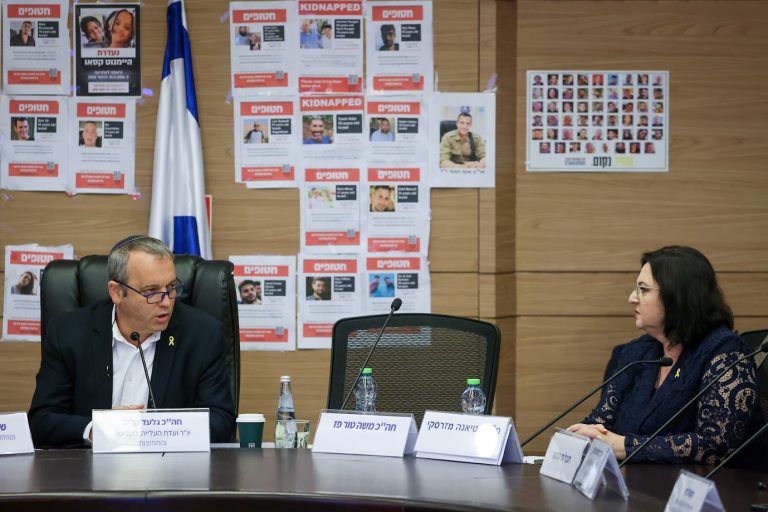
Knesset Press Release • July 9, 2025
The Committee for Immigration, Absorption and Diaspora Affairs, chaired by MK Gilad Kariv (Labor), convened on Tuesday for a special meeting on the occasion of National Student Day, on the topic of the impact of the war on the increase in antisemitism against Jewish students in the Diaspora.
Since the outbreak of the Swords of Iron war, a sharp and worrying increase has been recorded, of hundreds of percentage points, in antisemitic incidents against Jews in general and against Jewish students on campuses in the Diaspora in particular. In 2024 alone, an 84% increase was recorded in antisemitic incidents in the United States—many of which occurred in academic campuses, which were supposed to be safe spaces for free discussion and democratic dialogue. Antisemitism came not only from students, but also from faculty members. In addition, Jewish faculty members report cases of exclusion, hampering of professional advancement, and a hostile atmosphere in their institutions of learning.
Committee Chair MK Kariv: “Marking National Student Day in the Knesset drives us to think about the price that the younger generation pays during the war. The antisemitic incidents on campuses in the US undermine the sense of personal security of Jewish and Israeli students who study in these institutions. In many cases, there is a sense that the administrations of the institutions do not give a proper response to the antisemitic incidents. We’re not talking about spontaneous initiatives, but rather about initiatives that originate on social media, behind which there are large organizations that fund the dissemination of hatred. The committee works directly with all relevant government agencies in order to try to prevent and overcome the antisemitic incidents on campuses. Here in Israel we have to encompass the diversity of opinions and the spectrum of Jewish culture from across the Diaspora. The ministerial committee has decided to postpone by a month the bill proposed by MK Avi Maoz (Noam) to abolish the grandchild clause in the Law of Return. I regret this, and I call upon the Government to reject out of hand any change in the Law of Return that will reduce its scope. In the previous Knesset, the Israeli parliament adopted the IHRA definition of antisemitism, and we should act to ensure that additional bodies around the world adopt this definition.”
Netanel Levi, Deputy Director General of the Ministry for Diaspora Affairs and Combating Antisemitism: “We have identified an increase of 477% in antisemitic incidents throughout the United States over the past year. In Europe, the number of antisemitic incidents over the past year has been six times as high as in an ordinary year. A few months ago, we set up a control center that monitors activists and agents of antisemitism on social media, the outputs are distributed to all relevant agencies with the aim of preventing hate crimes against Israelis and Jews in the Diaspora. We distribute a review every two weeks that places an emphasis on antisemitism on campuses, with operative recommendations.”
MK Tatiana Mazarsky (Yesh Atid): “The Israeli and Jewish students who study at different campuses around the world are our best ambassadors. You can’t change the nationality of the Jewish people. Every Jewish student around the world becomes a representative of the State of Israel, whether he wants to or not. We should combat the phenomenon of antisemitism at all levels and with all possible tools. We should support academic studies that will contribute to eradicating antisemitism on campuses.”
Sivan Koren, Chair of the National Union of Israeli Students (NUIS): “Since October 7, the boundary between criticism and hate has been erased. Displays of antisemitism have entered academia prominently around the world. The IHRA definitions are intended to enable open dialogue and to prevent antisemitism. Many countries have adopted this definition, and the time has come to call upon all institutions of learning throughout the world to adopt it. We in the National Union of Israeli Students have adopted the IHRA definition of antisemitism and call upon all the different organizations to do so as well. We develop and distribute explanatory materials with legal guidelines for taking action against antisemitism on campuses worldwide.”
Chairman of the Yad Vashem Directorate Dani Dayan, who serves as IHRA Chair of the Israeli IHRA Presidency: “Since October 7, an academic theory has been created through research publications and conferences, which calls to destroy and liquidate the State of Israel. Demands to destroy Israel in the academic world should be completely prohibited. The IHRA operates by means of its member states and governments, and we apply pressure to dismiss lecturers who call for the destruction of the State of Israel.”
Committee Chair MK Kariv expressed solidarity with the Australian Jewish community following the severe antisemitic incidents in Melbourne. Jillian Segal, the Australian Government’s Special Envoy to Combat Antisemitism, said that since October 7 [Australia] had faced a very difficult period of displays of antisemitism against Jewish communities and their synagogues, Jewish restaurants and Jewish students. The displays of antisemitism on campuses, she said, come not only from students but also from teaching faculty and educational staff. She stated that the Australian Government was trying to carry out a broad range of actions to eradicate antisemitism in cooperation with the universities. Segal stated further that there were many pro-Palestinian organizations that operate openly or beneath the radar, and [the Government] was doing everything in its power to do the right things to stop them.
Sharon Rappaport-Palgi, Director of Jewish Communities at the Ministry of Foreign Affairs: “All ten of our missions meet with government agencies and with agencies that are relevant to universities, and raise the issue of increasing the Jewish students’ sense of safety throughout the world. We are members of the IHRA and through this organization are advancing the goals of the State of Israel for prevention of antisemitism on campuses. The demand arising from the field is not only to recognize antisemitism and adopt definitions, but also to ensure responsibility and enforcement measures against these displays [of antisemitism].”
Liron Brunner, a student in the United States: “I’m afraid to speak Hebrew in the campus I attend. I’m afraid to celebrate the holidays openly and to display my Star of David necklace. My friends remove their kippa because they’re afraid of displays of antisemitism against them. We hope to succeed in creating a more comfortable environment for Jewish students on our campus and on other campuses so that no one will have to be afraid to demonstrate their Jewish identity publicly. […]”
Shira Goodman, Vice President of the Anti-Defamation League (ADL), said that many cases of antisemitism were not reported in North America, so the extent of antisemitism was larger than reported. She said that according to internal surveys conducted [by the ADL], most of the students on campuses in North America have said that they witnessed or were involved in displays of antisemitism against them or their friends. Sixty-six percent of Jewish students on campuses feel unsafe and say that the universities aren’t able to protect them.
Committee Chair MK Kariv said in summation, “I am requesting that the National Union of Israeli Students (NUIS) send the committee recommendations for practical steps within projects that are already being carried out under the union’s leadership worldwide. It’s necessary to carry out cross-sector collaborations between the Jewish communities and the NUIS. We will conduct a follow-up debate on this issue, and will allow other agencies to present their position and accomplishments.”