
















Knesset Press Release • January 7, 2026
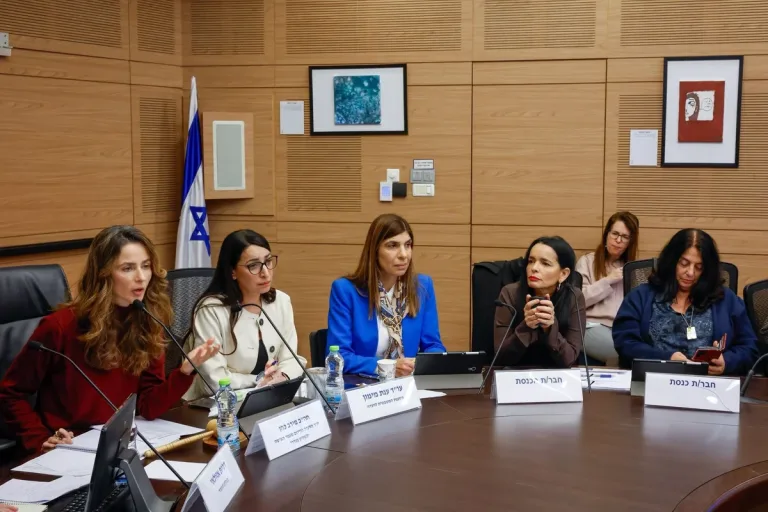
The committee on the Status of Women and Gender Equality, chaired by MK Meirav Cohen (Yesh Atid), convened Wednesday for a debate on the Government’s response to economic violence against women.
“This is a very severe form of violence that casts a shadow of fear over women’s lives, even if it is not always visible,” said committee chair MK Cohen. “It can be a husband who does not allow his partner to use a credit card, or a partner who dictates to a woman what she is allowed or forbidden to buy; or someone who threatens his partner that if she leaves him, he will bury her in debt. This is control over a woman through economic means. Women who suffer physical violence are often forced to return to their partners because of economic dependence on the man. Many women who were murdered had, in many cases, also suffered economic violence.”
A single mother of five from Netivot said, “Economic violence is a cross-sector phenomenon. It is usually directed at women who do not work. I was in that place, and my children and I lived on NIS 630. The shelves in the refrigerator were divided into ‘his’ and ‘ours.’ I counted every shekel in order to buy bread for the children. Two of my children broke their arms, and he refused to take them for medical treatment. Every time I tried to go out to work, he found excuses why I shouldn’t. I could not find a job and found myself at his mercy. The state needs to provide us with a response, not one that relies on the third sector. We do not want to be welfare-dependent women; we want to work and to serve as an example for our children.”
A survivor of economic violence said, “There is a multi-systemic failure here. I experienced violence against my daughters and myself. He followed me at work. He distributed checks by forging my signature. He opened a taxi business in my name. He forged checks – and all of this happened while I was in a shelter – and he left me with debts amounting to NIS 750,000. He is a former bankrupt. I no longer had the strength. I have a handwritten letter from him in which he admits to everything he did. I was pushed into bankruptcy; I had never owed anyone anything in my life. I proved that this was not my debt, and it did not interest anyone.”
A twice-divorced mother of three said, “You exist – you are breathing – but you are not truly alive. From the outside, everything looks normal, and there are no bruises because no one is hitting you. Day after day, in hindsight, you discover that you were living inside a prison whose boundaries you could not see. I reduced myself. I shrank my dreams, because the desires and aspirations belonged only to him. I did not ask for too much. I was afraid to live and to want things, and there was no life or hope within me. Every request became a threat. Economic violence does not come with shouting – it comes as a slow drip. I was married twice – once to a man who used physical violence, and once to a man who used economic violence, which was harder.”
Fainy Sukenik, Haredi Society and Business Partnerships Manager at the Red Lines initiative, said, “In the wake of the war, we are in the midst of an ongoing wave of domestic violence that requires a different kind of preparedness. Economic violence is no longer a separate or isolated phenomenon. It is a serious phenomenon with profound implications for freedom, security, and the ability to maintain basic existence.”
Adv. Hila Dolinski, assistant to the legal advisor at the Ministry of Welfare and Social Affairs, said, “We are in dialogue with the Ministry of Justice and other ministries regarding the wording of the bill. We understood that the proposal has difficulties and that a different direction is needed. Recognition is important, but the perception that economic violence stands on its own, detached from other patterns of violence, raises questions. We are asking what the most accurate legislative arrangement is. The direction we believe should be advanced is defining domestic violence, with economic violence as one of its forms. The Prevention of Domestic Violence Law does not define the phenomenon of violence, nor does it define economic violence as part of it.”
Committee Chair MK Cohen said, “This issue has been discussed for many years. Where does it stand, and when will there be a draft?” Adv. Dolinski replied: “I cannot commit to a date.”
Ministry of Justice official Adv. Rachel Spiro said, “We have held discussions with all government ministries, and recently we received the professional position of the Ministry of Welfare, and we are all mobilized on this issue. We are updating the professional positions.”
Committee Chair MK Cohen said, “It is clear that there is foot-dragging here, and it should not have taken years. How much time, in your estimation, until we see a draft for your legislation? Let’s set a target date.” Adv. Spiro replied: “The updated position was transferred to us and has not yet been circulated to the other government ministries.”
Anat Yakir, head of the Israel Police’s Crime Victims Division, said, “This is one of the most difficult debates I have participated in. Economic violence is not a criminal offense, but it is certainly on the investigator’s table when taking testimony from a victim of crime. The investigator completes a risk assessment questionnaire that provides tools to assess how exposed the victim is to danger from the perpetrator, and there are questions that can identify economic violence for the purposes of risk assessment. As the Crime Victims Division, we are in contact with the Women’s Spirt association. Even if it is not a criminal offense, it is within our organizational awareness.”
MK Matti Sarfatti Harcavi (Yesh Atid) said, “Within the framework of legislation, there must be a definition of early warning signs, because many women are not aware that they are in a situation of economic violence. It is therefore important to raise red flags. It starts small and escalates.”
Yafit Alfandari of the Central Bureau of Statistics said, “There are many challenges in measuring economic violence. In 90% of cases, no one knows what is happening. These are data involving a real danger to life, and there are unclear definitions of what constitutes economic violence. On a practical level as well, people are not aware that they are in this cycle. We developed a special module together with the index of the Authority for the Advancement of the Status of Women, and we want to monitor discourse on social media. In 2025, we added a module on gender-based violence, and a personal safety survey is currently being conducted. We asked people whom they reported to, what damage was caused, and what the prevalence is. We ask whether access to money or spending was denied, whether people were prevented from working. Findings to date show that 3% reported being in a cycle of economic violence – that is 75,000 people.”
MK Yoav Segalovitz (Yesh Atid) said, “The handling of physical violence is very poor.” MK Merav Ben Ari (Yesh Atid) said, “For three years we have been in a situation of a government that excludes women. I help women because they are women. All day long I find myself shocked and ashamed that people turn to the Speaker of the Knesset to have this debate cancelled.”
MK Shelly Tal Meron (Yesh Atid) said, “Because the issue is transparent, there is an assumption that it happens only to women from the periphery, but this is a phenomenon that can happen anywhere. I have encountered this phenomenon in my own circles of life. It involved paralyzing fear. Everything everyone is doing is very important, but the issue of financial education is critical, and we must also educate youth about these dangers.”
MK Sharon Nir (Yisrael Beitenu) said, “The fact that we have reached a situation where a discussion like this is questioned is a disgrace. Because the law is not advancing, awareness is not advancing. The law does not provide women with help through a definition of what economic violence is. We will not abandon the bill, because every woman has the right to a free life. The right to liberty is a basic right in the State of Israel.”
Adv. Shomrit Regev Schreiber, spokesperson for the Tax Authority, said, “We have found on-the-ground solutions for indebted women. Representatives of the Authority have come to us with problems of women who are suing for child support through the Enforcement and Collection Authority, and today they receive escort by a security officer from home through the entire process, and a secure return home. This is part of our work. In addition, requests have been made that, in child support proceedings, hearings be scheduled as early as possible. Once a woman presents evidence of a shelter residency order or a restraining order, she can coordinate an early hearing within up to 60 days before an Enforcement and Collection Registrar, who is a judicial authority. In addition, we assist women from the Women’s Spirit association.”
MK Yasmin Fridman (Yesh Atid) said, “The frustration is immense and awful, and I am holding myself back from exploding. For so many years, nothing has progressed – over a decade – and many women could have been saved.”
Women’s Spirit CEO Tamar Shwartz said, “This is destructive violence, a devastating blow. This violence is not seen. Sixty-six percent of victims of violence return to their economic abuser due to economic dependence. Professors come to us who are terrified to open a bank account. Reporting is minimal compared to the scope of the phenomenon. If a woman is economically independent, the likelihood that she will return to an abusive relationship is close to zero. Eighty-seven percent of the women who come to us succeed in earning a dignified livelihood. As long as this is not defined in legislation, we will not be able to provide women with legal aid and recognition.”
Keren Ben Harush from the Authority for the Advancement of the Status of Women said, “The Authority attaches great importance to the prevention of economic violence, with advisors in local authorities serving as our field agents. We carried out programs in local authorities to promote development and economic independence, with a budget of NIS 10 million last year.”
Related Topics