
In a heated discussion at the Committee for the Advancement of the Status of Women, difficult testimonies were revealed about barriers, lack of accessibility, and violence against women with disabilities; the Ministry of Health admitted that service accessibility regulations are still stuck pending the finance minister‘s signature, despite years of delays.
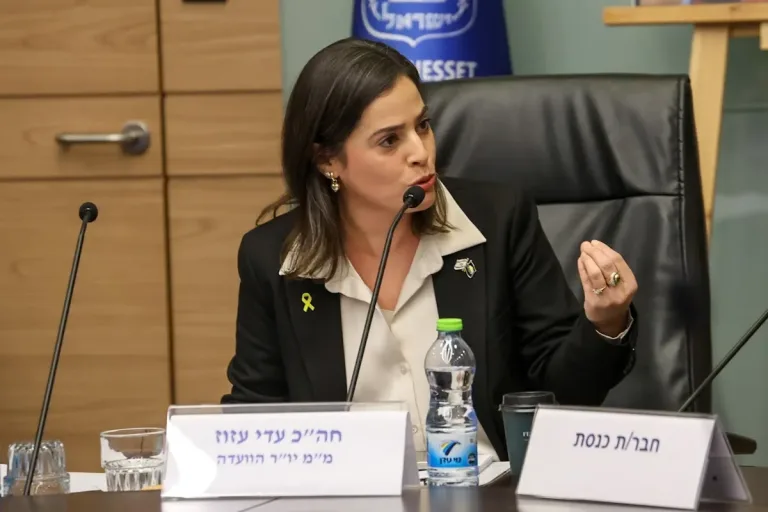
During the Committee for the Advancement of the Status of Women discussion, which dealt with the gaps and barriers for women with disabilities in receiving services from the public system, held today (Wednesday), serious systemic failures were exposed. Representatives of civil society organizations presented testimonies about lack of accessibility in clinics and hospitals. Acting Chair of the discussion, MK Adi Azouz, stated: “As of February 2025, the National Insurance Institute recognized approximately 165,000 people with special needs, of whom 42% are women. Women with special needs face double discrimination, gender discrimination and also discrimination based on disability. Many times this directly affects their socio-economic status, as well as many other areas of life. During the discussion, we will raise the need to increase awareness of the unique characteristics of women with special needs, which must be reflected in data collection and the provision of unique services in various fields.”
Adv. Rotem Eizik, Director of the Department for the Advancement of Rights and Government Relations at “Koach L’Ish”, said that the reality in which many women give up in advance on receiving community services, especially in the healthcare system, only deepens the violation of their rights. She emphasized: “The system is not built to see them, and although women with disabilities are exposed to higher rates of sexual violence and exploitation, the systems that are supposed to provide them with a response are often not accessible enough.”
Dana Sharov, Director of the Women and Autism Project at “Koach L’Ish”, described the difficult reality: “For an autistic woman, the world is a much noisier and more demanding place. They are at four times higher risk of experiencing sexual assault and exploitation compared to the general population.” Sharov recounted the story of Shira, a 24-year-old intelligent, sensitive, and autistic woman: “She hasn’t been examined by gynecologists for 7 years. Not due to neglect, but because the system doesn’t speak her language. The last time Shira tried to get examined, the doctor simply asked her to relax. While she was experiencing a complete sensory breakdown. For a woman with sensory sensitivity, the flickering fluorescent lighting, the strong smell of disinfectants, and unexpected physical contact are not just discomfort, they are an experience of physical pain and unbearable overload.”
According to Sharov, when the doctor labeled her as “difficult or uncooperative,” he actually missed the fact that her body was reacting with extreme stress to the clinic, which had become a torture chamber for her. Shira’s story is not an isolated incident; it is the reality for thousands of invisible women who forgo life-saving tests, not because they don’t want to be examined, but because the system is simply not accessible to them. The first barrier begins at the diagnosis stage. The data shows a worrying gap. For every four diagnosed boys, there is only one girl. This is not because there are fewer autistic women, but because of the unique characteristics of autistic girls, adolescents, and women.
During the discussion, difficult testimonies arose about lack of sensitivity in the healthcare system. An autistic woman, a mother of 7 children, described: “I gave birth to a premature baby and I wanted to go see her, and they told me no, you can only go see her accompanied by a social worker. When I entered the NICU and saw that my daughter had many tubes, I started asking. They told me everything is fine. I told them no, explain to me what the tubes are for because I am autistic, I need things explained to me.”
Orly Boni, Director of the National Service for Occupational Therapy at the Ministry of Health and responsible for Equality and Accessibility, stated: “We are writing the regulations for accessibility to our health services. This is a very long and comprehensive process because these are regulations that must encompass all types of disabilities.” Boni admitted that the issue is encountered by the healthcare system broadly, but explained that the service accessibility regulations are still awaiting ministerial signatures. According to her, the regulations for self-employed individuals are now being discussed in the Knesset: “We were asked to go out again to round tables and further discussions to examine. We are constantly in the process, including with the Knesset, on the issue that these regulations will maintain the balance and reasonableness between providing services to people with disabilities and providing services to the general public. Because if we create overly strict regulations that will close, that will cause the closure of health services, we will harm the entire public. If you demand that every doctor working in the community be maximally accessible physically, then people will close clinics, and we already lack clinics and the waiting times are getting longer. So we are indeed working on balances all the time, we are finding solutions. I can say, for example, that Maccabi, for instance, has opened over 30-40 doctor’s offices, allowing their independent doctors to work in accessible doctor’s offices to serve the entire population that they cannot serve in their own practices.”
A representative from the Commission for Equal Rights of Persons with Disabilities admitted: “These regulations have been delayed for many, many years. With all due respect to the very hard work that Orly and other colleagues in the Ministry of Health are doing, it is not enough. There are many very simple things that have come up and could have already been regulated. I will give an example from another field. Several years ago, as part of the Arrangements Law, we incorporated elements from the general service accessibility regulations into the healthcare system, such as the very simple matter of allowing service animals into health facilities, such as the very simple matter of sign language interpretation, and there are other things that have come up here, accessibility, internet accessibility, which is mandated today for any private or public service, but is still not mandated in the healthcare system because accessibility regulations have not yet passed.”
According to her, there is no polite word for this: “I think the committee needs to be a bit more assertive in its demands… I don’t understand, waiting for ministerial signatures, which minister, Orly, if you could explain. The Minister of Health has already approached the Minister of Finance, it is under discussion, the Minister of Justice does not need to sign, there is drafting work with the Minister of Justice. Orly, if you could clarify exactly where it stands and what else can be done in the short Knesset session that we still have ahead of us.” Boni replied: “It is awaiting the signature of the Minister of Finance, it is with the State Attorney’s Office because there is a High Court petition regarding it, and I cannot elaborate further because I really cannot. The signature of the Minister of Health, we already have the third signature from a third Minister of Health who has changed in the last year. We are ensuring that there is a signature from the Minister of Health, and we are waiting for the signature of the Minister of Finance. In any case, we want to complete the set of regulations that we have already managed to bring to the Knesset. We hope to make at least more progress in the upcoming session. Regarding the regulations that we have put on the table, they are being implemented in the healthcare system, there is the entry of service animals, there are systems being organized for sign language, there are all the things that are being implemented, websites are becoming more and more accessible, we are working hard on the issue of app accessibility and personal space.”
Regarding violence against women with disabilities, it was reported that in 2025, 377 offenses were recorded against women with disabilities: 148 violent offenses, 129 sexual offenses, 79 sexual offenses plus violence, and 11 online sexual offenses. A representative of the Forum of Women with Disabilities described difficult examples of the misuse of disability as a means of control and violence.
MK Azouz summarized the discussion, stating: The committee believes there is a need for a holistic response for women with special needs, and the public system in general needs cooperation with an emphasis on the Ministries of Welfare and Health. Regarding the lack of data on accessibility for women with special needs, the committee will approach the government ministries through the Knesset’s Information and Research Center with a request to conduct a data breakdown on the subject, including a breakdown for Arab women and others. The committee and the Research Center will submit a formal request. The committee requests an update from the Ministry of Health regarding the expected timeline for the completion of service accessibility regulations and calls on the Minister of Finance to convene urgently for signing.