





















Remarks by Prime Minister Benjamin Netanyahu at the Second International Conference on Combating Antisemitism, in Jerusalem
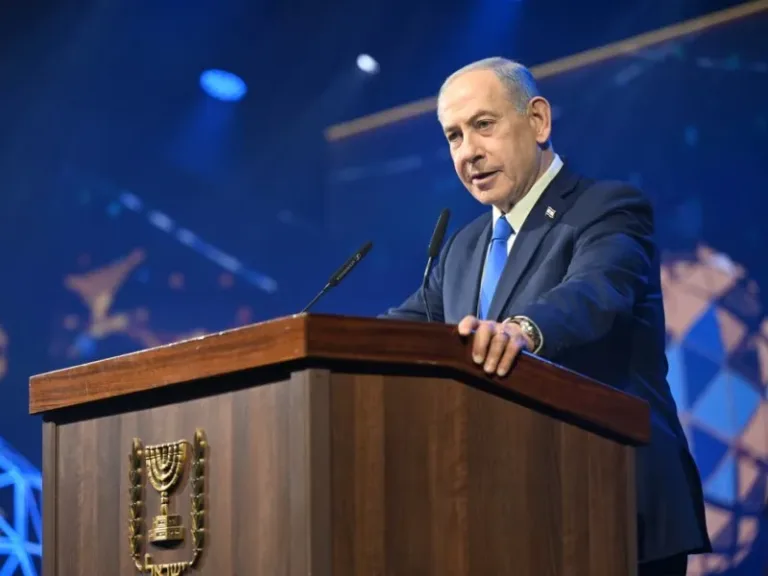
Prime Minister Benjamin Netanyahu, this evening, in Jerusalem, at the Second International Conference on Combatting Antisemitism:
“Minister Chikli, first of all, I didn’t know your English was that good. But it was the ideas that were exceptional and focused. Thank you for initiating this conference. This is the second one, and certainly not the last because the battle is long. You have assembled an impressive team here, and I want to welcome some very good friends of the State of Israel and the Jewish people and personal friends. First, the Minister, or rather the Prime Minister of Australia, Scott Morrison, a terrific, terrific champion of our people. Very good to see you, Scott.
And equally, the former Chancellor of Austria, Sebastian Kurz, another great champion and another great friend. The Minister of Justice of Argentina, Mariano Liberona. He comes not only in his own person, but representing an incredible friend of Israel, the President of Argentina, Milei, he’s breaking all the rules for the good.
There’s here another special friend. He’s the Senior Counsel and Chair of the Department of Justice Task Force to combat antisemitism. Mr. Leo Terrell, Leo, it’s wonderful to see you again. We know your passion. We know that you are doing everything you can to move under President Trump’s directive to fight antisemitism, which is dangerous to America, dangerous to our free world, dangerous to our common civilization. Thank you, Leo.
We have here at Members of Parliament, including the two brothers, Eduardo and Flávio, Bolsonaro. It’s very good to see you from Brazil. There are other Members of Parliament her and distinguished guests. I want to welcome all of you and I hope to meet all of you.
There are here also the family of the late Yaron Lishinsky, who, along with his betrothed, these wonderful, truly beautiful people, beautiful couple, mowed down by this antisemitic hatred in Washington right next to the Holocaust Museum. And we’re, we forever remember the ones that are fallen, and we committed to bring back our fallen heroes and also all the hostages that were taken, and people didn’t believe that we’d get the twenty live hostages. With President Trump’s help, we got them out. With our brave soldiers who went into Gaza, stuck a knife to Hamas, and they realized that their last stronghold was going to go. And President Trump stuck a diplomatic knife on the other side. We got the 20 hostages, but then we had to get another twenty-eight, twenty-eight deceased hostages, and we got them all out, and there remained one, Rani Gvili. Rani Gvili, from the special unit in the police who fought not only with a broken arm, he was shot twice, and he kept fighting, and he killed fourteen terrorists alone. And then he died. And we said we’d bring him back. He was the first to come in. He’s the last to leave, a hero of Israel. Rani is back. There are no more hostages in Gaza. Tremendous achievement for our heroic forces, our soldiers, our commanders, none like them.
Over 20 years ago, I was finance minister of Israel. I was invited to a university in Holland. It’s a very good university. It had, primarily, it had focus on business, and they were giving this Economic Man of the Year award, for some reason they chose me, so I went there. There were about one thousand Dutch students, shortest one was six foot six. Young guys. Young guys. And I gave my talk. I talked about the free-market reforms that we did here.
And then came the questions and answers. And the first one rises. And he said, “Prime Minister, what can we do about the Muslim minority in Holland?” I said, I dodged it. I wanted to talk about reforms, economic reforms. Second one rises. “Prime Minister, you didn’t answer the question. What can we do about the Muslim minority in Holland?” And I dodged that question. And so, it went on. And after this session ends, I walk out with these two young Dutch students, 21, 22 years old, and asked them why did they ask me about this. And they said, “Prime Minister, we are the most liberal country on the planet. We accept everyone. Black, white, yellow, brown, green, any color, any faith, gays, straights, trans, anything. But in this minority, there’s a radical fringe, and it’s different.
Because we want to accept them, but they don’t accept us. They want to impose Sharia law on us. They want to eradicate Holland as we know it.”
This is over twenty years ago. These young kids. And what they said was something prescient. They could see that our common, free, democratic civilization is under threat. And it’s since been invaded, every country in Western Europe and in America. It’s being invaded not by people of a different color, a different race, a different faith. That’s not the point. It’s people with a focused ideology, and the ideology is to destroy the West.
And for this purpose, they’ve made common cause with the most ultra-anti-Western progressives, and they have united, and they supposedly should disagree on everything, but they don’t, because they want to destroy the West as we know it. And they agree on one thing. What is the thing that they agree on? World War Jew. To conduct a world war, first against the Jews and against the Jewish state. And for the radical Muslims, they are right, because there would be no West in the Middle East if the Jewish state is eradicated. There would be no obstacle for the further invasion of Europe if the Jewish state doesn’t exist. And it also appeals to their internal hatred of the Jews, which has common roots with antisemitism over the centuries. What are those roots? Well, it’s a very ancient disease and anti-Semitism as a creed. Not racism. Racism exists for all times. There’s xenophobia and violent xenophobia throughout history. That’s not what antisemitism is. Antisemitism began as a creed, twenty-five hundred years ago, five hundred years before the birth of Christianity, with an ideological attack against the Jews, which is different. And it basically kept on morphing, changed the reason why the Jews were hated. But I’ll tell you why they were hated in the diaspora. Because they had two qualities that were infused together made them very, very vulnerable.
The first thing is they were prominent. The Jews were prominent in every society after we lost our land. We were spread through the far corners of the earth. And in these distant lands, we were prominent. And when you are prominent, you raise a human passion that is all too well known. It’s called envy. But when you fuse envy with vulnerability, when you’re weak and you cannot defend yourself, and this happens when there are societal changes. The combination of being prominent and weak is the deadly serum of antisemitism. And that’s why the Jews throughout the ages, again, elicited attacks again and again and again. And these attacks were always preceded by the most virulent vilifications. What did they not say about us? You’re familiar with what they said about us in medieval times, that we were poisoning the wells, that we were spreading vermin, that we were slaughtering Christian children for their blood to bake matzos in Pesach. You know all that. This was preceded by similar vilifications, even in classical Hellenistic times, right around here, communities around here. And it was carried into the modern times, into basically the same charges, culminating always these vilifications in murder, in massacres, in expulsions, until we reached the greatest massacre of them all in the Holocaust.
The Nazis spread this vilification and then proceeded to murder us. And there was very little we could do. That has not changed. Antisemitism took a respite for a few decades. You couldn’t really do that in polite society. But it raised its head again. And of course, most prominently, after October 7th, when the disease spread again, the virus spread throughout the world.
Why is it important? There was a great writer in the late 19th century. His name was Israel Zangwill. You don’t know him, but if you lived in England in the 19th century, you read his books or saw his play, the Children of the Ghetto. He was a great, great writer. And he became Theodor Herzl’s great supporter in Britain and brought him to Britain. And Zangwill had a saying. He said, “obsta principiis.” That’s in Latin. My Latin isn’t that good. But what it said was, what he meant by that, is oppose bad things when they’re small. Oppose bad things when they’re small. Don’t let bad things. Don’t let evil things grow and grow and grow because it will be impossible to fight them or much more costly to do so.
This is what we are facing today. Antisemitism is pure evil. Anybody in his right mind understands that. But what is not understood was not understood ninety years ago, that when this evil manifested itself in the heart of Germany or before that, as Theodor Herzl saw it, in the turn of the century, of the 20th century, in France, supposedly the most advanced society, when he saw that, he saw the danger not only to the Jewish people, he saw that as a danger to Western civilization.
As did my father. He was a great historian, but he was a young man. He was 23 years old when Hitler rose to power in 1933. And he said that Hitler’s racism will not only cause a Holocaust, the word he used, a Holocaust of the Jewish people. It will destroy the world. It’s the hatred, the evil that will spread unopposed and that we must harness. The people of the world, the people of the free world to understand that if it’s not stopped here, the darkness will spread everywhere.
This is what we face today. This is what Amichai Chikli just said. It’s not just a Jewish problem. It is, of course. It is. But it’s humanity’s problem. It’s the world’s problem. And we must fight it. I salute all of you who came here today, because our goal is to fight, fight, fight, and our cause is to win, win, win. This is what we’re here for. And we must do so, because if the invasion of militant Islam, radical Islam continues, our free societies are in peril; our world is in peril. If the regimes that harbor it and promote it acquire nuclear weapons and the means to deliver, every one of your cities will be under threat. Every one of your societies will be under threat. And what Israel is doing today is not merely defending itself. It’s defending you. It’s defending all of you.
And I’ll tell you what the difference is. The difference is that in our centuries of exile we could do nothing against these vilifications except flee, because we could not fight. We didn’t have a state, we didn’t have an army. We had no weapons. We lived in societies that outlawed our ability to even defend ourselves or hold a weapon. So we were led to the slaughter.
But this is the change that we’ve brought to Jewish history. We now have a state. We have an army second to none. We have soldiers. We have young men and women who are willing to fight, who are willing to die to defend our people and defend our future. Heroes like no other. And this change is something that makes all the difference. Because they can vilify us but they can’t destroy us.
We’re in the process of blocking the Iranian Shiite radical axis. There’s another one, it’s the Muslim Brotherhood, the radical Sunni axis. We’ll defend ourselves, but will the West defend itself? This is what we’re here to discuss. This is what we’re here to promote. And we know that this poison has now penetrated mainstream media. All global institutions, all governments that are faced often with Islamist constituencies, and their leaders, unlike the leaders that I mentioned before, they do not take a stand, they cower, they fall back. And of course, it’s most prevalent in the social media. This is the new battlefield. And this is where we must counter with our own weapons. We are late in the game, but we will win this battle too as we won on the battlefield, because we are developing the means to fight this. Not with cavalry against F35s, with F40s against F35s. This is the next thing.
I urge you, all of you, not merely to bemoan our problems. I urge you first to understand that we are joined in battle, and it’s as important for us to muster our courage, our creativity, our willingness to fight. It’s the most important thing. In battle, the most important thing is tenacity, the willingness to fight. There are many other things that are important but this is first. If you don’t have that, you have nothing.
So, I want to address myself first to young Jews everywhere. To Jews everywhere but especially to young Jews facing intimidation on campuses and city centers. I say to them don’t be afraid, don’t cower, don’t bow your head. Speak up, stand up, fight back, because this is how we endure. We fight and fight and fight. And to the leaders in this hall and to the world I say this: History will not remember those who merely denounced hatred in polite language. History will remember those who acted, those who defended truth when it was easier to look away. Those who stood with the Jewish people when others equivocated. Because when you stand with us, you stand with yourself. You must come out and you must speak very clearly and you must declare: no more antisemitism, not here, not now, not anywhere, not on the Right, not on the Left. And let us fight the lies with truth, because lies are the foundation of antisemitism. Truth is the antidote. May the light of truth shine from Jerusalem, and may we meet again next year in the third conference in a better, brighter, and more truthful world. Remember, if we fight, we win, and we shall win.”
Related Topics