










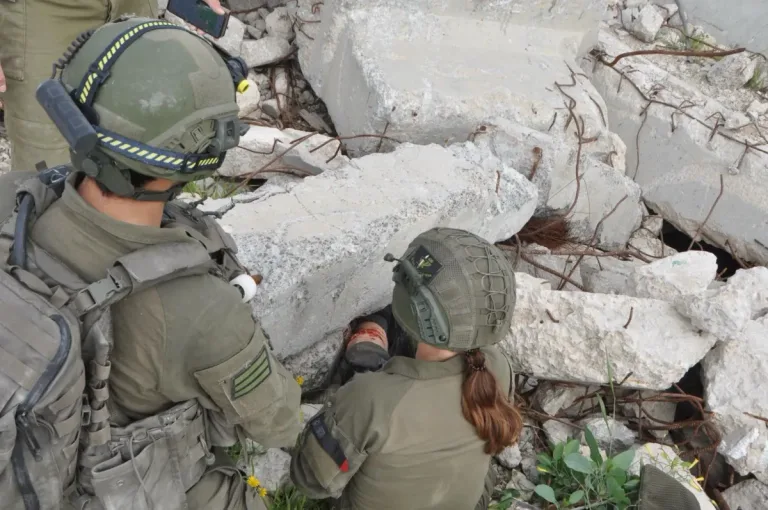
Whether it’s medics, paramedics, nurses, or doctors, whether in regular reserve duty, from infantry brigades or from the Air Force, the ‘Medic-Rescuer’ course of the Home Front Command trains all medical personnel in the IDF in advanced rescue medicine – in just one week.

Throughout the course, like the one that concluded recently, the approximately 30 trainees focused on providing aid for unique injuries, operating in environments with collapse hazards, and complex terrain. “Providing treatment at a destruction site is light-years different from treatment in any other condition,” states Sergeant Major Y., a rescue medicine instructor in the course. “We are required to consider many variables such as trauma, psychological first aid, and functioning even underground.”
“Unlike combat medic courses and other courses at Bahad 10, which specialize in treating soldiers and their peers, rescue medicine requires knowledge of all population segments and tailoring the relevant treatment to them,” he elaborates. “The ‘Medic-Rescuer’ trainees practice providing assistance to children, the elderly, or individuals with various underlying medical conditions.”

Another significant challenge, as mentioned earlier, is the confined and subterranean environments at destruction sites, which require careful entry, sometimes crawling: “The fundamental difficulty is that the injured cannot be evacuated immediately. Therefore, we must perfect teamwork and communication, as not all medical equipment can physically reach the patient and assess the situation as required. But even when it’s dark and the air is suffocating – we continue with all our might and provide rapid initial treatment.”
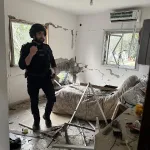
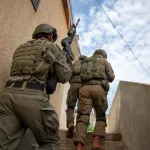
The week concludes with a Mass Casualty Incident (MCI) exercise at the destruction site in Kibbutz Zikim. The scenario: a missile strike on an urban structure. “The participants scan the area, locate trapped individuals, provide initial medical assistance to prevent deterioration, and then triage them according to urgency,” testifies Sergeant Major Y. “The evacuation priority is determined by several parameters, not just the severity of the injury – they consider the complexity of the rescue and the medical resources that can be brought to the trapped individual in their condition.”
Subsequently, they are required to gather the rescued individuals and transfer them for in-depth treatment – and decide whether to call for a helicopter or an ambulance, and to which hospital it is most appropriate to evacuate them.

“MCI is a difficult and complex situation,” declares Private First Class R., a trainee in the course and a medic in the Tavor Battalion, regarding the final exercise. “Initially, all forces converge to find all trapped individuals. You shout, scan, and compile situation reports. Then you have to decide who is evacuated when, who to focus the rescue effort on now – there are many considerations that, at the critical moment, can save lives.”
The exercise lasts for many hours, from morning until night, and encompasses everything learned throughout the week: “Our part doesn’t end with initial treatment, because the ambulance won’t be able to reach and evacuate the injured within a few minutes. Precisely because of this, it’s our responsibility to think long-term, to estimate and plan how long the evacuation will take – while on the move.”

Beyond the practical work, MCI demands mental resilience and high emotional readiness. “Fear and stress can affect physical treatment, so in these moments, our response also becomes psychological,” she emphasizes. “We practiced treating people with disabilities, difficulties, and anxiety – things that are important to know how to deal with when dealing with incidents involving the civilian population.”
During the course, trainees also simulate casualties themselves, for the practice of other medics, thus fostering empathy and a deeper understanding towards those whose lives are in their hands: “Experiencing the situation from the other side, through different eyes, those for whom you are ultimately doing this, changes everything. The broader perspective improves performance and increases motivation.”

As part of the week, the medics undergo a perceptual shift regarding the reception of a casualty and the relevant treatment. “The condition of the patients is always dynamic and not straightforward. Things can change in an instant: the condition can deteriorate, and there can be other hidden injuries and complications,” notes Sergeant Major Y. “Especially amidst the rubble, when the trapped individual might be covered in dirt or not fully visible, it’s always important to continue building the complete picture, connecting point by point, and performing further assessments.”
After the concluding exercise, once all casualties were rescued, the trainees received their ‘Rescuer Medic’ certification, a pin, and a special patch.
But beyond the important training, the medics and paramedics arrive with considerable experience from the battlefronts of the past two years. “Unfortunately, in the war, we have often encountered situations requiring rapid and precise treatment at destruction sites,” points out Private First Class R. “Precisely because of this, the course is so important – especially for medical teams, whose role it is to rescue and assist, everywhere.”
Related Topics