
These are the days of the British Mandate, and the then-commander of the Palmach, Yigal Allon, decided to establish an ‘Arab Department’ named ‘HaShachar’ (The Dawn), to gather intelligence from Arabs residing in the country and neighboring nations.
Its operatives, the Palmach’s ‘Mista’arvim’ (undercover agents), integrated into Arab communities, primarily in the Land of Israel, but also in Baghdad and Damascus, and were involved in smuggling Jewish immigrants in the late Mandate period. To create cover stories for themselves, ‘HaShachar’ fighters were sent to embed themselves in large workplaces in those countries.
During the War of Independence, the Palmach merged into the nascent IDF, and with it, the ‘HaShachar’ department, which received a new name – ‘Intelligence 18’. Its soldiers were sent on various espionage missions in and outside the country, and established agent cells in Beirut and Damascus, where they collected intelligence and carried out various intelligence-gathering operations. They maintained regular contact with their handlers in Israel using a radio set sent to them, and later were also equipped with explosives, weapons, and money delivered by boat.
During September 1948, intelligence information reached the commanders of the young Navy about the docking of the ‘Igris’ in the port of Beirut: a ship that was used until the beginning of World War II for the leisure of Adolf Hitler and other senior Nazis. At that time, its name was ‘Guerilla’, and the Führer planned to sail on it on the Thames, while receiving Britain’s instrument of surrender – a plan that, of course, never materialized.
With the start of the war, the ‘Guerilla’ was armed with military equipment and sent to the North Sea, where it underwent several transformations. After the defeat of the Nazis in 1945, the ship was taken by the British Navy to England and disarmed. About two years later, it was sold to a Lebanese industrialist for £375,000.

The ‘Igris’. Museum of Illegal Immigration and the Navy
“But the one who actually stood behind the purchase was none other than Farouk I, King of Egypt. The nascent IDF feared that the ‘Igris’ was intended to become a warship for the Egyptian Navy, and it would be convenient to arm it with cannons in Beirut,” reveals Yaron Bachar, an expert in the history of ‘Intelligence 18’.
“The Navy, which was then engaged in naval combat against the Egyptian Navy, feared that the ‘Igris’ was actually intended to become a warship, armed with cannons and joining the Egyptian Navy,” elaborates Colonel (Res.) Dr. A., Director of the Sayeret 13 Learning and Heritage Center.
“Efforts were made to gather intelligence on it even before its arrival,” Bachar explains, “The Mista’arvim cell in Beirut provided pieces of information, which they fed to the IDF’s Intelligence Department. For example, they took seemingly ‘innocent’ photos with the ship in the background, and in one of them, they wandered around the port as tourists and drew a complete and detailed map, disguised as an artistic painting. The agents also spoke with local sources, extracted information from documents, and so on.”

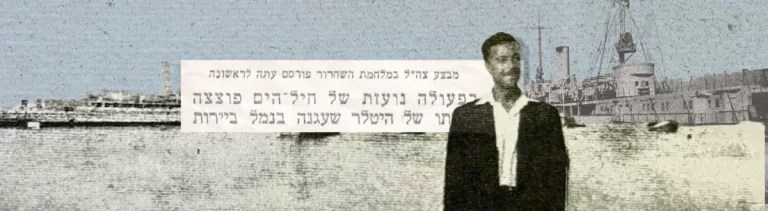
One of the Mista’arvim cell members posing with the ‘Igris’ in the background. IDF Archive
All findings indicated that a deceptive operation was required to thwart the threat. The Navy and Intelligence 18 decided it would be appropriate to train a Mista’arav for naval diving and demolition capabilities. One of the ‘Intelligence 18’ Mista’arvim was chosen for the mission, led by the Navy – Eliyahu Rika. The fighter was selected for the mission for a reason: he was slated to be part of the cell in Beirut, and therefore knew the local population well, so if the operation went wrong, Rika could blend in quite naturally.
Yos’eleh Dror, who later co-founded the Navy’s elite unit, Sayeret 13, with Yohai Ben-Nun, was chosen to be responsible for Eliyahu’s training and preparations for the operation, which was codenamed ‘Operation David’.
“Yos’eleh gained his experience in naval demolition operations against the British Navy as part of the struggle for Aliyah Bet (illegal immigration). At that time, he was the commander of the naval demolition divers unit, and he prepared Eliyahu for the daring operation: which required a lot of sharpness and impressive swimming abilities. The team taught him to swim, dive, carry an explosive charge – and how to properly waterproof it so it wouldn’t get wet,” describes A’.
The appointed hour was set for the end of November, and the waters in the port were frozen. For many long weeks, they trained for precise night diving, with heavy loads, and engaged in naval demolition – in harsh cold conditions.
Indeed, on November 29, 1948, INS Palmach departed from the port of Haifa northward, towards the shores of Beirut. In the evening, the Mista’arvim disembarked from the ship into small wooden boats, and under the cover of darkness, they deployed on the shore. There, Eliyahu arranged the equipment on his back, checked that everything was in order – and set off.
“Swimming in this bay is quite complicated,” explains Yaron Bachar, “There are fishing boats and searchlights illuminating the water, as well as guards patrolling and securing the anchored ships. Eliyahu swam in the cold water for almost two hours, with 4 mines on his body. At one point, he reached the ‘Igris’, attached them to the hull, and swam back to shore.”

Eliyahu Rika’s swimming route. IDF Archive
There, the Israeli team picked him up and gave him rum to drink, thinking it would help him warm up quickly: “He was completely blue from the long swim, but his part of the mission was completed. The mines were supposed to detonate several hours later, and Eliyahu Rika was quickly returned to Israel, as if he had never left.”
Almost three weeks passed, and the ship did not explode – which worried the operation planners in Israel. “They used a mine with a time delay mechanism composed of salt tablets, and additionally a ‘disarming’ mechanism that activates the charge the moment someone tries to remove it,” explains Colonel (Res.) Dr. A’.
And then, one day, there was a small ‘boom’. “It wasn’t as dramatic as in a Netflix movie, or an atomic bomb mushroom cloud,” Bachar reassures, “but it made a small hole, which was enough for water to enter the yacht’s hull, causing it to list to its side – and become inoperable.”
King Farouk, who intended it to become a warship in his army, lost interest in it because all repair attempts failed. “He left the poor Lebanese industrialist with a holed ship and debts up to his neck. He then sailed it to the United States to try and sell it there as a casino ship, but this attempt also failed – and it was scrapped there,” Bachar describes the sequence of events.
And after all, as a non-singular collaboration between the Navy and Aman (Military Intelligence), the damage to the ‘Igris’ constituted the thwarting of a potential threat to our nascent state, and its incapacitation was an achievement for the emerging army: the completion of a covert mission deep in Lebanon that also carried symbolic significance.