
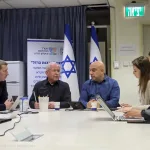



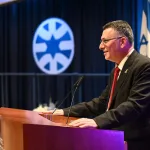









FM Sa’ar speaks to Sharri Markson on Sky News Australia
FM Sa'ar speaks to Sharri Markson on Sky News Australia, discussing critical Israeli foreign policy and regional developments.





FM Sa'ar speaks to Sharri Markson on Sky News Australia, discussing critical Israeli foreign policy and regional developments.
Real-time breaking news coverage from Israel and the Middle East. Stay informed with the latest developments as they happen.
Israeli Chief Justice eulogizes Judge Beni Sagie, a rising star in the judiciary and President of the District Court in Be'er Sheva, remembering his dedication.
My son,
I stand here and cannot believe it. I refuse to believe that the journey of your life was cut short so suddenly and painfully. The words I am reading now from this page were carved out of the sorrow, shock, and pain that befell us all. We stand here with your family, with your parents, with your beloved wife Yael and your children, with your many friends and admirers – multitudes – and still cannot believe, cannot comprehend that this has happened.
In legal circles, the name Benni Sagie is synonymous with professionalism, dedication, determination, and out-of-the-box thinking. Benni was a rising star in the judiciary: he was appointed to the bench at a young age, went from strength to strength until he became the President of the district court in Be’er Sheva.
Day after day, Benni would arrive early in the morning at the courthouse, first in Tel Aviv and then in Be’er Sheva, enter the courtroom, and sit down to do justice. No headlines, no fanfare – just to do justice.
The long focus days, which were Benni’s hallmark, were a fascinating lesson in both criminal law and human understanding. Benni knew how to truly listen to the parties who appeared before him. He brought with him a deep knowledge of the intricacies of criminal law; but no less knowledge – of the intricacies of human beings, their hopes, their motives, and their desires. Benni was an expert in the delicate seams between law and life.
Anyone who had the privilege of knowing Benni could not help but be impressed by his stature, both physical and metaphorical. Benni was a great man in every sense of the word, an exceptional legal talent, and a rare individual from whom charisma simply flowed. A man with a huge heart, a man whom everyone, but everyone, loved to love – judges, staff, lawyers, even defendants – everyone who met him was immediately captivated by his charm.
In his roles as Vice President and President of the courts in Tel Aviv and Be’er Sheva, Benni was a true force of nature. I will not exaggerate if I say that he worked wonders wherever he went, and so it was at the District Court in Be’er Sheva, which he unified and led in the last year and a half. Benni was a president who managed with a systemic vision and a sense of justice, and was meticulous in leading primarily through personal example. I have no doubt that were it not for this terrible tragedy, Benni would have achieved many more accomplishments in the court system and beyond.
Benni’s passing leaves a great void in the hearts of many, in the heart of the judiciary, and also in my heart. As someone who knew Benni since he was in the Magistrate’s Court, I was impressed by him anew at every conference and every meeting, and I greatly appreciated his professional approach as well as his good spirit and sharp sense of humor.
A special and deep bond connected Benni with the Director of the Courts, Judge Tzachi Uziel – a bond that began at the start of their careers, during their internships, and was built over years of friendship and partnership.
On weekends, Benni and Tzachi would walk around Tel Aviv – and so they also walked the paths of life: on their professional journey and in the court system. They developed together, were shaped together, and a deep, sincere, and rare true friendship was forged between them. Tzachi, I know you have lost a soulmate and life partner, I share in your sorrow.
Benni’s loss is a deep personal blow to all who accompanied him – from the beginning of his path until that accursed yesterday.
In an article you wrote, Benni, you stated that “a judge is a human being who is required daily to make complex decisions concerning people like himself. […] A judge who does his work faithfully is a judge who enters the courtroom with knowledge, the ability to listen, openness to be persuaded, and a clear understanding that he too might err in his ruling.”
You preached well, Benni, and you practiced well. You were a guide to many judges, you shared your experience, your insights as a judge and as a human being.
Benni – you were a champion in human relations, a champion in judicial work, a champion in criminal law, a champion in arrests, mediations, and plea bargains in the most complex cases, a champion in your unbelievable work output, in your endless dedication to judicial work, in your burning belief that it is possible and necessary to work with youth, to speak with students at eye level and introduce them to the justice system. Benni – you did not condescend to the people, because you were always among the people, part of the people, loving people as they are, a man of the people. So many people testified that you were their friend, because indeed you were everyone’s friend, a true and unquestioned consensus.
Benni, I hope that your image, your work, and the values you championed will be a small comfort to your dear family whom you loved so much. They were your pride. To your parents – Yossi and Frida; to your sisters – Sharon and Neta; to your dear wife Yael; and to your beloved children – Rani, Gili, and Ori – there are no words that will be adequate comfort. We bow our heads in deep sorrow, and ask to embrace you on behalf of an entire system. We will continue to stand by your side.
Benni, we will miss you very much.
Alas for the lost and unforgotten. We will not forget you, Benni.
Dr. Sharon Alroy-Preis requests to conclude her term as Chief Executive of Israel's Public Health Division, a role she held during the COVID-19 pandemic.
Dr. Alroy-Preis joined the Ministry during an exceptionally challenging period at the onset of the COVID-19 pandemic, leading the Public Health Division’s response to the crisis, including developing policy and overseeing the national vaccination campaign.
During her tenure, the division also tackled a range of significant public health challenges, including providing healthcare services to populations evacuated during Operation “Iron Swords” and managing a measles outbreak.
In parallel with emergency response efforts, long-term systemic initiatives were advanced under her leadership, including establishing a health intelligence system, creating a national vaccine registry and digital vaccination record, advancing food business licensing reform, and preparing the healthcare system for the impacts of climate change.
Ministry of Health Director-General Moshe Bar-Siman-Tov: “I sincerely thank dr. sharon Alroy-Preis for her many years of professional service to public health in Israel and her contributions as a senior member of the Ministry’s leadership. Her impact is evident both in crisis response and in the development of long-term systemic infrastructure.”
The process to appoint a new Chief Executive of the Public Health Division will begin in the coming days, in accordance with established procedures.
Israel's energy economy proved resilient this past year, overcoming damage and record consumption to ensure no shortages. The nation also strengthened its.
Minister of Energy and Infrastructure Eli Cohen: “The past year has proven that the State of Israel has a strong energy economy. Despite damage to strategic facilities during the ‘With All Our Might’ operation, and breaking electricity consumption records during the summer heatwave, there was no shortage of electricity, water, fuel, or natural gas. We strengthened our position as a regional energy superpower with the approval of the natural gas export deal to Egypt, the largest in the country’s history. In addition, the electricity reform, the largest consumer reform since the cellular reform, continues at full force on its way to two million citizens who will enjoy electricity at a reduced price. We will continue next year to work to strengthen the position of the State of Israel, and for the benefit of all citizens.”
Director General of the Ministry of Energy and Infrastructure, Yossi Dayan: “The past year has demonstrated more than ever the strategic importance of a strong, diverse, and resilient energy economy. Even against the backdrop of security and regional challenges, the Ministry of Energy and Infrastructure has led a significant leap forward – in expanding renewable energies, in strengthening the natural gas economy as an economic and geopolitical anchor, and in laying infrastructure for the day after: artificial intelligence, storage, hydrogen, and future energies. Alongside this, we have advanced consumer reforms, strengthened the energy security of Israeli citizens, and deepened international collaborations that position Israel at the forefront of global energy. We will continue to act with determination to ensure an advanced, safe, and sustainable energy economy for the benefit of the economy, society, and future generations.”
The Ministry of Energy and Infrastructure summarizes the past year’s activities, which were full of unprecedented achievements:
Natural Gas:
In recent weeks, approval was signed for the natural gas export deal to Egypt, the largest deal in the country’s history, worth NIS 112 billion. The state’s expected revenues from the deal amount to NIS 58 billion. The deal strengthens Israel‘s position as a regional energy superpower and contributes to political and security interests. As part of intensive negotiations led by the Ministry’s Director General Yossi Dayan, priority for the domestic market was ensured at all times, as well as an attractive price for the domestic market that will ensure continued low energy prices. It should be noted that, thanks in part to natural gas, the price of electricity in Israel is 50% lower than the average price in Europe on an annual comparison.
In addition, the Ministry will soon publish another competitive tender for natural gas exploration in Israel’s economic waters, following the issuance of exploration permits last year to two international energy giants: Britain’s BP and SOCAR from Azerbaijan.
In the first half of 2025, state revenues from natural gas royalties, minerals, and fees amounted to approximately NIS 980 million, and are expected to exceed NIS 2 billion by the end of the year. Concurrently, the Ministry continued to promote connections of peripheral areas to natural gas: the connection of the Jordan Valley and Beit She’an to the natural gas grid was completed, with an investment of approximately NIS 10 million. Furthermore, the Ministry’s Natural Gas Authority continued to connect hospitals to natural gas, and their number now stands at 10. In addition, the Ministry connected approximately 40 large consumers to the natural gas distribution network, the highest number of connections to date for a single year.
Chen Bar Yosef, Director of the Nature Resources Administration at the Ministry of Energy and Infrastructure: “We are pleased that through intensive teamwork led by the Minister of Energy and Infrastructure and the Director General of the Ministry, we have achieved significant improvement, both in energy security in terms of increasing expected production capacity, and in state revenues which are expected to rise to billions of shekels per year. This, alongside the entry of significant international players into the natural gas market. The natural gas production sector, under our leadership, has demonstrated energy resilience, strength, and flexibility in dealing with the ‘Swords of Iron’ war, the ‘With All Our Might’ operation, and all the threats that arose from them. We will continue to supply this product safely and continuously to electricity consumers in Israel.”
Moshe Grazi, Director of the Natural Gas Authority at the Ministry of Energy and Infrastructure: “Despite a complex security reality, the natural gas economy maintained stability and enabled energy continuity for the electricity sector. Simultaneously, many connections to the economy were advanced, and a record number of new consumers for the year was recorded, particularly in the periphery, alongside steps to strengthen competition. For the first time, a license was revoked from a private company due to delays in connecting consumers, and it was transferred to Netagaz – a move to strengthen infrastructure in the Jerusalem area.”
Performance of the Energy Economy During the War:
Throughout the war, including the ‘With All Our Might’ operation, the electricity sector functioned flawlessly. Despite damage to strategic facilities, and even the shutdown of some natural gas platforms, there was no shortage of electricity, water, fuel, or natural gas, and emergency reserves were not even used. During the war, the Ministry of Energy and Infrastructure, along with all government energy companies, held daily situation assessments and meticulously supervised supply and consumption.
Electricity Reform:
The electricity reform, launched in July 2024, continues to gain momentum, and during the year, over 100,000 households and businesses, representing about half a million customers, joined it. Customers who left the Israel Electric Corporation and moved to private companies are enjoying a discount of 7% – 20% on their electricity bills, saving hundreds to thousands of shekels per year. The Ministry of Energy and Infrastructure is promoting measures to increase the electricity supply for private companies, in order to increase competition and enhance discounts.
It should be emphasized that this year’s State Comptroller’s report found that the Ministry of Energy and Infrastructure is the ministry that has done the most regarding the cost of living. The reform in the import of electrical products, led by the Ministry, reduced the regulatory and bureaucratic burden on importers, increased competition, and led to the introduction of a wider variety of energy-efficient products. The reform led to a decrease in the prices of household electrical products in a vast market of over NIS 10 billion per year, as well as annual savings of hundreds of shekels for each household.
Renewable Energies:
Ron Eifer, Director of the Sustainable Energy Division at the Ministry of Energy and Infrastructure: “This year, we expanded Israel’s use of renewable energy by over 15% with the addition of approximately 1,000 megawatts of clean energy. This is a dramatic increase.”
As part of an overall strategic vision, Israel has been working for several years to promote renewable energies as a central anchor in Israel’s energy economy goals. Within this framework, numerous projects have been advanced, covering a wide range of areas from public information accessibility, through the removal of regulatory barriers in the field, to encouraging the establishment and use of renewable energies and the transition to sustainable and renewable energy:
During the operational year, the Ministry of Energy and Infrastructure’s Sustainable Energy Division led several flagship projects:
Promoting Policy and Strategy for Economic Development, Climate, and Diversification of Sources:
Sharon Chatzor, Deputy Director General for Policy, Planning, and Strategy at the Ministry of Energy and Infrastructure: “Today we are already planning for the days after natural gas, with nuclear being one of the things we are considering.”
As part of the multi-year strategic plan for the energy economy, the Ministry has also promoted the development of additional energy sources this year, including nuclear energy and hydrogen. In this context, the Ministry led a multi-sectoral forum on hydrogen this year. The multi-sectoral forum included government officials, entrepreneurs, technology companies, and various organizations, and formulated a published report, including policy steps, among them support, together with the Israel Innovation Authority, for the establishment of a pilot site for fuel alternatives with an emphasis on hydrogen. In addition, the Ministry will soon publish calls for proposals for the establishment of a hydrogen valley in the eastern Negev.
Furthermore, understanding the strategic importance of international connections and collaborations, the Ministry of Energy and Infrastructure continued to work this year to strengthen strategic ties, with agreements signed during the year with:
Research and Development:
Prof. Brian Rosen, Chief Scientist of the Ministry of Energy and Infrastructure: “Grants through academic research tracks, such as Startup and Pioneer, provide significant support for the development of promising energy technologies. We expect that this year’s grant recipients will contribute to the growth of Israel’s energy market by establishing new companies and expanding the activities of existing companies. In addition, the Ministry places great importance on supporting the next generation of scientists and engineers in the energy fields, including through excellence scholarships. These tools are designed to encourage students to choose fields of study essential for strengthening Israel’s energy security.”
Based on a clear policy to promote innovation and new technologies, the Ministry of Energy and Infrastructure invested over NIS 23 million this year in promoting groundbreaking technologies and research in a variety of fields, including: electricity, energy storage, renewable energies, transportation fuel alternatives, hydrogen, energy efficiency, water, and energy recovery from waste. Within this framework, the Chief Scientist’s unit in the Ministry awarded grants to 18 innovative projects in the Startup and Pioneer tracks amounting to approximately NIS 13.4 million, and also provided funding of approximately NIS 10 million for 21 advanced research projects from Israeli academia, as part of the commitment to lead Israeli scientific and technological innovation.
Physical Planning
Ariel Prinz, Senior Director of Physical Planning at the Ministry of Energy and Infrastructure: “The year 2025 was characterized by significant planning activity in the energy economy. The promoted initiatives lay the groundwork for continued growth in the establishment of dual-use facilities, and particularly for the expansion of the agro-voltaic market led by the private sector, alongside encouraging the installation of storage facilities and government promotion of large-scale solar facilities in reclaimed areas.”
In 2025, the Ministry of Energy and Infrastructure achieved significant progress in physical planning, as part of efforts to expand energy infrastructure and meet government renewable energy targets. Among the key achievements are the approval for validation of the integrated infrastructure corridor from the Arava Junction to the Timna area (TAMA 37/3/E) – a strategic plan of approximately 160 km along Highway 90, including integrated infrastructure complexes that will enable the connection and transmission of various infrastructures to and from the south of the country, while adhering to principles of integrated infrastructure and minimizing damage to land resources. Concurrently, the formulation and approval by the subcommittee of TAMA 1/24 were completed – groundbreaking planning regulation in the field of agro-voltaic facilities, which is expected to receive final approval in early 2026. This TAMA will enable the orderly promotion of solar facilities over agricultural land, including in urban areas and high-demand zones, and will even allow for the issuance of permits without the need for a detailed plan.
In addition, a large-scale solar site in the Timna area (TATL 116) was approved for validation, and the planning of another site in the Halel Reservoir dams in the Eshkol region was completed – its approval is expected in early 2026. All of these were carried out using reclaimed areas and constitute central infrastructure for promoting renewable energy production in Israel.
Fuel and Gas Administration
Bat Sheva Abuhazira, Director of the Fuel and Gas Administration at the Ministry of Energy and Infrastructure: “The year 2025 highlighted the importance of a strong and stable fuel economy. Even under complex operational and security challenges, the Fuel and Gas Administration ensured full supply continuity to the economy, while continuing to promote national infrastructure, hydrogen solutions, renewable fuels, and clean transportation – as part of a broad and long-term energy security vision for the State of Israel.”
During 2025, the Ministry of Energy and Infrastructure’s Fuel and Gas Administration led a series of key and significant initiatives that were at the core of Israel’s energy economy activities. During the ‘With All Our Might’ operation, the Administration had to contend with exceptional operational and security challenges, while maintaining the stability of the fuel economy and ensuring supply continuity to all sectors of the economy – industry, transportation, defense, and more.
Concurrently, the promotion of national infrastructure continued in accordance with government decisions, focusing on the establishment and expansion of storage facilities for refined products and LPG, the construction of marine connections, strengthening the supply system at ports, and other infrastructure projects essential for the energy security of the State of Israel. This year also marked a milestone for the entry of hydrogen technology into transportation, with the promotion of a national initiative to establish a second hydrogen station and the purchase of hydrogen-powered trucks – a move intended to pave the way for wider hydrogen penetration into the transportation sector.
In the sustainability domain, the Administration continued to promote renewable and clean fuel solutions, by developing regulatory tools and incentives to reduce the use of polluting fuels and decrease emissions from the transportation and industrial sectors. In addition, significant progress was made in the deployment of public charging stations for electric vehicles, in cooperation with local authorities and private entrepreneurs. This is an important step in promoting smart and clean transportation, while creating a reliable and accessible infrastructure for the general public.
In general, the year 2025 was characterized by a combination of ongoing management of a sensitive and complex fuel economy and the promotion of innovation, the establishment of infrastructure for a green future, and the fulfillment of national energy policy goals.
Tel Aviv Stock Exchange adjusts hours to Monday-Friday, syncing with global markets and drawing international investors by increasing Wall Street and European.
Jerusalem, 5 January, 2026 (TPS-IL) — The Tel Aviv Stock Exchange on Monday began following a Monday-to-Friday trading week, aiming to sync with global markets and draw international investors. Friday sessions will close at 2 p.m. before the Sabbath, replacing the former Sunday-to-Thursday schedule.
TASE says the change increases overlap with Wall Street and European markets, giving Israeli investors more opportunity to respond promptly to major global market developments and announcements, while maintaining local observance of the Jewish Sabbath.
Israeli authorities arrested Lakachao Damash, suspected of Iran-linked spying and photographing near ex-PM Naftali Bennett's home, receiving money for.
As part of a joint operation by investigators from the Serious Crime Unit in the Shfela region, police officers from the Rishon Lezion station, and the General Security Service, Lakachao Damash (30, Rishon Lezion) was arrested during December 2025 on suspicion of committing security offenses under the direction of Iranian elements.
His investigation revealed that in recent months he had been in contact with Iranian intelligence elements and was instructed by them to carry out a variety of tasks for which he received various sums of money.
Damash was arrested after being identified as someone who had photographed near the home of former prime Minister Naftali Bennett. In his interrogation, he admitted that before carrying out the photography, he was asked by his handler to purchase a car camera for the purpose of carrying out the mission, an old mobile phone, and a SIM card, for communication with the handler.
His activation began with simple tasks, such as hiding a cigarette box and taking photographs, and later transferring various photographs to his handlers, which he carried out in his city of residence and in other cities.
According to the assessment, similar to the investigation of Vadim Kuprianov, which was published on 25.12.2025, these are intelligence gathering missions by Iranian elements in order to advance harm to former Prime Minister Naftali Bennett.
At the end of the investigation, an indictment was filed against Damash
Dr. Sharon Elorai-Price resigns as Israel's Public Health Chief, having led crucial efforts during the COVID-19 pandemic and the Swords of Iron war.
Dr. Alrai-Price joined the ministry during a particularly challenging period with the outbreak of the Corona pandemic, and led the Public Health Division’s activities in dealing with the crisis, including policy formulation and leading the national vaccination campaign.
During her tenure, the division dealt with a series of other significant challenges, including providing a health response to evacuated populations within the framework of the “Swords of Iron” war and dealing with the measles outbreak.
In parallel to emergency activities, long-term systemic initiatives were advanced during her tenure, including the establishment of a health intelligence system, a national vaccine repository, and a digital vaccination record, advancing a reform in food business licensing, and preparing the health system for the impacts of climate change.
Director-General of the ministry of Health, Moshe Bar Siman Tov: “I thank Dr. Sharon Alrai-Price for her many years of professional contribution to public health in Israel and for her work as a senior management member in the Ministry. Her contribution is evident both in dealing with emergencies and in building long-term systemic infrastructures.”
In the coming days, the process for filling the position of Head of the Public Health Division will begin, in accordance with procedures.
Israel seeks a West Bank Planning Control Officer (Grades 36-41) to advance planning procedures, promote local plans, and ensure legal compliance in Judea and.
Promoter of Planning and Control, Grades 36-41, Rank 11, Academic Staff, Planning Bureau in Judea and Samaria for:
Education:
Academic education (Bachelor’s/Master’s degree): in Geography / Architecture / Civil Engineering or Urban and Regional Planning.
For architects and engineers – registration in the Engineers and Architects Register.
Experience:
Experience will be counted prior to receiving the degree.
Additional Desired Qualifications:
Full-time position.
Thank you for your interest in applying for the position.
To submit your application, you will be directed to the Civil Service Commission website. In the job listing, scroll left and click the “Submit Application” button.
Last date for submitting applications for the tender: 19/01/2026
Here you can find extended information about the submission process and the tender process.
This document is written in gender-neutral language according to Hebrew language rules and addresses both women and men.
This position is eligible for a recruitment bonus. For information on the subject – click here
Israel approves therapeutic farms for trauma victims, providing occupational support for combatants, at-risk youth, and animal rehabilitation.
Against the backdrop of the complex reality during the war, and at a time when more and more Israelis need spaces for rehabilitation and healing, the Ministry of Agriculture and Rural Development and the Israel Land Authority are publishing a new framework that for the first time allows for regulated use of agricultural land for the establishment of therapeutic and rehabilitative farms. The new policy will enable the establishment of agricultural farms that provide occupational support for combatants and those dealing with post-trauma, educational farms for at-risk youth, and frameworks for people with disabilities. Additionally, the framework defines a dedicated track for rescue and rehabilitation farms for abandoned or injured animals. The move removes barriers for non-profit organizations and social entrepreneurs, regulates existing activity, and allows them to operate on agricultural land continuously and without interruption.
Recently, many people across the country: combatants, evacuees, affected families, and civilians exposed to difficult events, are dealing with physical and mental injuries. A large portion of them experience anxiety, depression, post-trauma, or feelings of loneliness. The need for rehabilitation and healing frameworks is greater than ever, and the demand for therapeutic solutions on this issue is only growing. On the other hand, the agricultural space and nature prove themselves time and again as a healing engine. Proximity to the land, manual agricultural work, being among animals and vegetation – all of these contribute to reducing anxiety, strengthening a sense of belonging, and creating a supportive, non-judgmental framework. Now, on the initiative of the Ministry of Agriculture and Rural Development and in cooperation with the Israel Land Authority, a regulated response to this need will be provided, through the new framework.
The war accelerated this process. Within months, new farms were established across the country, some for combatants, some for reservists, and others for youth who fell into distress due to the events. Now, for the first time, the Ministry will allow any moshav and any kibbutz to regulate such activity on part of its lands. Thus, therapeutic farms will be able to operate with full recognition and in a stable, long-term manner.
Rimona Farms Association operates agricultural education-therapy complexes throughout the Negev. The farm works with youth on the verge of disconnecting from the education system, with combatants and individuals undergoing processes of coping and rehabilitation from post-trauma, and with communities affected by the events of October 7th. At the association’s farms, therapeutic processes, agricultural work, and community support take place, providing a healing space for thousands of people. The farms are currently in the process of regulation, and the new framework will ensure the continuation of their important activity on agricultural lands in a regulated and stable manner for years to come.
Judea/Samaria seeks a Planning Control Officer (grades 36-41) to promote and advance comprehensive master plans, ensuring compliance with planning legislation.
Promoter of Planning and Control, grades 36-41, rank 11, academic staff, Planning Bureau in Judea and Samaria for:
Education:
Academic education (Bachelor’s/Master’s degree): in Geography / Architecture / Civil Engineering or Urban and Regional Planning.
For architects and engineers – registration in the Engineers and Architects Register.
Experience:
Experience will be counted prior to receiving the degree.
Additional Desired Skills:
Full-time position.
Thank you for your interest in applying for the position.
To submit your application, you will be directed to the Civil Service Commission website. In the job listing, scroll left and click the “Submit Application” button.
Last date for submitting applications for the tender: 19/01/2026
Here you can find extended information about the submission process and the tender process.
This document is written in gender-neutral language according to Hebrew language rules and addresses both women and men.
This position is eligible for a recruitment bonus. For information on the subject – click here
Central District Planning Branch Head sought for monitoring, control, and administrative tasks on salary grades 37-40. Drive managerial effectiveness through.
Branch Head (Monitoring and Control), Salary grades 37-40, Rank 11, Central District Planning Bureau, for:
Education:
Academic education*
Experience:
Experience in office and administrative work and/or customer service and/or coordination of control and monitoring activities with parties and stakeholders.
For those with a bachelor’s degree – one year of experience as required above.
Additional Desired Skills:
• Planning and organization ability
• Computer skills and digital orientation
• Ability to work under pressure and heavy workload
• Thoroughness and systematic approach
• Efficiency
• Developed interpersonal and work relations
Full-time.
Thank you for your interest in applying for the position.
To submit your application, you will be directed to the Civil Service Commission website. In the job listing, scroll left and click the “Submit Application” button.
Last date for submitting applications for the tender: 19/01/2026
Here you can find extended information on the submission process and the tender process.
This document is written in gender-neutral language according to Hebrew grammar rules and addresses both women and men.
This position is eligible for a recruitment bonus. For information on this topic – click here