


























By Pesach Benson • April 22, 2026
Jerusalem, 22 April, 2026 (TPS-IL) — In the harsh, shimmering heat of the Dead Sea, where desert cliffs fall into one of the most extreme landscapes on Earth, a new study suggests that survival in the wild may depend on something surprisingly human: personality. Fan-tailed ravens navigating this rapidly changing environment are not responding to human activity in the same way, and those differences may decide who lives and who dies.
The research, led by Dr. Miguel Guinea and Prof. Ran Nathan of the Hebrew University of Jerusalem with international partners from Austria and the UK, shows that so-called “animal personality” — consistent differences in risk-taking behavior — can shape how wildlife adapts to expanding human presence.
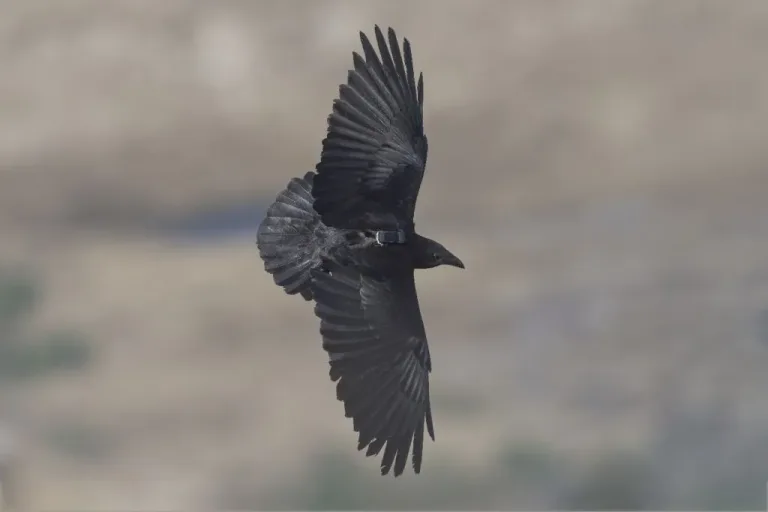
To understand this, researchers studied fan-tailed ravens (Corvus rhipidurus) living along Israel’s Dead Sea coastline. In laboratory experiments, birds were tested for their willingness to approach unfamiliar objects, eat novel foods, and forage near humans — all behaviors linked to risk-taking in changing environments.
The results were remarkably consistent. Ravens that took risks in one context tended to do so in all others. Bold individuals approached novelty, exploited unfamiliar food sources, and tolerated human presence, while cautious birds avoided all of these situations.
But the true breakthrough came in the field. Using GPS tracking, scientists discovered that these personalities played out in real landscapes. Risk-prone ravens clustered around tourist sites and human settlements, feeding on easy resources but exposing themselves to greater danger. More cautious birds ranged farther, avoiding human activity altogether.
The survival data was stark: bolder birds were more likely to die over time, despite their short-term gains. “Our findings show that consistent behavioral traits are not just quirks, they can determine life or death,” said Dr. Miguel Guinea. “This is particularly crucial for fan-tailed ravens in The Dead Sea, a population declining so rapidly that it may soon disappear from the region.”
Prof. Ran Nathan added, “This study highlights how integrating lab-based behavioral assays with real-world movement data can reveal patterns we would otherwise miss. It’s a powerful approach for understanding how animals cope with human-driven environmental change.”
Researchers say the findings show that adaptation to human activity is not uniform across species. Instead, it depends heavily on individual behavioral differences, meaning that populations may evolve in unpredictable ways under growing human pressure.
This pattern may extend beyond ravens, the scientists stress. As cities expand and tourism intensifies, animals across ecosystems are being pushed into similar decisions about whether to exploit human environments or avoid them entirely. While bold individuals may initially benefit from access to new food sources, long-term risks such as traffic, conflict, and habitat disruption can reverse those gains. In contrast, cautious individuals may survive longer but miss short-term opportunities, potentially affecting reproduction and population dynamics over time.
The findings could help conservationists better identify which wildlife populations are most vulnerable as human activity expands. If boldness or caution affects survival, then species cannot be managed as behaviorally uniform, and conservation planning may need to account for the mix of risk-taking and risk-averse individuals within a population. The study also suggests more targeted interventions, such as creating safer feeding alternatives or buffer zones in areas where bold animals are drawn into dangerous human environments.
Understanding that animals respond differently to human presence may also help predict where wildlife is most likely to move through or concentrate in developed landscapes. This could guide the placement of roads, industrial zones, and tourist areas, as well as the design of wildlife corridors that reduce conflict and mortality.
The study was published in the peer-reviewed Ecology Letters.
Related Topics