
























By Pesach Benson • December 2, 2025
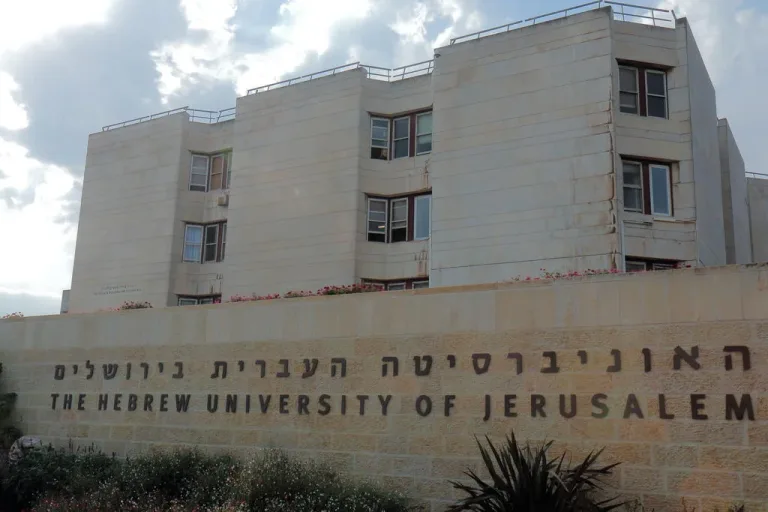
Jerusalem, 2 December, 2025 (TPS-IL) — Israeli scientists have developed a gas sensor that can distinguish “mirror image” molecules in the air, a breakthrough with the potential to revolutionize medical diagnostics, food and beverage quality control, environmental monitoring, and pharmaceuticals, Hebrew University of Jerusalem announced.
By detecting subtle structural differences in volatile compounds, the sensors could power non-invasive breath tests for diseases such as lung cancer or diabetes, track changes in illness over time, and ensure consistency in flavor and aroma in food and fragrances. They could also help identify spoilage or contamination before products reach consumers.
Mirror-image molecules, also called chiral molecules, are pairs of molecules that have the same chemical formula but are arranged like left and right hands — identical in composition but not superimposable on each other. Even though they look nearly identical, the two forms can have very different effects, such as producing distinct smells, tastes, or biological responses.
The study, detailing the design, testing, and potential applications of the sensors, was published in the peer-reviewed journal Chem. Eur. J.
The sensor uses carbon nanotubes coated with specially designed sugar-based receptors, which act like a molecular lock-and-key to interact with specific airborne chemicals. “By adding a sugar coating, we created a precise chemical architecture around the sensor that can even interact with very weakly binding scent molecules,” said Prof. Shlomo Yitzchaik, one of the study’s supervisors.
The research team, led by Ariel Shitrit and Yonatan Sukhran under the guidance of Yitzchaik and Prof. Mattan Hurevich, demonstrated that the sensors could clearly differentiate between mirror-image forms of limonene and carvone, two common scent molecules, while showing no reaction to similar forms of α-pinene. Remarkably, the sensors detected the (–)-limonene molecule at concentrations as low as 1.5 parts per million, roughly ten times more sensitive than many comparable methods.
The sensors’ effectiveness comes from the interaction between the sugar-coated nanotubes and the airborne molecules. Using electrical measurements combined with computer simulations in collaboration with Germany’s Technical University of Dresden and Friedrich Schiller University Jena, the researchers found that each molecular mirror image binds slightly differently to the receptor. These tiny differences alter electron movement in the nanotubes, producing measurable changes in the electrical signal.
“Understanding how molecular structure affects sensor performance gives us a blueprint for designing better artificial smell receptors,” said Hurevich. By testing different receptor designs, the team identified chemical features that improve selectivity, paving the way for more precise and versatile sensors.
The research is part of the European SMELLODI consortium, which explores links between body odor, smell perception, and physiological and emotional states. Non-invasive analysis of volatile organic compounds—including mirror-image molecules—is a key goal of the project, with potential applications in health monitoring, environmental safety, and industry.
Transforming sugar molecules, which normally dissolve in water, into stable, functional gas sensors posed a significant chemical and engineering challenge. The team overcame this by creating a two-part system: adjustable sugar-based receptors chemically attached to carbon nanomaterials. The design can be fine-tuned by altering the sugar “frame” or the chemical groups attached to it, enabling tailored detection capabilities.
Beyond healthcare and food, the sensors could have applications in environmental monitoring and pharmaceuticals. They can detect air pollutants or chemical leaks at extremely low levels, improving safety for both people and ecosystems. In drug manufacturing and chemical research, the sensors could verify the purity and composition of chiral molecules, which often have different biological effects depending on their mirror-image form, helping ensure products are safe and effective.
Looking ahead, the researchers believe computational tools, including advanced physics simulations and machine learning, could accelerate the creation of new receptor designs, expanding the range of detectable airborne molecules and their mirror-image forms.
“Our work shows that tiny changes in molecular structure can be picked up reliably using sugar-coated nanotubes,” Shitrit said. “This opens the door to electronic sensing systems that were previously thought impossible.”
Related Topics