













By TPS-IL • December 16, 2025
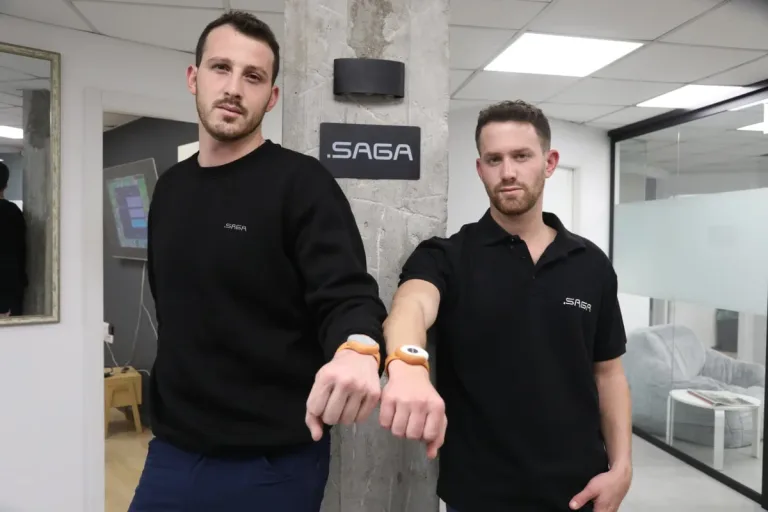
Jerusalem, 16 December, 2025 (TPS-IL) — The collapse of Israel’s civilian communications on October 7, 2023, did not only expose intelligence and military failures. It revealed a deeper vulnerability shared by modern societies everywhere: in moments of mass panic, basic safety systems stop working. Recently selected to represent Israel’s innovation “Dream Team” at the Mind the Tech summit in Berlin, dot SAGA was born out of the October 7 tragedy and built by founders who developed the technology while serving reserve duty during the war.
The catalyst for dot SAGA was the Nova music festival massacre, where thousands of civilians were left effectively invisible once cellular networks failed. Emergency services lost contact with crowds. Families could not locate loved ones. The disaster demonstrated that modern “smart” security infrastructure was built on the fragile assumption that public networks will hold under pressure.
The all-night music festival, attended by 3,500 people near Kibbutz Re’im, became a killing field where 364 people were massacred and 40 others were taken hostage. Of all the locations attacked by Hamas on October 7, Nova’s death toll was the highest.
The founders of dot SAGA, veterans of elite military units, had been developing early versions of off-grid communication technology before October 7. They were even contacted by the Nova festival production team, inquiring if their device could be available to the festival. But the technology was not ready for use yet, founder and CEO Noam Goldman told The Press Service of Israel.
“I think about what would have happened if it was ready,” Goldman said. And that’s exactly what prompted him to transform a technical concept into an urgent mission. During reserve duty, while rotating between military service and development, Goldman and his partners accelerated work on a system designed to function precisely where existing infrastructure collapses.
At its core, the Tel Aviv-based dot SAGA replaces dependence on cell towers with a wearable-based mesh network. Each device acts as both user and relay. Signals hop from person to person, creating a closed, venue-owned network that does not rely on cellular, Wi-Fi, or satellite connectivity, but on age-old radio technology.
“For the first time we are taking the existing, resilient technology of the radio and bringing the ability to have an end-user communicate and connect with the security system of a site. If you’re taking your child to Disneyworld, and he gets lost, even if he has an AirTag or an Apple SOS tag, that call is going to get to 911. And until 911 finds and indicates where you are, that time is crucial and critical. We are connecting you to the closest team member, with whom the end-user currently has no direct communication.”
This architecture reverses the logic of traditional crowd security. Cameras, guards, and control rooms are reactive. They observe after something goes wrong or react to calls. dot SAGA is built around personal agency. A single button press on a rugged, screen-free wristband sends an emergency alert through the mesh, pinpoints location indoors or outdoors, and routes the signal directly to responders on site.
Unlike its competitors, Goldman told TPS-IL, dot SAGA works directly with business venues rather than selling to consumers. This means that venues such as ski resorts, amusement parks, and concert halls will be able to provide the wrist device to their visitors upon arrival. And 40,000 users per venue can be active at the same time, according to lab tests, Goldman told TPS-IL.
Dot SAGA has finalized its prototype testing and is now launching a pilot project at Bulgaria’s Bansko ski resort. Currently in the pre-seed investment phase of $1 million, Goldman said they expect to be ROI-positive within two years.
Security specialist Yagil Rimoni, whose security firm was responsible for safety at the Nova music festival on October 7, told TPS-IL that a device of this kind could have been critical.
“The hardest challenge was communication,” he said. “Getting information, transferring it, understanding what was happening in real time. A tool like this could have saved many lives and significantly changed the situation.”
Related Topics