















By Kostis Konstantinou • February 8, 2026
Jerusalem, 8 February, 2026 (TPS-IL) — It was a cold, overcast day, dust filling the strong wind, the kind of smog in which the afternoon light never quite reaches the landscape. In a rare opportunity, The Press Service of Israel and a small group of foreign journalists embedded with the israel Defense Forces (IDF) entered central Gaza in recent days, reaching Deir al-Balah, an area off-limits to international media during two years of war.
After a brief safety briefing on what to do in an emergency, we put on our helmets and flak jackets, climbed into the army’s Humvees, and set off for the Gaza Strip.
We passed through the parking area of the makeshift crossing into Gaza, where trucks loaded with aid and pallets beside them were lined up one next to the other. Our convoy advanced to the point where the Israeli side of the Yellow Line ends and the first buildings of eastern Deir al-Balah began. This is the narrowest part of Gaza, where a mere six kilometers separate Gaza’s border fence with Israel and the Mediterranean coast.
The visit offered a brief on-the-ground view of an area at the center of sporadic operations, following infiltrations into the Yellow Line, as part of Hamas terrorists’ continued efforts to carry out attacks against IDF positions despite having accepted the U.S. peace plan. It is in areas like Deir al-Balah that Hamas is consolidating its manpower and rearming, while world attention focuses on whether the U.S. will attack Iran.
Our IDF escorts had warned us that Hamas snipers were frequently positioned in the buildings opposite us, launching attacks either from those locations or via tunnels that the army had yet to uncover.
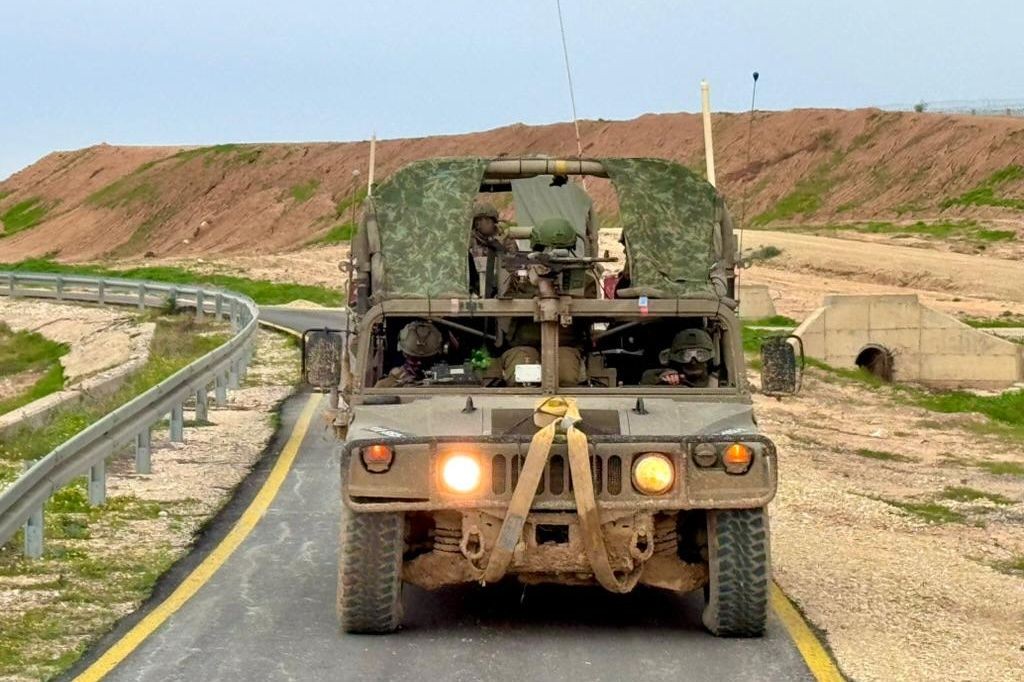
An Israeli jeep escorts embedded journalists in the central Gaza area of Deir al-Balah in recent days of February 2026. Photo by Kostis Konstantinou/TPS-IL
According to the United Nations Satellite Centre and the United Nations Institute for Training and Research, Deir al-Balah was the least-damaged area in Gaza, based on satellite images they collected. Fewer than half of the buildings in the area were destroyed, a reality clearly visible from the ground. Tall residential buildings, as well as mosques, could be seen in the distance. They stood in stark contrast to the rubble in front of the Yellow Line, which became a battleground following Hamas’ October 7, 2023 attack.
Deir al-Balah’s lower level of destruction also means more terrorists are concentrated in the town’s civilian areas. Israeli intelligence and security analysts have identified it and Gaza City’s Zeitoun neighborhood as Hamas’ two most active remaining “strongholds.” Both serve as hubs for Hamas and Islamic Jihad units that were dispersed from other combat zones.
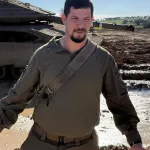
Our escort, IDF International Spokesperson Lt. Col. Nadav Shoshani, said that Palestinians crossing the Yellow Line are almost exclusively Hamas terrorists — deliberately testing soldiers and their response. In the limited cases where civilians crossed, he added, the vast majority turned back after seeing Israel’s Arabic-language leaflets repeatedly dropped along the Yellow Line, warning people away.
“You just don’t hear about them in the news,” Shoshani said. “Today, terrorists crossed, and we dealt with them. Yesterday, civilians crossed; they found leaflets and went back,” he added.
“This is the reality here,” he stressed, insisting that Hamas’s refusal to disarm remained the main obstacle to advancing a ceasefire agreement in Gaza, adding that the terror group was instead attempting to rearm and carry out daily attacks.
He went on to say that the duration and nature of Israel’s military presence in central Gaza depended entirely on how quickly the agreement progressed. Israeli soldiers are the only barrier preventing Hamas from reaching southern Israel again, and he insisted that the IDF will not withdraw if Hamas is not disarmed.
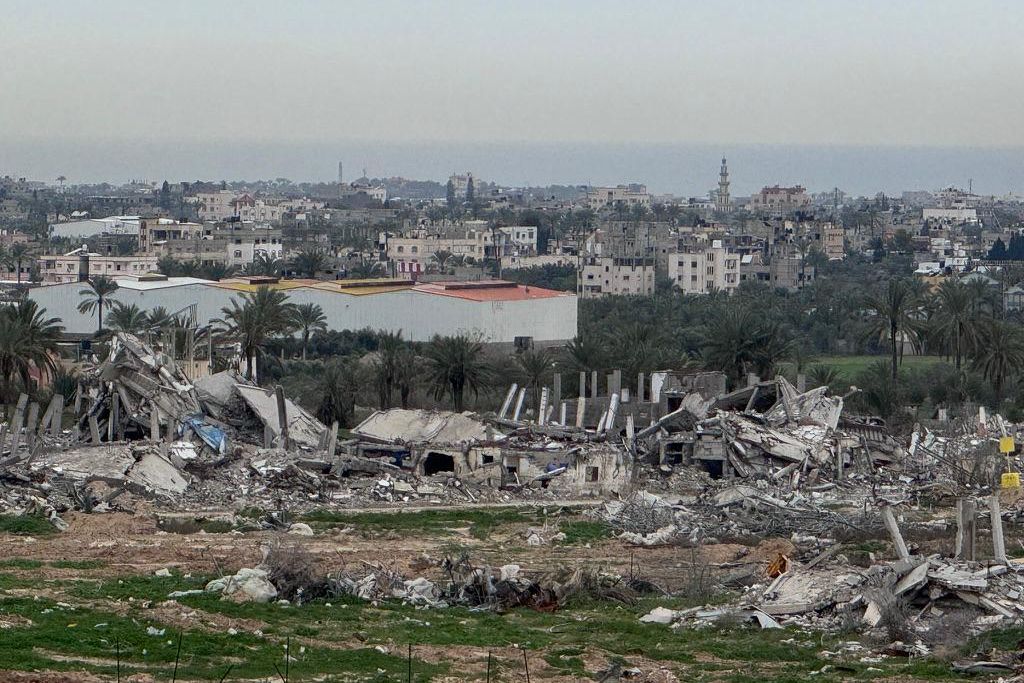
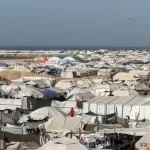
The Palestinian city of Deir al-Balah in central Gaza in recent days of February 2026. Photo by Kostis Konstantinou/TPS-IL
Shoshani stressed that the ceasefire stipulates that Gaza should become a “terror-free zone” and that Israel had complied by advancing only to agreed positions and halting further movement. He accused Hamas of repeated violations across multiple areas. While trying to avoid harming civilians, he stressed that Hamas operates without uniforms inside civilian areas and uses residents for cover.
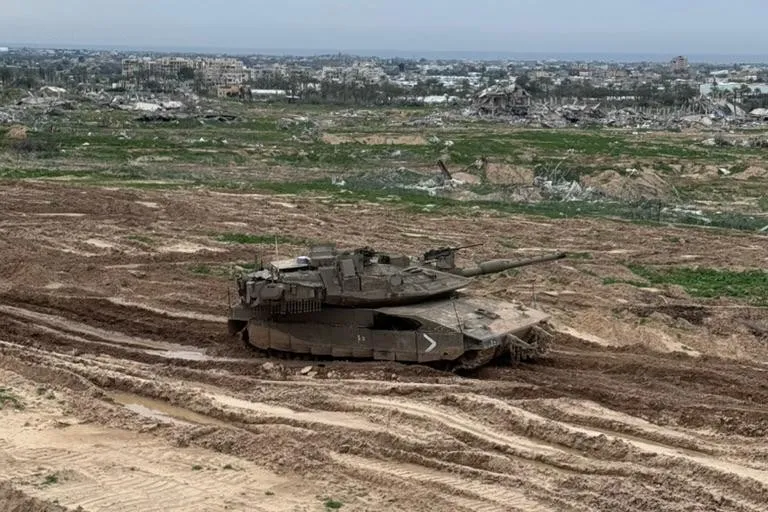
The lifeless calm hanging over the area is occasionally broken by the roar of a massive turbine pumping cement into newly discovered tunnels somewhere in the distance or sporadic gunfire. At the breach in front of us, armored vehicles guarding the post — and us — were the only things that could move through the mud left everywhere by recent stormy weather.
The journey out of Gaza didn’t take longer, but it somehow seemed that way. Thoughts were hard to shake off. Why did all this happen? How did Hamas manage to build such an extensive tunnel infrastructure over the years? If fighting resumes, what will Hamas’ last stand in Deir al-Balah or Zeitoun look like?
Approximately 1,200 people were killed, and 252 Israelis and foreigners were taken hostage in Hamas’s attacks on israeli communities near the Gaza border on October 7. After more than two years, the remains of the last hostage, Police Master Sgt. Ran Gvili, were buried at the end of January.
Related Topics