













By Sveta Listratov • June 8, 2025
Jerusalem, 8 June, 2025 (TPS-IL) — In a modest event space in Tel Aviv last Thursday evening, families, soldiers, authors, and educators gathered for a ceremony both heartbreaking and heartwarming: the launch of “The Gifts of Salman,” a bilingual children’s book commemorating fallen Israeli officer Lt. Col. Salman Habaka. The book, written in both Hebrew and Arabic, was penned by his aunt, Kawakib Safe, and is based on Salman’s love for language, nature, and family — values he lived by and ultimately died for.
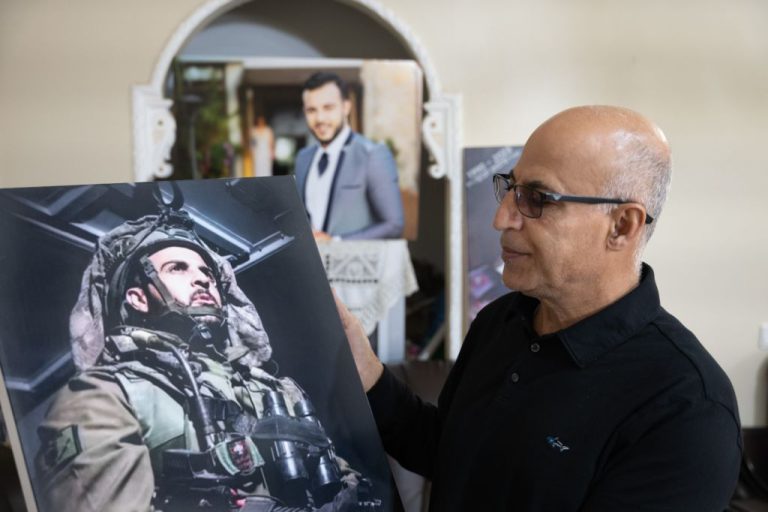
“His house was filled with books — on leadership, history, culture,” Kawakib told The Press Service of Israel at the launch. “He believed in words. He believed in teaching. This book is for his son, and for every child who wants to know who Salman was.
Salman, a Druze Israeli, commanded the IDF’s 53rd Armored Battalion. On October 7, 2023, after Hamas launched its surprise attack on southern Israel, Salman drove south from his home in Yanuh. His leadership helped save civilians in Kibbutz Be’eri, one of the hardest-hit areas that day. He was later killed in combat in the Zeitoun area of northern Gaza.
Following Salman’s death, a nonprofit organization called Dreams of Life reached out to his family. The organization helps bereaved families fulfill an unrealized dream of their loved one. For Salman, who was raising his young son Emad to speak Arabic, Hebrew, and English, the answer seemed clear: a book celebrating language, heritage, and love.
The book tells the story of a Druze boy and his grandmother herding goats. When a baby goat gets stuck between rocks, the boy first tries to pull it free — and fails. Then, gently, he moves the stone. On the way home, he picks flowers and gives them as gifts to his mother and grandmother. It’s a story about compassion, creativity, and generosity — traits that defined Salman.
“This is more than a children’s book,” said co-writer and youth novelist Iris Eliya-Cohen. “It’s an act of remembrance, of healing, and of hope.”
Among those attending the book launch were not only Salman’s family and childhood friends — but also Israelis who had never known him personally. One such couple, Dafna and Nissim from the city of Bat Yam, saw a news segment about his heroism. They were deeply moved by his words to his soldiers after the battle in Be’eri: “I’m proud of my soldiers — they are the true heroes. We will rise stronger, united and powerful. We will not allow those inhuman, cowardly weaklings to break our spirit,” Salman told his troops after securing Be’eri.
Compelled by his words, they drove to the northern village of Yanuh to pay respects during the mourning period. Since then, they’ve stayed close with his parents, turning a moment of empathy into a lasting friendship.
“We didn’t know him in life,” said Dafna, “but we feel as if we do now. He was so Israeli to his core, so familiar. And we feel a duty to stand by the family.”
While Israel’s Druze community makes up just 2% of the population, their representation in the army — including in elite combat units — is disproportionately high. Salman’s story — as a high-ranking Druze officer deeply connected to both his heritage and his Jewish comrades — resonated across communities.
The book was carefully crafted to reflect this dual identity.
“We wanted it in both languages,” said Kawakib. “Not just for our community, but because we want Jewish children to learn Arabic, too. The goal is not only pedagogical — it’s emotional. We want hearts to open.”
“We believe in bridges between people,” said Kawakib, her voice trembling. “And we believe in Salman’s voice, even if he can’t speak it anymore.”
Salman was not just a warrior — he was a leader, a thinker, a father. His story, and this book, offer a glimpse into what heroism can look like off the battlefield: tenderness, vision, legacy.
“This book is our answer to grief,” said Emad Habaka, Salman’s father to TPS-IL. “It asks a question — who was Salman? And it lets the children, and maybe their parents too, go find the answer.”
Israel’s Druze community of 152,000 trace their ancestry back to the Biblical figure Jethro, the father-in-law of Moses. In Israel, the Druze serve in senior positions in public and military life, and the bond between Jewish and Druze soldiers is referred to as the “covenant of blood.” The Druze speak Arabic but are not Muslim.