























By TPS-IL • March 1, 2026
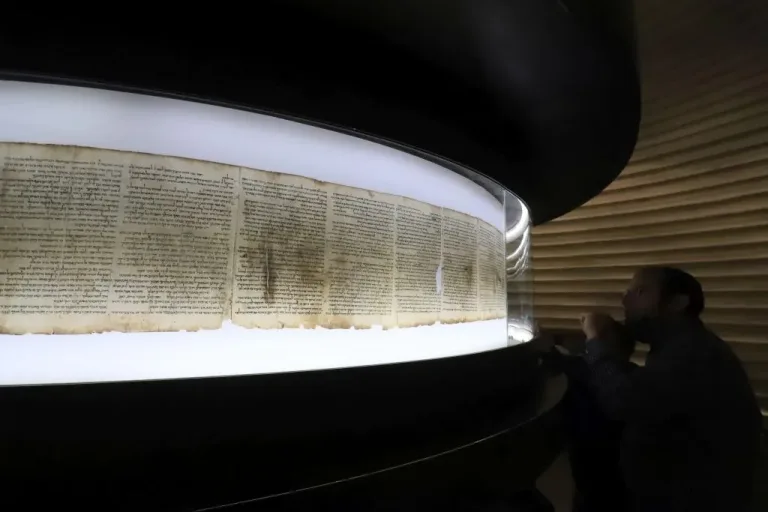
Jerusalem, 1 March, 2026 (TPS-IL) — Just days after it was returned to public display for the first time since the 1960s, the Great Isaiah Scroll was placed under special protective shielding as war with Iran erupted and missile sirens sounded across Israel.
Acting under the Israel Museum’s emergency protocol, staff rushed on Saturday morning to the Shrine of the Book to secure the 2,100-year-old manuscript, the most complete and earliest known biblical text ever discovered. Curator of the Dead Sea Scrolls Hagit Maoz told The Press Service of Israel exclusively that the team had prepared in advance for such a scenario.
Home Front Command has placed restrictions on public gatherings during the war, and the Israel Museum in Jerusalem is closed until further notice.
“We knew it might happen, so we were ready and prepared a special shield for the scroll, because it is too big to move around,” Maoz said. She would not detail what the shield is made of, only saying that it was prepared by the museum’s technical labs.
“It was kept in a special room nearby just for this scroll. Other artifacts were either brought down to an underground shelter or left with a regular shield based on their importance,” Maoz told TPS-IL.
Maoz said the move followed established wartime protocols designed to safeguard national treasures. Staff members worked while air raid sirens were active, moving quickly between protected areas to ensure the artifact’s safety.
“It was very scary. Team members left their kids at home in safe rooms out of a sense of responsibility and duty. We all felt relieved when the scroll, and other artefacts, were safe, so we can sleep at night,” Maoz added.
The scroll was written around 125 BCE and is widely regarded as the most significant of the Dead Sea Scrolls. It predates by many centuries other known biblical manuscripts and provides insight into the development of the biblical canon, Maoz said.
The scrolls, a collection of hundreds of manuscripts and thousands of fragments of ancient Jewish religious texts, were discovered in 1947 in caves near ancient Qumran above the northwestern shores of the Dead Sea. They are among the earliest texts written in the Hebrew language.
The Great Isaiah Scroll measures 7.17 meters in length and is written in Hebrew on seventeen sheets of vellum. It contains all sixty-six chapters of the Book of Isaiah arranged in fifty-four columns. Its state of preservation has often been described as extraordinary.
“It is remarkable how it has been preserved, perhaps because it was written on vellum, which is thicker than regular papyrus,” Maoz said.
Maoz noted that in 1965, at the inauguration of the Shrine of the Book, the original was briefly displayed before preservation constraints required its removal from public view and replacement with a high-quality facsimile that has remained at the center of the gallery ever since.
The recent exhibition of the Great Isaiah Scroll was mounted last week to mark the sixtieth anniversary of the Shrine of the Book and the Israel Museum.
Climate controls in the gallery were carefully calibrated to meet strict conservation requirements, allowing visitors to view the manuscript in its entirety, the museum said.
“We continue evaluating the situation daily, but once the war is over, we will remove the special shield and the scroll will be on display again,” Maoz said.
Related Topics