


















By TPS-IL • December 2, 2025
Jerusalem, 2 December, 2025 (TPS-IL) — A newly surfaced letter attributed to Albert Einstein offers a rare, intimate look at the man behind the equations, including one striking note in which the physicist reflects with warmth and candor on a former research assistant who helped him work on the theory of relativity.
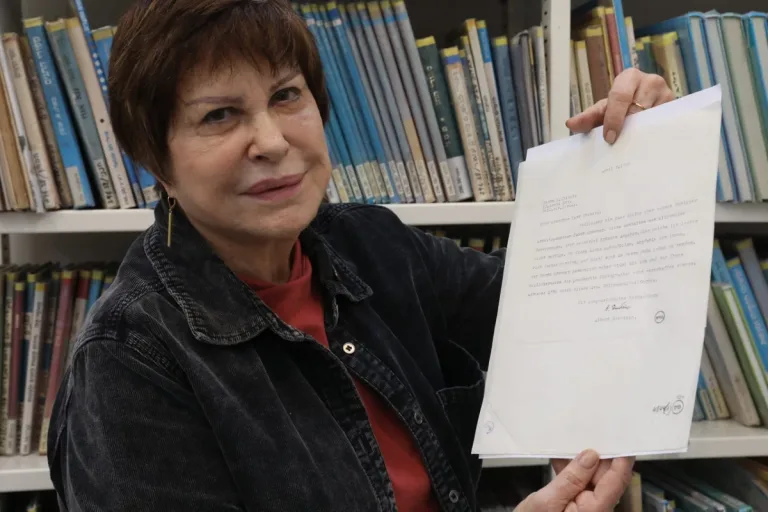
Discovered last week by Tel Aviv’s Gnazim Institute, the world’s largest archive of Hebrew literature, and shared exclusively with The Press Service of Israel, the document adds fresh texture to Einstein’s persona as both a towering scientist and a deeply human, sometimes sentimental figure.
The letter has not yet been authenticated but is most likely genuine, according to external expert opinion given to TPS-IL.
At the center of the discovery is a German typed letter from April 1953, signed by Einstein in his own handwriting, in which he praises his “exceptional” research assistant, Jacob Grommer, a Jewish mathematician from Brisk, Lithuania. In the note, Einstein describes the assistant not only as a sharp mathematical mind but as someone who “was always ready to advise and help others.”
“He came to Berlin and worked with me as a private assistant on the theory of relativity. We published several papers together. He stayed with me until the early 1930s, and then moved to Minsk following a respectable job offer. Mr. Grommer was not only a sharp thinker but also a man of wide-ranging interests, especially in matters related to judaism, and he was always ready to advise and help others,” Einstein wrote of Grommer in the letter.
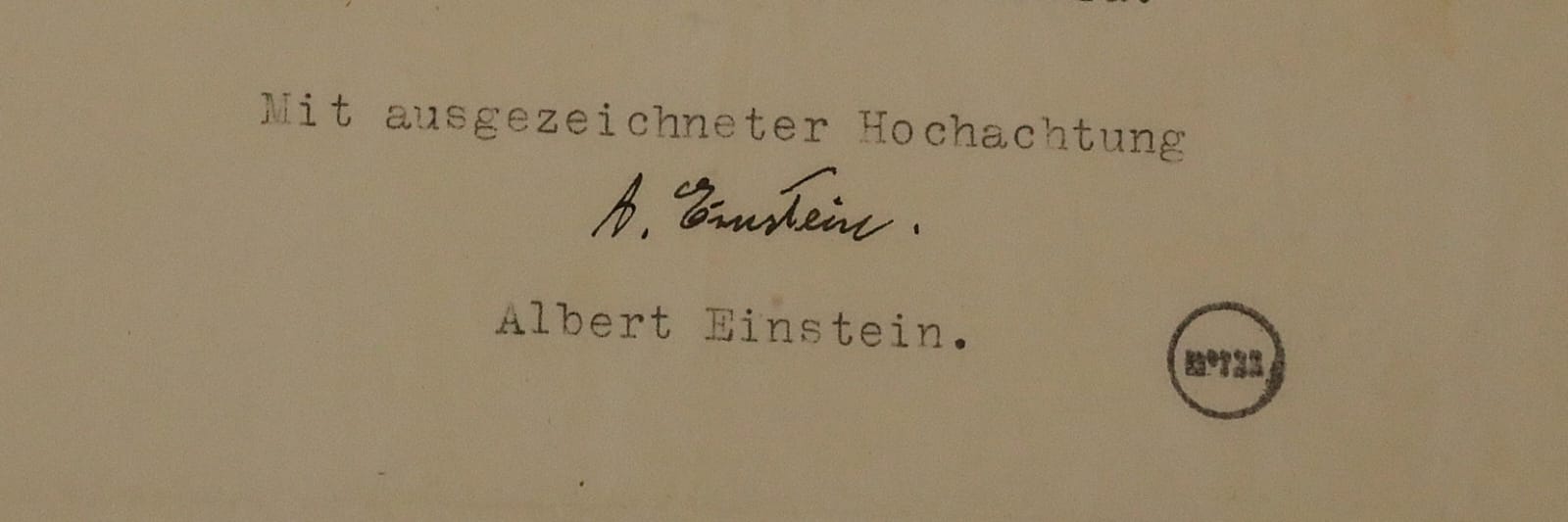
Albert Einstein’s signature at the bottom of a letter recently discovered at Tel Aviv’s Gnazim Institute on Nov. 30, 2025. Photo by Gideon Markowicz/TPS-IL
The tone is unusually personal for Einstein, Gnazim’s archivist Amir Ben-Amram told TPS-IL. “It presents Einstein in a human light and reminds us that he had research assistants, who are usually forgotten. It shows that Einstein respected them. Einstein even wrote in an article that Grommer did all the mathematical calculations for him,” Ben-Amram said, referring to a 1925 article titled Unified Field Theory of Gravitation and Electricity, in which the great scientist praises Grommer.
While Einstein’s breakthroughs are often told as feats of solitary brilliance, the correspondence hints at a more social, collaborative process—a reminder that even the most brilliant minds rely on the people around them, Ben-Amram explained.
The letter also shows Einstein’s compassion for Grommer’s struggle with acromegaly, a rare hormonal condition in adults that causes bones, organs, and other tissues to grow abnormally large.
“If we take into account that he suffered from a severe illness that distorted his face and weakened his body,” Einstein wrote of Grommer in the letter, “then one can imagine how exceptional his qualities and abilities must have been.”
Grommer later became a professor at Belarus State University thanks to Einstein’s recommendation, Ben-Amram said.
The letter was addressed to Nahum Hinitz, an author in Israel who was then editing a book about the Jewish community in Brisk, Ben-Amram explained. Hinitz was interested in Grommer and asked Einstein for information about him. Einstein’s reply was discovered while the Gnazim team researched Hinitz’s letters. “One of our workers was going over the Hinitz archive and suddenly came across this letter,” Ben-Amram said.
Asked about the letter’s authenticity, Ben-Amram told TPS-IL there was no reason to question it, especially because the Hinitz–Einstein correspondence is mentioned in one of Hinitz’s books. “It may have been typed by his secretary, but he signed it by hand.”
Gal Wiener, chief executive of Jerusalem-based Winner’s Auctions, which has sold Einstein handwritten notes in the past, told TPS-IL that upon preliminary inspection of a photo — without testing the paper or ink — Einstein’s signature seems genuine.
The chairwoman of the Gnazim Institute, Adiva Geffen, hopes for more discoveries: “We have an empire of literature here, with over 900 archives of the greatest Hebrew writers since the mid-19th century,” she told TPS-IL. “We uncover remarkable gems every day, and this Einstein letter is one of them.”
Related Topics