








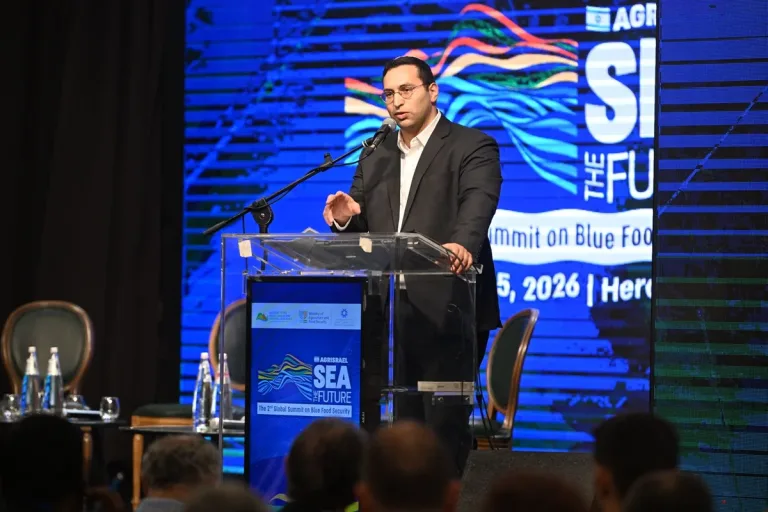
The Ministry of Agriculture and food security, MK Avi Dichter opened the conference: “Here, in the city of Eilat, where desert meets the sea, marine agriculture and desert agriculture innovation is the key to strengthening Israeli and global food security. Our strategy is to greatly increase local production, while maintaining a high level of environmental sustainability and animal wellbeing. I wish us all a fruitful conference!
Minister of the Negev, Galilee and National Resilience, MK Yitzchak Wasserlauf: “There is a vision here shared by Israel and the entire world. The conference deals with food security; and here in Eilat, we transform a problem into opportunities. What appears to be a desolate desert, becomes a competitive advantage here. This desert region is a laboratory for solutions. Eilat is transformed from a city of tourism to a city that is also a center of information and knowledge”
In a world in which the effects of climate change are becoming increasingly more severe, and as the population continues to grow, food production systems must adapt to the changing needs. The local aquaculture industry is a limited field that has been taking off in recent years, thanks to its tremendous potential as a source of sustainable, nourishing and effective source of protein, which can become a central aspect in the food security of the future.
Yesterday, the Sea the Future 2026 Conference opened in Eilat, spearheaded jointly by the Ministry of Agriculture and Food Security and the Ministry of the Negev, Galilee and National Resilience. The conference will deal with research, innovation, technology and development in the field of food security of the marine agriculture. Also partners in this conference are the Ministry of Regional Collaboration, the Eilat Municipality the Eilot Regional Council, AquaTec, AquaculTech and SeaNovation.
The conference that was part of a multi-year government decision for the development of the city of Eilat and the Eilot Region, has attracted more than 400 researchers, agriculturalists, professionals, industry representatives and Israeli and foreign entrepreneurs, who promote national and global collaborative efforts and reinforce the connection between research, development and application in the field of aquaculture.
The conference is hosting international delegations from countries interested in technological and research collaboration, including: agricultural and fish farming ministers from Ghana, India and Azerbaijan, the deputy agriculture minister of Georgia and professional delegations from Romania and Morocco.
During the three days of the conference, a wide variety of Israeli startup technologies in this field will be presented as will ground breaking research and professional panels featuring senior members of the industry. Topics will include: marine agriculture, advanced marine technologies, innovation and policy in the field of marine food, development of sustainable marine food systems and research and technological collaborations. In addition, the head of the Food Security Administration at the Ministry of Agriculture and Food Security, Mr. Yuval Lipkin, presented the national food security plan for 2050 that was formulated by the Ministry of Agriculture and Food Security in conjunction with government ministries, associations and organizations.
The Eilat – Eilot Region, characterized by the unique combination of sea, desert and extreme climate conditions, serves as the natural environment for the development of applied and innovative research. In this region, advanced research activity is conducted in the fields of marine agriculture, marine biotechnology, renewable energy and marine science, alongside oceanography (marine and ocean science) and limnology (the science of lakes and potable water). This activity contributes to the development of innovative solutions for coping with environmental, economic and social challenges.
Director General of the Ministry of Agriculture and Food Security, Oren Lavi opened the conference: “Seven delegations from around the world have come to the conference, with the shared understanding that the world needs quality sustainable protein, and protein from the sea is a central part of the solution. The State of Israel is a leader in the field of mariculture knowledge, research and startups and integrates scientific innovation with practical application. This is the true face of the State of Israel, a country that leads the way forward, invests in resources and develops solutions to global challenges.”
Director General of the Ministry of the Negev, Galilee and National Resilience, Yohanan Mali: “We are all here for one purpose: to lead the revolution in the field of food security and the continued development of aquaculture in Israel. The collaboration between Eilat and the Eilot Region and the government ministries, research and educational institutions have shown us the achievements that can be reached. The State of Israel has become a center of ground breaking research in this field.”
Mayor of Eilat, Eli Lankri: “In the era of climate changes and population growth, food security is a central component of global resilience. Eilat with its unique combination of sea and desert is at a significant regional juncture and serves as an extraordinary applied platform for the development and application of advanced solutions in aquaculture, biotechnology and renewable energy. We are hosting this conference for the second year, combining research, industry and decision makers, and strengthening regional and international collaborations for the development of practical solutions for food security.”
The conference is being broadcast live on the Ministry of Agriculture and Food Security and Ministry of the Negev, Galilee and National Resilience Facebook pages, LinkedIn and YouTube.
Conference website: www.gov.il/he/departments/topics/sea_the_future_2026
Agenda: https://www.gov.il/he/pages/seathefuture_agenda
Booklet of the presenting companies: https://www.gov.il/he/pages/innovation_exhibition_booklet
Speakers booklet: https://www.gov.il/he/pages/speakers_seathefuture_2026
Aquaculture – Data and Numbers:
✔ The rate of global demographic growth, which is currently estimated at over 200 thousand people per day, is accompanied by the continuous increase in the demand for protein from the sea and marine food products. These trends set a significant challenge for global food systems, especially natural fishing resources.
✔ Some 90% of the world’s fish species are currently over-fished or fished-out, and the marine ecological systems are experiencing difficulties in recovery.
✔ The growth rate of aquaculture and mariculture is currently the fastest of all the world’s agricultural fields, and is estimated at 8% annually. The industry is worth more than $310 billion, and provides more than 50% of the fish consumed globally.
✔ In light of the continued demographic growth and increase in demand, the industry must double its activity within a decade. This is an achievable target that requires extensive investment in innovation, applied research and development and expanding collaboration between governments, academic institutions and industry. The aquaculture industry in Israel, most of which is still small and has even reduced in size in recent years, is expected to gain traction due to the national strategic plan and the allocation of specific resources for investment, research and development. Currently, there are 200 breeders, entrepreneurs and researchers in the field in Israel, including: fish and seaweed breeders, technology developers, protein substitute entrepreneurs, breeders of food sourced from the sea and research institutions.
Related Topics