














By Pesach Benson • January 19, 2026
Jerusalem, 19 January, 2026 (TPS-IL) — A Knesset committee session on a government-backed bill establishing a commission of inquiry into the failures of October 7, 2023, was marked by protests from bereaved families and boycotts by opposition lawmakers on Monday.
Only two coalition members attended the Constitution, Law and Justice Committee meeting: committee chairman Simcha Rothman of Religious Zionism and MK Ariel Kallner of Likud, who introduced the bill. Members of the bereaved families’ Law and Justice Forum, which opposes the establishment of a state commission of inquiry, were also present. Due to the protesters, Rothman limited the number of people admitted into the hearing room.
“Investigating the October 7 massacre is important to the bereaved families, but also to the entire people of Israel, to soldiers, to civilians, and to anyone who wants to prevent the next disaster. The issue is not the exclusive property of anyone in Israel,” Rothman said. “We will allow the discussion to proceed, but I will not allow outbursts intended to disrupt the legislative process, regardless of positions or personal opinions.”
In an adjacent room, opposition lawmakers and members of the October Council organization—comprising victims of the October 7 massacre and their families—held a parallel discussion criticizing what they called the governing coalition’s politicized probe.
The controversy centers on Kallner’s bill, which proposes an alternative to a state commission of inquiry. Under the bill, a six-member investigative committee and its chair would ideally be appointed by a supermajority of 80 out of the Knesset’s 120 members. If no agreement is reached within two weeks, the coalition and opposition would each select three members. The panel would also include four supervisory representatives of bereaved families.
Critics argue that the structure effectively guarantees coalition control. The legislation allows the Knesset speaker to appoint committee members if either side refuses to cooperate. With the opposition now pledging a boycott, Speaker Amir Ohana, a member of the governing coalition, would likely make the appointments himself.
“The people sitting in the room next to us are not the investigators—they are the ones being investigated. The opposition will not cooperate with this,” opposition leader and Yesh Atid chairman Yair Lapid said, flanked by Einav Zangauker, mother of released hostage Matan Zangauker. “In the first month of the next government, we will establish a state commission of inquiry to ensure that this never happens again.”
Democrats chair Yair Golan also denounced the process. “The Israeli government does not want to investigate and does not intend to investigate. And if it does investigate, it will be a false investigation and a national disaster,” he said. “The struggle to establish a state commission of inquiry is part of a broader struggle. If we do not replace the government, Israel’s revival is in danger—an existential danger.”
Rafi Ben Shitrit, father of soldier Shimon Alroy Ben Shitrit, who was killed on October 7, added: “The demand for a state commission of inquiry is a moral and ethical demand of the highest order. The same government that led the country during its greatest massacre continues to hang on for dear life. All they are promoting is just a pathetic and pitiful attempt to evade the truth.”
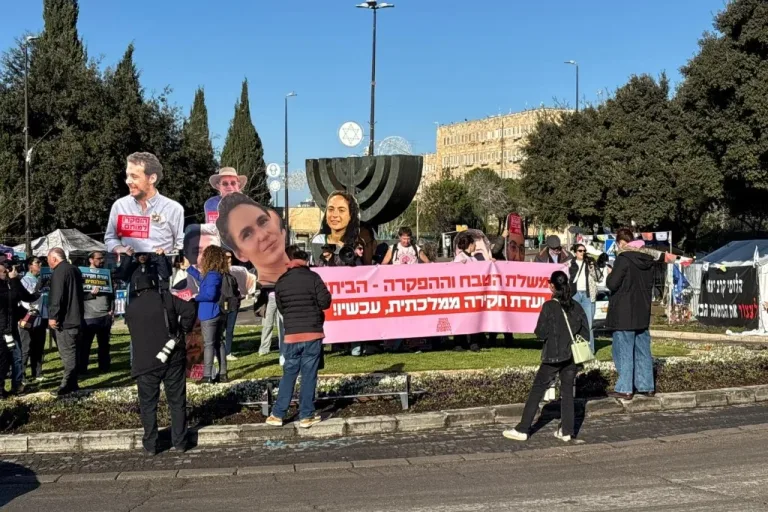
Outside the Knesset, dozens of protesters called for a nonpartisan state commission.
Also on Monday, Attorney General Gali Baharav-Miara submitted the state’s response to petitions before the High Court challenging the political commission of inquiry. “The government is seriously undermining the ability to uncover the truth about the events of October 7,” she wrote, urging the court to schedule a hearing. “Under existing law, a state commission of inquiry is clearly the appropriate and designated legal instrument for investigating the events of October 7 and the war.”
In November, the High Court issued a provisional order asking the government to justify why it is not establishing a state commission of inquiry, following petitions filed after the cabinet approved a “state-national commission of inquiry.” The government responded that the proposed committee is intended to ensure “a full, thorough, and independent investigation” and that the court has no legal basis to intervene.
Prime Minister Benjamin Netanyahu has resisted calls for a formal state commission of inquiry, calling it “politically biased.” Such commissions, led by senior Supreme Court justices, can summon witnesses, collect evidence, and make recommendations, though the government is not required to follow them.
The Israel Defense Forces has released a series of detailed internal probes examining how roughly 5,000 terrorists from Hamas and Palestinian Islamic Jihad were able to storm Israeli communities and overrun military positions. However, the military probes only address issues of operations, intelligence, and command—not decisions made by the political echelon.
Around 1,200 people were killed, and 252 Israelis and foreigners were taken captive by Hamas during the October 7, 2023, attack on southern Israel. Most were freed in a series of exchanges with Hamas as part of a ceasefire, though soldiers recovered the remains of others in Gaza. The body of Israeli Police Master Sgt. Ran Gvili remains in Gaza.
Israel’s last commission of inquiry investigated the deaths of 45 people in a 2021 stampede at Mount Meron. That commission ultimately held Netanyahu personally responsible in 2024.
Related Topics