




















By TPS-IL • February 17, 2026
Jerusalem, 17 February, 2026 (TPS-IL) — Israeli officials denied on Tuesday that a proposal to expand a community north of Jerusalem would enlarge the capital’s municipal boundaries.
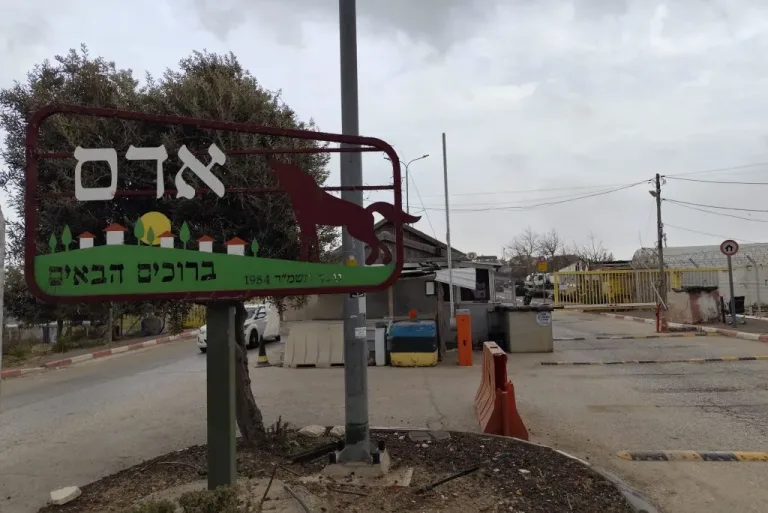
“There is a plan to expand the Adam settlement, it’s been planned for over a decade under my council’s jurisdiction. It has nothing to do with a de-facto expansion of Jerusalem, it’s nonsense,” Israel Ganz, chairman of the Yesha Council, told The Press Service of Israel. The council is an umbrella organization for Jewish communities in judea and samaria.
Ganz is also head of the Mateh Binyamin Regional Council, where the expansion is planned. He stressed that Adam’s development plan was strictly under his council’s jurisdiction and had no connection to Jerusalem.
The project would be built between the nearby Palestinian towns of Hizma and Al Ram. According to Peace Now, the development includes a government investment of about NIS 120 million ($38.7 million) to build 2,780 housing units, infrastructure, public spaces, and community institutions on 500 dunams (50 hectares) between Adam and Jerusalem’s municipal boundary. The plan has not yet been deposited with the Civil Administration’s Higher Planning Committee, a procedural step that could mean final authorization takes up to two years.
Although the site is within the boundaries of Adam, it is physically separated from the community by Route 437 and Israel’s security barrier. The only access road to the area being developed is through eastern Jerusalem. The area is closer to Neve Yaakov — a Jewish neighborhood of eastern Jerusalem — than to Adam.
Adam, home to 1,350 families, is located in Area C of Judea and Samaria, where Israel has both administrative and security jurisdiction.
Israel began constructing the security barrier around Jerusalem in 2002 during the Second Intifada. The barrier — composed of fences, concrete walls, and electronic surveillance — was intended to prevent attacks, particularly suicide bombings, from Palestinian areas. The Jerusalem section of the barrier does not strictly follow the Green Line, deviating to protect Israeli neighborhoods, take advantage of the terrain for surveillance, and reduce vulnerability to attacks.
Hagit Ofran from Peace Now told TPS-IL that the move amounted to “a backdoor annexation,” asserting that the project would function in practice as a Jerusalem neighborhood even if it is formally registered as part of Adam. Ofran added that the new development would likely receive at least some municipal services from Jerusalem.
“It is a kind of a bluff. It will function as a neighborhood of Jerusalem, without having to call it annexation,” she told TPS-IL.
Officials from the Jerusalem municipality did not respond to requests for comment.
Related Topics