















Minister Regev: “We continue to invest in expanding service offerings, extending trains, introducing an advanced train fleet, and improving connectivity between the periphery and the center. This is part of the ‘Connecting Israel’ vision.”
Israel Railways is stepping up its efforts. Following a record year in train travel, and in anticipation of continued growth in 2026, the Ministry of Transport and Israel Railways are leading a significant expansion of service, including extending trains, adding carriages, integrating advanced electric trains, and expanding operating hours in the periphery and the center. All of this translates to an addition of over 40,000 seats per day.
After a historic year of record demand on the railways, and in anticipation of continued growth in passenger numbers in 2026, the Ministry of Transport, through Israel Railways, is introducing a new and upgraded timetable starting Saturday evening, January 17, 2026.
The new timetable includes an addition of over 40,000 seats daily across the country, extending trains and adding carriages on main lines, integrating new and high-capacity electric trains, and expanding operating hours at many stations – with an emphasis on the South and North. This is another step in Minister Miri Regev’s policy to increase public transportation offerings, improve service quality, and strengthen connectivity between employment centers, the periphery, and metropolitan areas, as part of the “Connecting Israel” vision.
The year 2025 concluded with an unprecedented record of approximately 72 million train journeys. The growth in demand is a direct result of the policy promoted by the Ministry of Transport in recent years, which includes large-scale strategic moves, such as the procurement of new trains and carriages, accelerated electrification, service upgrades, train extensions, and the integration of advanced, high-capacity electric trains carrying up to approximately 2,000 passengers.
All of this is intended to meet the growing demands, while improving the travel experience, operational reliability, and service continuity, within the framework of the Ministry of Transport’s policy and in accordance with the vision of the Minister of Transport.
The new timetable includes: Extended operating hours at Be’er Sheva stations (Western Negev line) and the addition of approximately 4,000 seats daily. Upon completion of the electrification works on the track segment between Ofakim and Be’er Sheva, operating hours at Be’er Sheva stations (Western Negev line only) will be extended until midnight on Sundays through Thursdays and until 3:00 PM on Fridays, and service will resume on Saturday evenings.
As the electrification project progresses, new and high-capacity Siemens electric trains will be integrated for the first time on the Sharon Ring and Western Negev lines. Additionally, electric trains on the Netanya-Rehovot line will be extended from 6 to 12 carriages, an addition of approximately 8,000 seats daily.
Trains on the Karmiel-Be’er Sheva line, characterized by high demand on Sundays and Thursdays, will be extended to nine carriages, an addition of approximately 3,240 seats daily. Trains on the Nahariya-Ben Gurion Airport-Modi’in line, one of the most sought-after lines, will be extended to nine carriages during peak hours, with an addition of 13,140 seats daily.
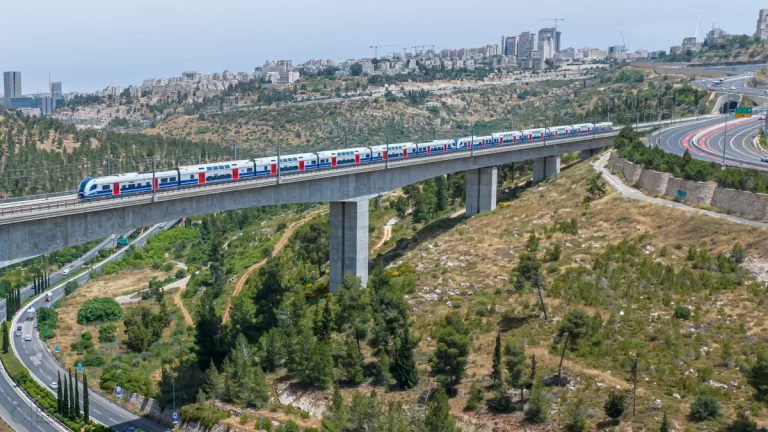
Trains on the Nahariya-Be’er Sheva line will be extended to eight carriages, an addition of approximately 3,240 seats daily. Trains on the Beit She’an-Atlit (Valley Line) and Karmiel-Haifa lines will operate using double-decker trains, with an addition of over ten thousand seats daily.
As part of the implementation of the new timetable, changes will be made to the departure times of some trains, as well as adjustments to operating hours on Saturday evenings in accordance with Shabbat departure times. It is recommended to check the full details and updated travel times on the website, the Israel Railways app, or the telephone service center at *5770.
Minister of Transport and Road Safety, Brig. Gen. (Res.) Miri Regev: “We continue to invest in expanding service offerings, extending trains, introducing an advanced train fleet, and improving connectivity between the periphery and the center, as part of the ‘Connecting Israel’ vision. The impressive growth in passenger numbers is an expression of public trust in the policy we are leading, and we will continue to act decisively to provide good, efficient, and accessible service to all citizens of Israel.”
Director General of the Ministry of Transport and Road Safety, Moshe Ben Zaken: “The new timetable is the result of professional and consistent work by the Ministry of Transport and Israel Railways to promote large-scale transportation solutions, with a long-term systemic view. The integration of advanced electric trains, train extensions, and service expansion in the periphery reflect the Ministry’s commitment to increasing public transportation offerings and improving service for passengers across the country.”
Chairman of the Board of Directors of Israel Railways, Adv. Moshe Shimoni: “We thank the passengers for their trust and choice of Israel Railways and its train service, and we are already preparing for the expected growth in the coming year, with an addition of 40,000 seats on all travel lines, and extensive service upgrades. The welcome growth in demand, and the steps to adapt the service to high demand, are the result of the Ministry of Transport’s vision through the company’s board, management, and employees to develop rail infrastructure and procure advanced trains and upgrade all aspects of service. I thank all parties for their contribution to the development of rail transportation and the improvement of the quality of life for the country’s residents.”
Acting CEO of Israel Railways, Avi Elmaliach: “The new timetable, which brings many service benefits across the country, is the result of dedicated and continuous work carried out in recent years, for the procurement and integration of new trains, for the development of rail infrastructure and its electrification, and for the integration of advanced technologies in operation and service aspects. I thank the railway employees and all our partners for their support in the development, expansion, and improvement of rail service processes.”
Related Topics