














By Pesach Benson • February 15, 2026
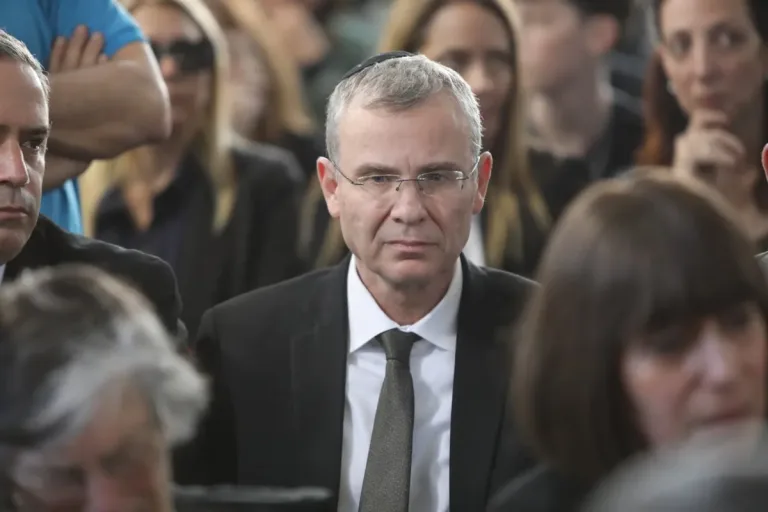
Jerusalem, 15 February, 2026 (TPS-IL) — Israel’s High Court of Justice on Sunday issued a conditional order requiring Justice Minister Yariv Levin to explain why he has not convened the committee responsible for appointing judges, a move petitioners say has left the country’s courts dangerously understaffed and public access to justice at risk.
The ruling, issued Sunday by Supreme Court Justices Ofer Grosskopf, Alex Stein, and Gila Kanfi-Steinitz, comes after a tense hearing last Thursday in which the justices pressed Levin’s legal team over delays in judicial appointments. Under the court’s timetable, Levin must submit a sworn affidavit by March 8 explaining his position, with the Attorney-General and petitioners filing their arguments by March 15. A hearing on the petition is expected in late March.
The petition was filed by the Movement for Quality Government in Israel (MQG), which argued that judicial vacancies have paralyzed the legal system.
“For over a year and a half, the judicial system has been paralyzed, with dozens of judge positions vacant in all instances—from magistrate courts to the Supreme Court, where four seats remain empty,” the group said. “The Israeli public is paying the price through delays, accumulating cases, and severe harm to the right of access to justice.”
MQG accused Levin of turning himself “into a veto player over judicial appointments, a power that is not granted to him by law,” and said he should not be allowed to “hold the committee hostage for political purposes.”
Justice Stein cited cases in the Beer-Sheva District Court, which is missing six judges, saying, “We are releasing people accused of murder — that means something is not working. Sir, you know what happens when there are delays in proceedings. We are forced to release people accused of serious offenses as an alternative to detention. In my opinion, this is a crisis. It is impossible to describe it any other way.”
Justice Grosskopf pressed Levin’s attorney, Zion Amir, on the public consequences of inaction. “How can it be said that the minister is acting in the public interest, if court presidents say that criminal proceedings cannot be initiated because there are no judges?” he asked. “A system that is unable to fulfill its role, a minister who does not appoint judges for various reasons—where will we go from here?”
Under Israeli law, the Justice Minister chairs the Judicial Selection Committee and is responsible for convening it when judicial vacancies arise. According to the Attorney-General’s Office, roughly 44 judicial positions are currently vacant, with another 21 expected to open by the end of the year, bringing the total to around 65 — excluding new positions created under recent budgets. Without appointments, cases accumulate, hearings are delayed, and litigants wait longer for justice.
Attorney-General Gali Baharav-Miara criticized Levin’s approach as illegal and harmful.
“The Minister of Justice is using the governmental power entrusted to him…to create for himself out of thin air a veto right, which is not limited in time, over the selection of judges, in a manner that contradicts the provisions of the law, and while massively harming the functioning of the judicial branch,” she wrote in a court filing.
Levin and his legal team maintain that appointments should proceed only when there is broad agreement among committee members, who include representatives of the judiciary, the Israel Bar Association, and the Knesset. Amir said the requirement for consensus is a legitimate exercise of discretion, noting that Levin has appointed 200 judges and registrars in the past year alone.
The government’s controversial judicial overhaul agenda includes giving the Knesset the ability to override certain High Court rulings, changing the way legal advisors are appointed to government ministries, and restricting the ability of judges to apply the legal principle of “reasonableness.”
The initiative was frozen with the formation of a unity government following Hamas’s October 7 attack. But the government has since resumed its efforts.
Supporters of the legal overhaul say they want to end years of judicial overreach, while opponents describe the proposals as anti-democratic.
Related Topics