















Knesset Press Release • September 29, 2025
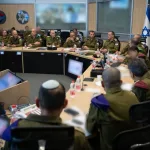
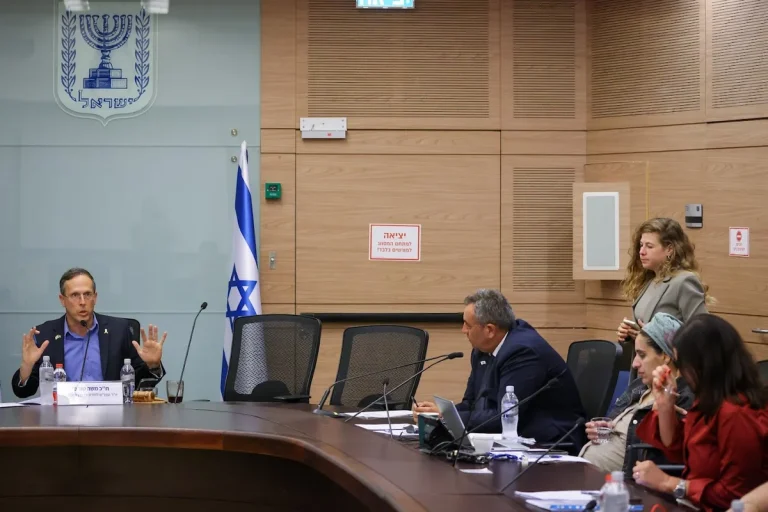
The foreign affairs and Defense Committee’s Subcommittee for Foreign Policy and Public Diplomacy, chaired by MK Moshe Turpaz (Yesh Atid), convened on Monday for a debate on Israel‘s diplomatic isolation in light of the Swords of Iron war.
At the opening of the debate, Subcommittee Chair MK Turpaz said, “I must protest the absence of the Ministry of Foreign Affairs from a discussion dealing with Israel‘s foreign relations. Our very existence relies, among other things, on our relationships with the world. To fall back on statements such as ‘everyone hates us’ is wrong. Those who hate us may indeed hate us more, but it is our friends in the world, those who defended us, whom we are gradually losing. No one likes criticism, and it seems that this government likes it even less so than others.
“This House issues harmful statements that, fortunately, are disconnected from reality—but the damage is done. When the Minister of National Security tells police ‘we will build you villas in Gaza,’ and the Minister of Finance talks about a ‘real-estate bonanza,’ we know they are talking nonsense, but the world quotes these statements. Every foolish remark that is made is quoted abroad and turns into a weapon,” he said.
Ministry of Culture and Sports Director General Kfir Cohen said, “Minister Miki Zohar attaches supreme importance to this matter. The whole world of sports is complex, and we must be very cautious, because once our intervention—of the government, of the state—is detected, we enter problematic territory. As of today, we have not yet been boycotted anywhere, except for a specific case of a cycling competition in Italy.
“There was a media report about a UEFA discussion, but at this stage we are unaware of such a discussion. Still, we are all aware of the troubling discourse and we feel the atmosphere around us in the sports world. We are all worried about what is coming, and we are constantly working together with the ministries of Foreign Affairs and Justice. In the cultural field, we do not yet see the same high volume of pressure as in sports. Like everyone else, we hear the voices regarding Eurovision; I am not so sure it will reach the level of a boycott, but we need to act wisely,” he said.
Uri Resnik, senior director for foreign policy at the National Security Council, said, “We must remember that our relationship with the most important country in the system is perhaps the best it has ever been. Indeed, in the broader diplomatic arena there is a crisis, with many factors and causes. There is a deliberate and funded delegitimization campaign. This campaign is a complementary move to a strategic effort aimed at preventing Israel from being able to defend itself.
The answer lies in a new regional architecture based on removing the military threat rooted in Iran and its proxies. We are paying a diplomatic price for the moves to dismantle that axis militarily. More must be done in the realm of public diplomacy, but whatever is done in this arena—if we do not deal with the strategic problem of defeating the axis—it won’t help.”
MK Efrat Rayten Marom said, “When I see the collapse of our legitimacy in the world, especially among the younger generation—which will have a major impact in a few years—and when I see what is happening with the two voices we are hearing in the U.S., both among Democrats and Republicans, these are very troubling things. This is a strategic event for the very existence of the State of Israel, and I do not see any real policy management. And the representatives of the Ministry of Foreign Affairs did not even come here to give an account.”
MK Simon Davidson (Yesh Atid) said, “The world of sports is different from everything else. One of the Olympic Committee’s most important banners is the separation of politics, but unfortunately, we are no longer there. Politics has entered the world of sports and it is having an impact. The state woke up when it came to soccer, but what about all those swimmers, judokas, cyclists?”
MK Karine Elharrar (Yesh Atid) said, “The fact that there is no representative of the Ministry of Foreign Affairs here reflects the whole event. The fact that there is no head of public diplomacy due to ego battles between the Prime Minister and the Foreign Minister says it all. We went into the most just war in the world with the greatest international credit imaginable, and within two years we have reached the lowest point for Israel that I can remember.”
Rémi Daniel, a researcher at the Institute for National Security Studies, said “At the beginning of the year, there was a positive trend in Israel–Europe relations. In the summer of 2024, a new EU Foreign Minister took office who was considered closer to Israel than her predecessor. But since then Israel has burned its relations and scored a severe own goal: In July, Foreign Minister Sa’ar promised the EU that the Cabinet had decided to allow aid into Gaza, but in practice nothing happened. Thus, Israel not only damaged its credibility, it was also perceived as deceitful by European states. Within just a few weeks, we went from European support to postponed sanctions, and then to Macron’s declaration of recognition of a Palestinian state. When Macron initiated this step, he was isolated, but Israel dismissed him—and in doing so we contributed to an anti-Israeli wave and a diplomatic tsunami that could have been prevented. We have forgotten what diplomacy is.”
Michal Hatuel, senior advisor and program director at Mind Israel, said “Among other things, to deal with diplomatic isolation we are proposing a strategic diplomatic plan with both short and long-term steps. In the immediate to medium term, we propose advancing a technological MOU (Memorandum of Understanding) with the U.S., alongside the security MOU, with similar components: our own financial investment as well, dollar-for-dollar, anchored for a long period into the future, and with congressional approval. In the long term, we propose establishing a regional architecture mechanism that would enable cooperation in fields such as energy, maritime security, climate, and more. We believe these and other measures we propose would secure Israel’s place in the region and strengthen its value in the eyes of the world’s countries, especially those we consider our strategic partners.”
Dafna Kaplansky, director of trade and international relations at the Manufacturers Association of Israel, said “Economic resilience is an inseparable part of national security, and this resilience has been damaged. It is difficult to separate what happens in the diplomatic arena from trade. There are boycotts and exclusion of Israeli companies from exhibitions, and more, and the situation is not simple.”